
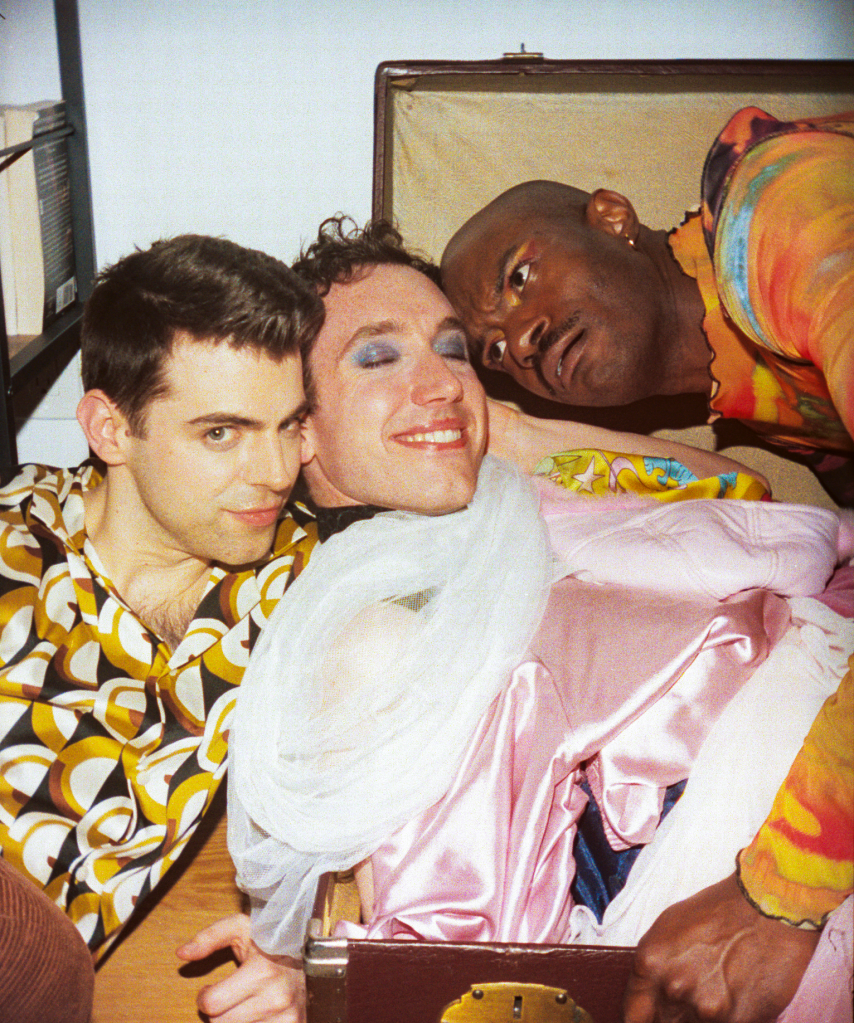
Born from friendship and shaped by fearless truth, Throuple is the love letter to queer joy and chosen family we didn’t know we desperately needed.
When two people meet and instantly feel like family, it’s the kind of connection that doesn’t just change lives – it makes art inevitable. That’s exactly what happened when Michael Doshier and Tristan Carter-Jones met during welcome week at college. From that moment, a chosen family was born – one built on shared language, mutual admiration, and a creative bond that’s carried them through growing pains, heartbreaks, and breakthroughs.
It also led to the inception of ground-breaking and sexy rom-com Throuple. Written by and starring Michael, with Tristan starring as a version of herself, the film is a love letter to Brooklyn’s underground music scene, to queer joy and complexity, and to the evolving dynamics of friendship and love. What began as Michael’s fascination with third-wheeling through open relationships and queer friendships became a raw, honest, and often hilarious script.
The film premiered last year at Wicked Queer Film Festival and has received a lot of praise at various film festivals in Europe, Canada, Australia and the US. Available now to stream on Dekkoo, Amazon, AppleTV, and many others, Throuple’s impact is far from subsiding. In this interview, Michael and Tristan open up about their collaboration, the world that inspired it, and the deep love story of their chosen family that sparked the magic in a story that was waiting to be told.
How do you two know each other?
Michael: I met Tristan during welcome week of our college journey in New York and we’ve been inseparable ever since. I think that we felt more like family than friends pretty quickly in our relationship and there was an immediate leaping-off point for a really beautiful friendship. Even beforeI fully integrated the term “chosen family” into my vocabulary, I was living it with Tristan. It was a formative bond that was unlike anything I had experienced up to that point at 18 years old.
Tristan: I just feel like I was born in Michael’s living room. One day he was just there. I know that we grew up until 18 without each other, but since we met, we’ve had a shared language. I don’t know how to describe what that is, other than like having known each other in another life.
We’ve been through a lot of shit together and we’ve seen so many different versions of each other, but we’re still always meeting those versions with the same love and enthusiasm and compassion. I feel the nature of our creative journeys has been similar. And that’s been an amazing thing.

Michael, you are the writer behind this exciting movie. Can you tell us what inspired you to write this screenplay?
Michael: I felt really inspired by the world of the underground music scene in Brooklyn. Before I had my own band, I was doing open mic nights as a solo performer and hearing a lot of folk and pop adjacent singer songwriters’ songs. These were some of the best written songs I had ever heard, but these artists were working day jobs all day or night and weren’t as famous as, for example, Taylor Swift. But I was thinking: These songs were as good as Taylor Swift’s songs, and I had access to these geniuses. That was blowing my mind.
At the same time, I was seeing Tristan’s shows with her amazing, electric band and people were filling these venues in Brooklyn and on the lower East Side to see her. So, I really wanted to write a movie that would center around these artists and this profound world with the lights, the sound, the venues.
Plot-wise, I was experiencing dual-throuple-structures in my life: Tristan had been my primary partner in a lot of ways since I was 18, and she was now experiencing her first romantic partnership. The question arose: How would I fit into this new part of her life as, what could feel at times like, a third wheel? Throuple shows that it is more nuanced than that, that your chosen family can take so many different shapes and forms, especially for queer people. But as a screenwriter, you’ve got to find tension somewhere. And the “third-wheel-ness” of it all was interesting to me.
At the same time, I was single and on dating apps. And a lot of gay men were in relationships that were opening up and were taking in dating thirds or just being poly more generally. That was super juicy for me and all I needed: I had two different situations in my life where I could conceivably be a third wheel. I could sit down and map something out with those three elements.
What’s the purpose of Throuple, what’s its message?
I would sum it up by saying you have the right to go after what you want in your life. I think Throuple offers new, imaginative possibilities for what that can look like. For instance, my character, the protagonist, finds himself in the midst of two couples, Tristan and her girlfriend, and this married couple that he starts to fall in love with. And all five characters have to adjust to what is happening interpersonally between all of them. Yet they all emerge in a new and exciting place that I don’t think any of them could have imagined at the start of the movie. They all have to find courage within their hearts and their minds to imagine what the future could look like for them.
I feel that’s what the movie puts out there: Your happiness is within your control. But you have to announce to the world what you want out of your life. I’ve certainly gotten better at this with age, but it’s still a thing I struggle with. It was really hard at first and Throuple is written from a place of how hard it is to openly profess the desires of your heart.
I hope that it inspires everyone to find that bravery within themselves, especially queer people, especially anyone who has any embedded shame that would stop them. Throuple proposes that there’s no limits to what you can desire and what you can go after.
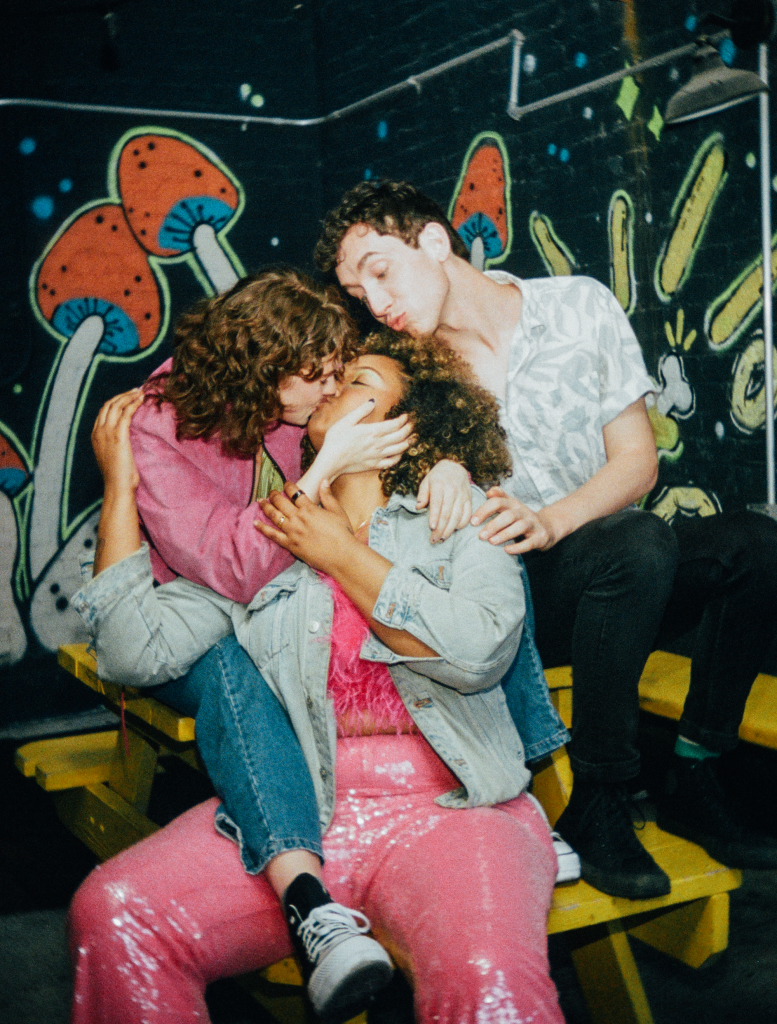
Tristan, you’re playing a version of yourself in this movie. How was it to portray yourself? And Michael, did you have to write Tristan’s role or did you just ask her to “run with it”?
Michael: I would say that there’s enough similarity between me and my character Michael, and his relationship to Tristan, that it felt strange to give us fake names. And that’s why we kept our names. But I had to imagine a character who was unable to communicate properly, because open relationships rely on open communication for them to succeed. So to write and to wring the drama out of this piece, the protagonist had to learn how to communicate to make things work. We had to start from a place where he was completely unable to and that definitely came from a real place. I really struggled with communication in my 20s; it was one of the hardest things to say what I wanted in life.
I also had to lose any ego that would get in my way of writing a compelling screenplay because I’d be afraid to be that guy. And so I have my own cognitive separation: I am Michael Doshier, the screenwriter, and that’s Michael from Throuple.
Tristan: It was so much more difficult than I anticipated it would be. I just thought I’d turn up on set and play myself. I was with Michael as he was writing various versions of this script, and I got to see a couple of different versions of stories and things that were pulled from our actual life. Then there were things my character was saying and I thought: ‘No, I don’t talk like that.’ I had to wrap my brain around the fact that my character is not the real me. And that was a weird thing to have to go through.
At times we would get lost in the weeds of our friendship, wanting to include a lot of inside jokes and references that literally nobody could understand but us, and that shit got cut so fast! [laughs] Everyone was like: ‘What are you talking about? This doesn’t connect with anybody else but you two.’
Michael: Sometimes they just let us shoot it but I knew they were all thinking: ‘We’re deleting these files before they even get to the editor.’ [laughs]
What were the best bits about making this movie?
Tristan: It was a two-week shoot for me and being on set felt like being in a cocoon. It’s an independent film, there was a lot going on and a lot of stressful things were happening. I could feel when Michael was feeling tense about something.
We were all feeling really passionate about doing the best that we can to get this project done. For five years, we’ve been waiting to even get funding! It was such an incredible moment of Michael having manifested and put this dream on its feet and the feeling of that was everywhere. It felt like such a warm, free place to be. I still have a lot of close relationships with people that I met on the set; it was like being around family and I still have that feeling when I think about the movie.
Michael: I completely agree. It brought us so much new community. I also learned how many people truly go into making a feature film. Even on our scale, there was just such a beautiful team there of creatives, set designers, costume designers, hair and makeup artists, and cinematographers. It brought so many new amazing people into our lives who I’m still working with to this day.
Everyone had experience with shorts or music videos, but this was everyone’s first feature film, so we all arrived with the same energy; it was a game changer for all of us individually, and that helped with the collective feeling of ‘let’s do this and let’s do it well’. I think that’s why the relationships have stayed so strong.
Tristan: It felt like leaving summer camp when we wrapped, it was like leaving this magical microcosm of a place. It was such a beautiful experience and everyone on set was so deeply talented and we were all chugging along towards making this thing as beautiful as it could possibly be and I think that we accomplished that.

The reception has been incredible. Did you expect this?
Michael: My main emotion is just intense gratitude to everyone that made it possible, and then to the critics who have written about it so far, as well as the film festival audience. Being able to watch the response with live audiences, especially at queer film festivals was incredible.
Three Throuples came to our premiere at the Boston Wicked Queer Festival! They found the film on their own; they were intrigued, and they came, and there was a lot of moving conversation after [the film], about how they felt like it was the first time they saw their relationship represented on screen in a positive way.
That’s a dream come true for me as a writer, that someone could feel that way about the movie, that they felt seen by it. And that’s certainly what I was always looking for, and continue to always be looking for in the art that I seek out.
Tristan: I think some people just aren’t cognizant of how painful it is to go through an entire life without seeing yourself reflected back at you, whether it’s the people that you’re around, on TV, in movies, or in whichever way. It’s deeply painful; it alters the chemistry of your brain and it affects everything about your life. But the ability to see yourself represented, and to understand that you’re not alone in your beliefs, that you’re validated in your existence, and in the love that you choose and in the space that you choose to live in – that means the world.
Whether we like it or not, this is the way we relate to each other: If you can’t get out and visit all the other communities of the world, this is how you learn about these other communities. It’s so necessary for us to see the way that other people live, but also to see ourselves reflected back in these stories. Especially now [during these times]: My art is just going to get blacker and queerer as I go on. Because what else are you going to do? Black as hell and queer as hell, always!

Can we expect a sequel?
Michael: I’m obsessed with that question! I would say you can expect so many incredible, brilliant films and music from everyone involved in the Throuple team. I’m certainly chugging away at a million screenplays. Tristan’s band, Dakota Jones, has only elevated since we shot Throuple. I don’t know about a Throuple sequel, but I would say the energy of Throuple will continue to generate awesome, forward-thinking work, hopefully forever. What do you think, Tristan, do you want to do a sequel?
Tristan: I would love to create a Bridget Jones universe of Throuple where we follow each other over the span of 20 years. And then it ends with us being in a Throuple with Leo Woodall [laughs].
What advice do you have for aspiring filmmakers and artists embarking on a big project?
Michael: You can’t really underestimate the fight to make an indie feature. I would ask any writer, director, or filmmaker who is getting ready to undertake such a project, to really develop a relationship with the material that is sacred and that you believe in no matter what. Of course, you’re going to have moments of doubt, but you always have to believe that it’s worth making. There’s going to be a tornado of rejections and people that aren’t interested in the subject matter. So you have to find it in yourself to believe in the thing so deeply, and really be in love with your piece. And that’ll be infectious when you need to pitch it. Your relationship with your art is sacred.
Tristan: My outlet most of the time is music. I’m not writing anything for what I think other people are going to want to see or hear. I have these voices in my head that want to come out, and I’m going to let them out. One, I need to spit out what’s dying to get out of me. And two, I need to have the unending belief that I’m the only one that can do what I do. My work deserves to be seen and heard. So hold on to that with everything that you have.
Also, it’s never too late to make your art. You’re on time, always. If you feel the need to do it, just do it. Start now. You’re worth putting that art out there. Don’t let anybody tell you otherwise.
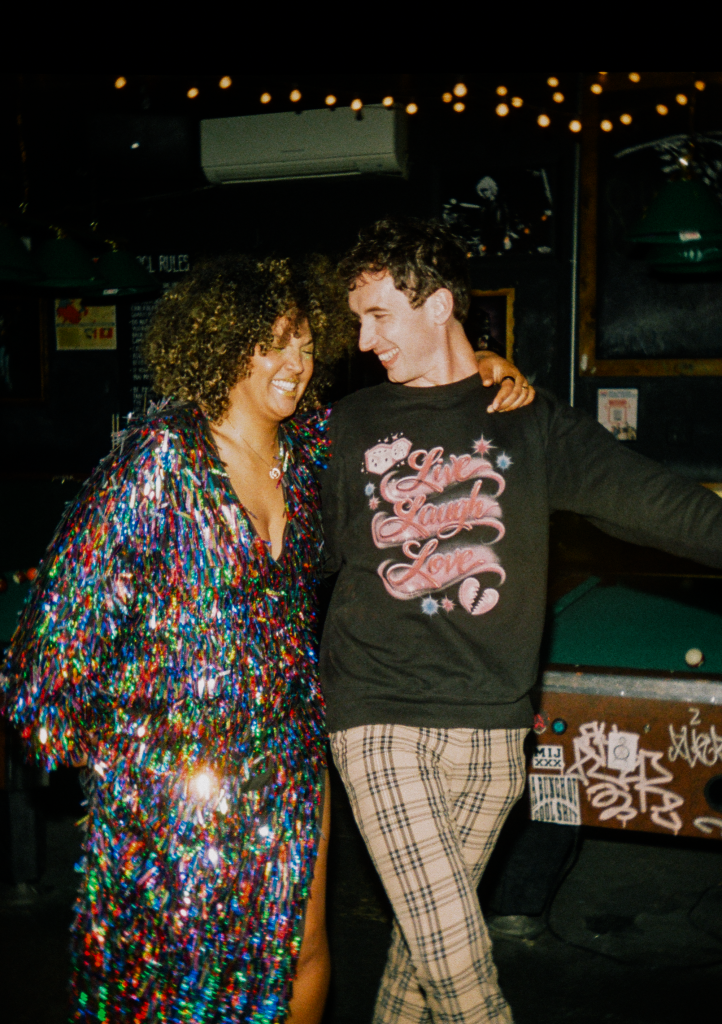
Michael and Tristan’s creative partnership is a testament to the power of radical honesty, and the courage to imagine life outside the script we’re handed.
Throuple isn’t just a film about unconventional relationships – it’s about the bravery it takes to name your desires, to risk discomfort for authenticity, and to make space for joy in unexpected configurations. Especially in the political climate we currently find ourselves in. Their story resonates because it’s rooted in something real: the messiness and magic of growing and thriving alongside someone who truly sees you.
As Michael and Tristan continue to evolve as artists, their work will no doubt keep pushing boundaries — blacker, queerer, bolder. And for anyone still waiting to feel seen, Throuple offers this quiet, radical promise: the life you want is possible – but first, you have to be brave enough to want it out loud.
 neunmagazine.com