
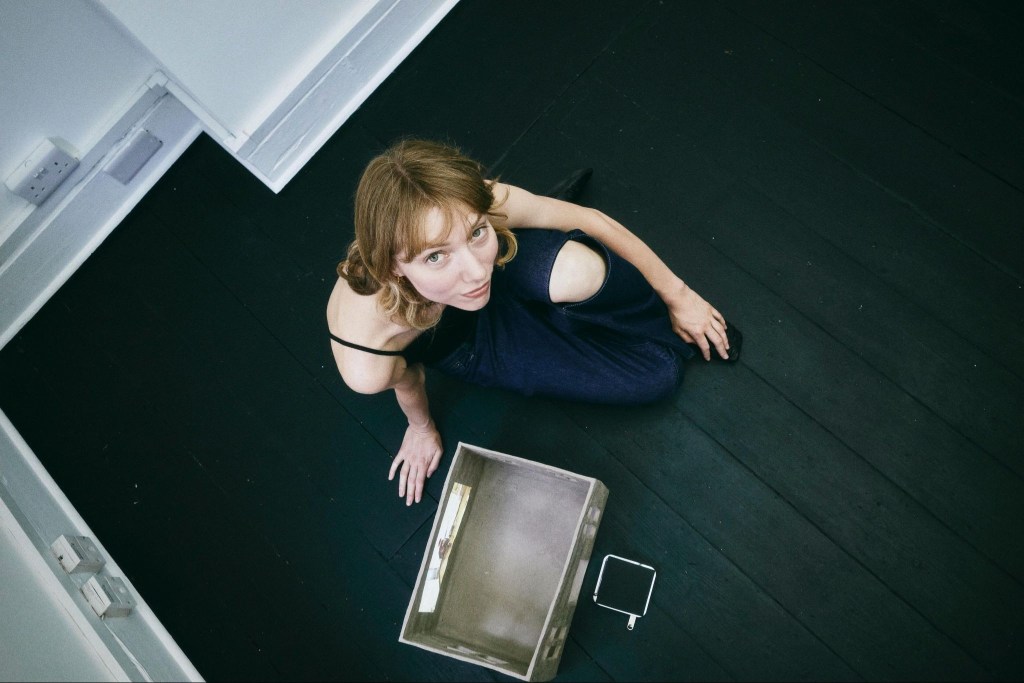
Art that speaks of loss, transformation, and luminous emotional depth
Masha Silchenko’s works tell stories of loss, nightscapes, and narratives imbued with ghostly spiritualism. When dealing with such subjects, it is easy to darken one’s art with morbid tones, yet Masha manages to evoke a genuine sense of emotional involvement and curiosity. Perhaps it’s due to her unusual, anti-naturalistic palette; perhaps it lies in the subconscious symbolism that hides in her forests and blue nights, prompting those who witness her art to ask, “What lies beyond?”
Origins and early training
Masha attended the Grekov Art School in her hometown of Odesa, Ukraine, where, through traditional academic training, she was able to dive deeper into the world of art and creative expression. In an environment where breaking the rules wasn’t necessarily frowned upon, she recalls drawing much of her inspiration from her friend, artist Alexandra Katzevich.
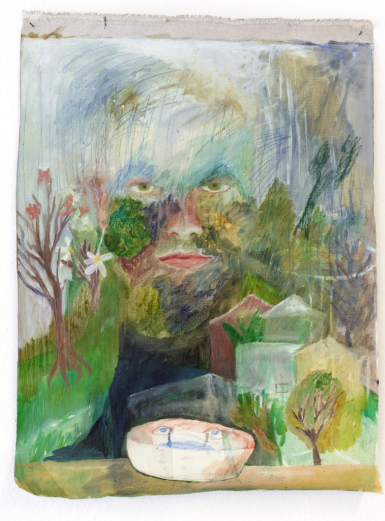
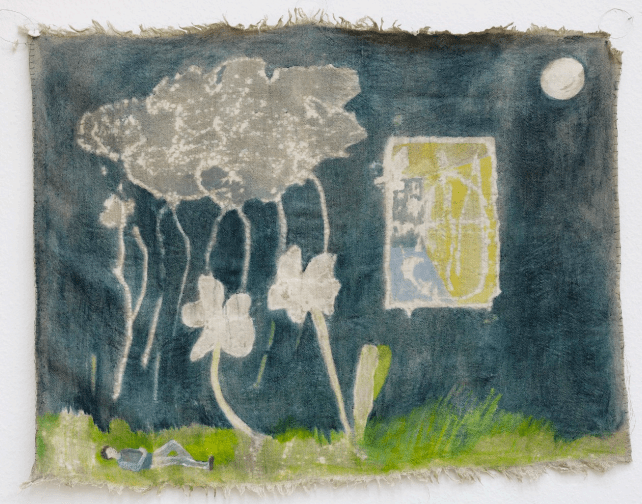
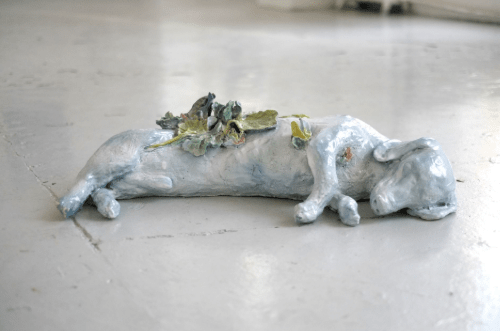

To this day, her works show a deep intertwining between tradition and the desire for deconstruction of the traditional idea of painting, which she accomplishes through experimental and approachable materials, such as bleach: “I often work with bleach on raw canvas, drawing directly with a cleaning agent that both erases and marks at once. This process, rooted in the everyday and in domestic gestures traditionally assigned to women, introduces an underlayer of controlled destruction. The bleach corrodes the surface, softening and breaking the integrity of the fine canvas, while the subsequent layers of rabbit-skin glue and oil paint act as both preservation and repair. The surface becomes a fragile palimpsest — a place where acts of erasure, mending, and embellishment coexist.
“There is also the component of anger”, she shares, “I am inspired by protest signs, where the words need to fit into a limited space.” In the same way, the words in Masha’s art are decompressed, fitting a selected space. In their compositions, the message runs deep.

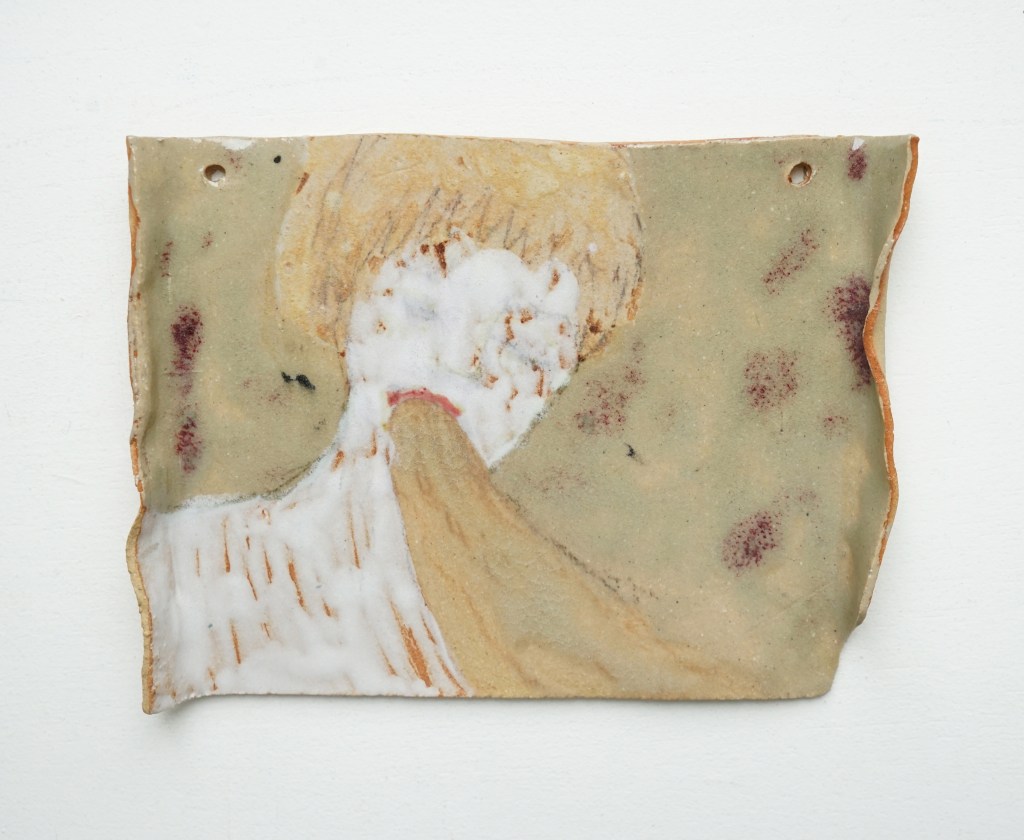
Masha moved to Paris early in her career, where she graduated from the École Nationale Supérieure des Beaux-Arts in 2021. During her studies, she took part in an exchange program in Japan in 2018, where – “by mistake” – she was placed in a pottery class, and she gladly embraced the “opportunity to experiment.” She continued this exploration during a three-month residency in the countryside of Yugawara. “When you put something in the kiln,” she explains, “there’s always the chance you won’t know exactly how it will turn out. ”It was there, surrounded by abandoned buildings and a haunting quiet, that Masha first encountered local myths and the Japanese yokai. The atmosphere left a lasting impression on her – mystical, uncanny, and deeply formative for her later work with ceramics and themes of the unseen.

Mourning, magic, and spirituality
On the occasion of Masha’s exhibition: Language of the Night (2024), essayist Romain Noël wrote a beautiful text, uncovering the veil of shadows and unconscious which run deeply in Masha’s visions. As he puts it:
In a text entitled “The Child and the Shadow”, Ursula Le Guin offers some valuable insights on this subject. The shadow is not merely evil,” she writes, “it is inferior, primitive, left, bestial, childish, but also powerful, vital, spontaneous […] it is dark, shaggy and indecent. But we are nothing without it. What is a body that casts no shadow? […] Anyone who denies their deep connection with evil denies their own reality. He cannot make or create; he can only undo, destroy.” I think this concept of the shadow helps us to understand the immense work, both conscious and unconscious, that goes on in Masha’s work. For her, it’s not a matter of mobilizing the nightmare motif with a certain critical distance, but of becoming, for a moment, like the nightmare. To let it settle inside you, and observe it attentively”.

In her art, mourning and loss are deeply intertwined with cultural identity. Where the air in the Western world felt heavy and solemn, Masha’s art embodies a blue, mystical spirituality, intimate yet open. Masha finds inspiration in artists like Mike Kelley, whose ironic narrative approach influences her way of treating serious themes with subtle humour and detachment. Amongst other names, Lee Lozano, Ree Morton, and Kai Althoff are mentioned as inspirations.
What strikes most about Silchenko’s work is the tenderness of her hand: instead of closing the eye or oppressing the emotion, she opens and envelops it, welcoming and nurturing. Masha does not explicitly narrate the ongoing war in her home country. Death and mourning, in her work, are explored through a non-traditional lens, shaped by culture and introspection. She reinterprets grief, the emotions it evokes, and the way it transforms us: “My work seeks to hold this duality: to show how something delicate can also be resilient, and how something beautiful can quietly hold the trace of violence and loss”.
Colour palette and inspirations
As her visual “pen” evolved, so did her colours and topics. The city now takes space within her practice: whether it is Paris, the city she lives in now, or her hometown appearing in her dreams, both memories and physical places live in symbiosis; some of these don’t exist anymore, some have been destroyed, playing with the physical and subconscious. The psychological difficulties of living in the city are protagonists, in what can be called: “City’s dreamscapes”.
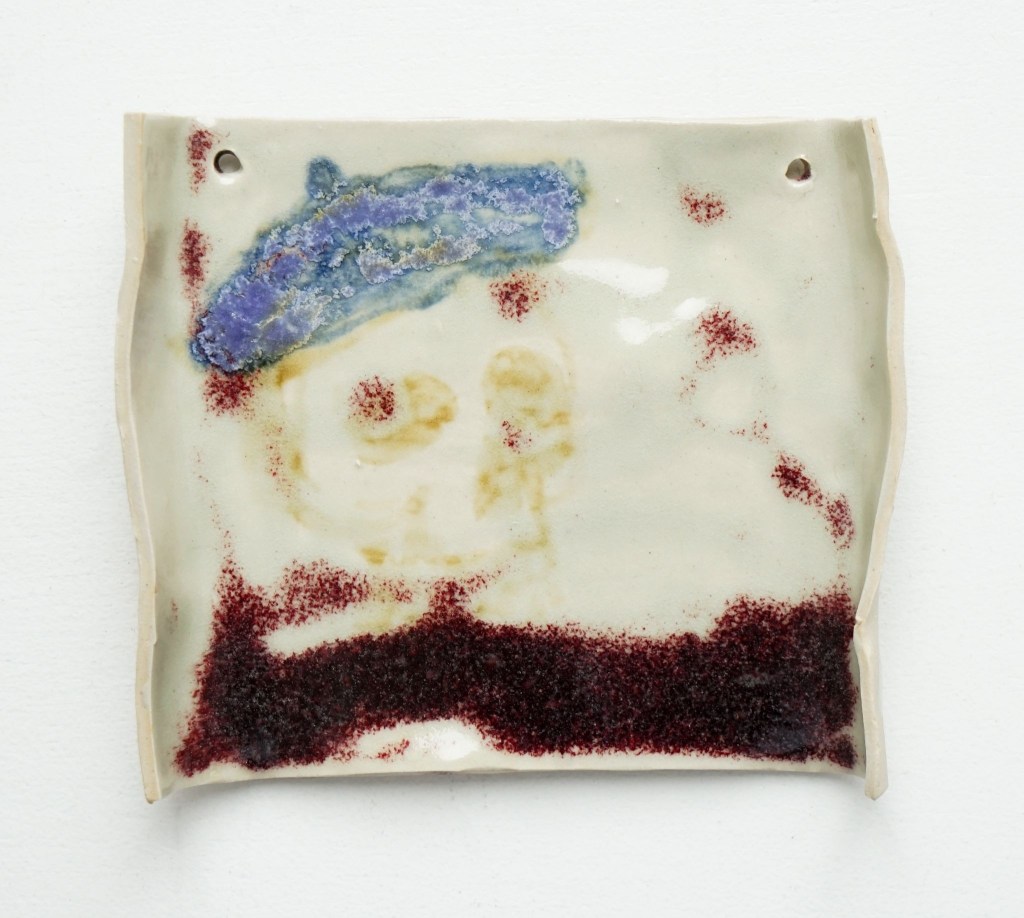

As per colours, ochre and brick red are the tones most recently seen in her work, often on bleached, frameless canvases or applied to ceramics. Her process is entrepreneurial in spirit, always prioritising exploration and curiosity, by adopting methods and techniques she hadn’t tried before. “I’m working with ashes at the moment,” she says. “I also have different glazes, and each might produce a different result during firing.”
Music is also a big component in her creative practice, emerging from her painting work, where she allows creative multi-media approaches, such as performative shows, in collaboration with her musician friends, to enter her ever-evolving vision.

Like many artists, Masha balances creative practice with side jobs, which allow her to meet fascinating people. She finds inspiration in the little things, and enjoys swimming at her local pool or simply going for walks in nature.
Between the tangible and the mystical, Masha Silchenko’s art speaks of what cannot be seen – the quiet persistence of loss, and the luminous beauty that can arise from it.


 neunmagazine.com