

With tassels, sequins and bows, the Farrago founder proves that conscious design and sustainable consumption don’t have to compromise on creativity.
In a world of throw-away fashion and trends that vanish faster than a shooting star in the sky, sustainable fashion has become a mantra shared not just by social media communities, but has also found its way into the fashion industry. Whilst most high street and luxury designer brands are great at green-washing, real sustainability is often hard to find.
British designer Matthew Bedford knew he wanted to challenge the current patterns of consumerism when he walked through department stores and saw pieces of fashion that would live fast and fade faster. With his fashion brand Farrago, Matthew created luxury footwear that wouldn’t just stand the test of time and passing trends. For him, sustainability also means craftsmanship, versatility, and repeatedly wearing an investment piece.
With what he calls modular footwear, the Jimmy Choo Dato Award winner has not just made waves in the London fashion scene with his 3-in-1 footwear designs. He has also seen his footwear on global stars such as CMAT, Suki Waterhouse, Mya and Jisoo – proudly showing off his unique designs on stage, in music videos, or world-famous chat shows.
Through all this, the 25-year-old remains humble, grounded and true to his mission to, in his words, “challenge fashion’s obsession with excess.” He spoke with neun Magazine about his journey into shoe design, accepting his weaknesses and turning them into strengths and how he faithfully believed in his gut instinct to create “intelligently designed footwear that adapts to the wearer’s life.”

Matthew’s venture into the fashion world started when he was only 16 and looked for colleges. He eventually found a women’s clothing design course run by the London College of Fashion.
“I remember I wasn’t very good at it, because I have no patience for technical skills like sewing. All that practical stuff is really not me. One day, I ended up in Chelsea and Westminster Hospital A&E with an electric needle bent through my finger. The nurse told me, as it hadn’t touched my bone, she’d just have to pull it out. But before she did, she asked me, ’ Out of curiosity – what were you making when you had your accident?’ And I just burst into tears and said: ‘I don’t even know!’ From that moment on, I was wondering whether women’s fashion design was what I wanted to do. It was a course correction of the universe, stepping in with a needle. Because I started studying footwear design not long after.”
Matthew spent the next few years at Cordwainers College, a technical shoe-making college since the late 1800s, before being acquired by the London College of Fashion in 2000. During his time at the establishment, he also learnt how a shoe is technically constructed; something he thinks is one of the most important factors in any design course — and one that some tend to overlook. “I think you need to understand how something is technically put together. Even if you don’t want to be the one to do it, you need to have that knowledge in order to design it.”
Matthew admits that he thought his portfolio looked a little strange in comparison to his fellow students. “Everyone was able to make shoes, but I just used anything I could find to experiment with ideas and designs. And I used a lot of glue guns and a lot of super glue. It’s way more fun as well, you know?” He shrugs and carries on, matter-of-factly: “When doing design development, who cares if it looks a bit shit? It’s just you getting your ideas out of your head, which I think is the important thing.”

His gut feeling, belief in what he was doing, and embracing that some things were not right for him, paid off at the end of his degree. The graduates were encouraged to apply for awards, one of them the Jimmy Choo Dato Award, in honour of Jimmy Choo, who had also studied at the London College of Fashion.
“I had just finished my submission for my degree and drove to the site where we had to present our work. We’d been told to do a PowerPoint, but I hadn’t had time to make one. So, because I had everything with me, I said that I had planned to present my work in print instead. Luckily for me, the judges were so refreshed that they could touch and feel this stuff after watching one PowerPoint after the other. My work was a concept of interchangeable accessories, which I presented in a Dragon’s Den or Shark Tank style, like a business proposal. We ended up having a really good conversation, but one of the judges was grilling me, challenging me, asking lots of questions. I came out of the presentation thinking ‘Oh my God, I’m not even going to get shortlisted for this!’”
Instead, Matthew didn’t just win the prestigious Jimmy Choo Dato Award, but also the Cordwainer’s Prize for Sustainability. To walk away with not just one but two awards wasn’t just the recognition Matthew deserved, but also paved the way for what would come next.

His debut shoe collection under the name Farrago [‘farrago’ means ‘confused mixture’ – and beautifully captures the idea of the juxtaposing mixture of Matthew’s designs], something that has been in the making since he left college in 2022 and was finalised in May this year. He tells me that the concept of this extraordinary collection is simple yet, as he admits, quite difficult to explain to people. He recalls how he was inspired to create a versatile and multi-functional shoe that was built to last, not just for its timeless design, but also because of its premium quality.
While walking around some of London’s department stores, he noticed the amount of expensive occasion wear pieces that are limited in their use. Matthew told me he thought that if you were to spend a large amount of money on something that lacked versatility, it would be, in his eyes, wasted. It made him wonder why expensive pairs of shoes couldn’t be used for multiple purposes, so the customer could get maximum wear out of them.
“Luxury should never be defined by expense alone. It should be about quality, longevity and design that earns its place in your wardrobe.” – Matthew Bedford.
“I started looking at different zips or poppers that I could use to fasten things to a shoe and then take them off again. In my opinion, these shoes are the first of their kind, and so I did a physical pop-up shop to explain the concept to people.”
Matthew thought that the shoes would be self-explanatory, but he quickly realised that even putting a shoe with a removable bow next to one another proved alien for most. “When you explain it to people, they love it and tell me how clever it is. But the marketing [of the concept] is more difficult. I have a few seconds to [get people’s attention] and it’s really hard because there’s simply nothing like it on the market.”
Matthew has looked at many other items since the birth of his idea of a more versatile and multi-use product and wonders why they can’t follow the same concept.”I look at everything now and think: That could have an extra fastening, like a zip, a magnet, a popper, or a clip, and you could get so much more out of a single piece of clothing or an accessory.”
With such an eclectic mix of aesthetics, versatility, and practicality in mind, how does Matthew approach his designs, and how does his artistic process unfurl once he has an idea? He candidly says that his thought processes deal with functional aspects first.
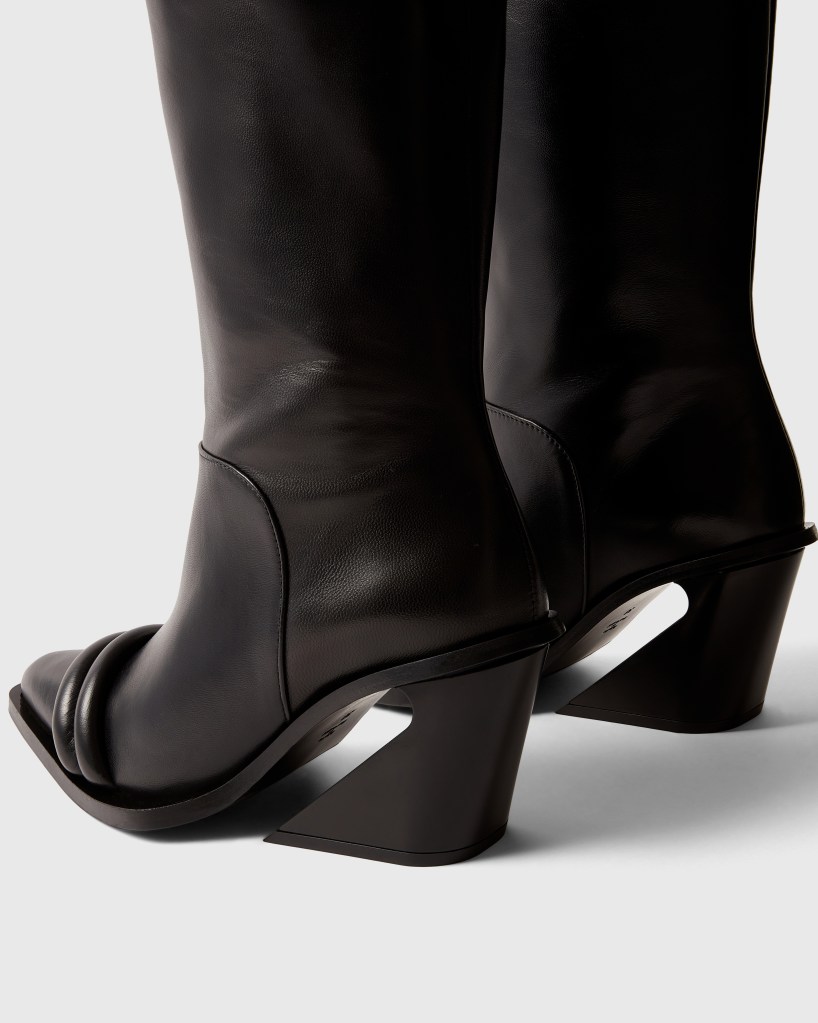
“When you study art or design, you’re taught to have mood boards and do loads of artistic research. If I’m really honest, I just had some factual ideas in my head: For example, I wanted my shoes to have heels, but I didn’t want them to be too thin because I don’t think it’s practical. Especially in the UK, a lot of women don’t even wear high heels to work anymore. Times have changed. And so I needed my shoes to have a block heel and to be comfortable whilst also looking nice.”
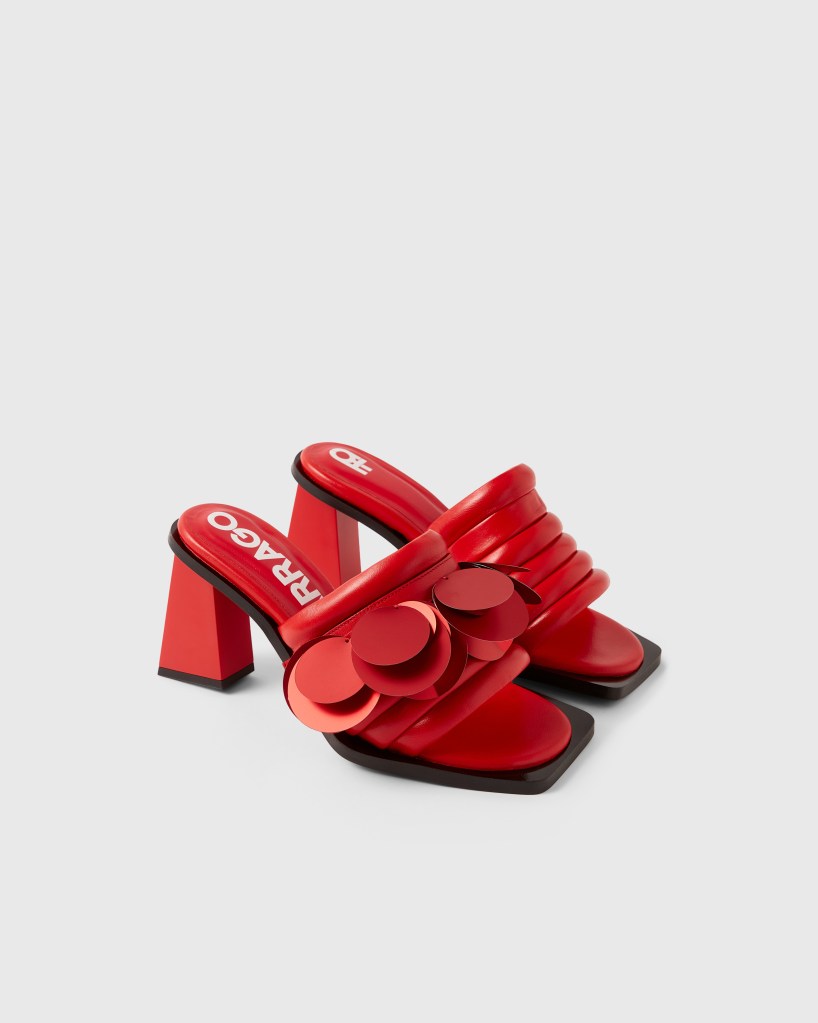
The idea for the detachable accessories came to Matthew when looking at bag charms, brooches and costume jewellery. Whilst the concept itself held weight, the real challenge was how they could be attached to the footwear. He tells me it was the most difficult part of the design process. And once that problem was sorted, the sustainability of the accessories was the next challenge to be overcome, especially with the giant sequins. “A lot of [sequins] come from China. I didn’t want to source them from there because it’s challenging to track your supply chain, which isn’t ideal for a sustainable product.”
Eventually, he found The Sustainable Sequin Company, an English independent business that buys materials made from recycled PET bottles and cuts them with a laser into the desired shape and size. “So I got some samples, took them to the factory in Portugal, and we just played with them until we found something that worked.”
Although Matthew makes the whole process from concept to shoe collection sound effortless, he tells me that he faced a lot of hurdles and negativity from various professions and individuals. He recalls that finding a factory that would commit to manufacturing his shoes was nearly impossible.“People told me it wouldn’t work, it wouldn’t sell, and that the idea was rubbish. A PR agent told me that the product and the marketing were a mess and that I should give up, get a job, and stop wasting money.”
He also faced backlash on social media and LinkedIn. “Stylists told me my products were ugly, and others slated me, saying my products weren’t sustainable when I was using real leather. They told me I was killing animals and that I was a terrible person.” What surprised him was that most of the people who shared their opinion spoke to him as if they were helping him with sound advice. “I just thought: No, I’m not making a mistake. This isn’t constructive criticism. There will always be people who don’t believe in your ideas, what you’re doing, or you as a person. But I think you just need to find the people who do believe in you.”
One of those people is Irish singer-songwriter and all-round powerhouse CMAT. Matthew knew that CMAT’s stylist had received some shoes from the Farrago collection for a photo shoot, but she hadn’t used them. One day, however, out of the blue, an old school friend sent Matthew a picture of CMAT in her Irish hometown, wearing the Farrago Thalia Electric Blue Boots.
“I messaged her, not expecting her to reply. But she did. She told me she loved the boots, and I told her I would love to meet her. She invited me to an event in London, to which I went with my mum. CMAT had only been given the boots, but none of the accessories, and she’d told me she liked the tassels. When she was on stage, I screamed: ‘Do you want the tassels for your boots?’ to which she reacted with ‘Oh my God, it’s you, there you are!’ And she stuck her leg off the stage for me to attach the tassels, and then she continued with her performance.”
Matthew tells me that CMAT has worn the boots publicly multiple times, on stage, in music videos and on TV appearances such as the Jimmy Kimmel Show in the US. “What’s great about this is that she wasn’t paid to wear them. She fell in love with them on a personal level. I also think that she’s that kind of person who will turn around and say: ‘No, I don’t want to wear this, I’m going to wear these [Farrago boots]’. And even if people were to tell her that she only wore them the other day, she’d say: ‘I don’t give a fuck. I wore them yesterday because I like them. I’m wearing them today because I like them. And I’m going to wear them again.’ This is rare because a lot of stars will never wear the same thing twice. It’s really nice to see that she’s using them and loves them. Plus, the blue perfectly matches her Euro Country album colour!”
Asking him if there is anyone who he’d love to see wearing his shoes, he doesn’t miss a beat when he tells me it’s Lady Gaga. “I’ve made it when I see her wearing a pair of these, I think.”
Whilst he is not opposed to showing his art at fashion shows, Matthew admits that many creatives and young designers can feel pressured to take part in events that aren’t financially sustainable for those with no or a very limited budget. “No, you don’t have to do everything. It’s about picking and choosing what you want to be a part of. And, speaking for myself, I’m in no hurry either. You know, it’ll work in its own time and at my pace, and that’s fine.”

It’s that calm and measured attitude, not swayed by pretence or prestige, that makes Matthew so likeable, not just as a person, but also as a creative, an artist, a designer. With new ideas to expand his wearable and sustainable fashion collection, Matthew wants to see his products and ideas seen by as many people as possible. His passion for his message of maximum wear and multi-purpose clothes and accessories is infectious, and he invites much-needed and long-overdue conversations in our societies that are overrun by overconsumption and a throw-away mindset. Most importantly, Matthew Bedford has created something that is a show-stopper, but is equally comfortable to wear, every day, on repeat.

 neunmagazine.com