
Part Two: Transformation
Established artists build on foundations of hope
“Life is undeniably harsh, but like flowers growing in the desert, no matter how difficult the circumstances, we must continue to flourish.” When Haya Kaabneh speaks these words from her studio in Jericho, she captures something essential about the generation of Palestinian artists working through Ahmed’s consortium. They are creators who have inherited both the harshest conditions and the most sophisticated platforms for resistance, artists who transform limitation into liberation with the kind of quiet determination that changes everything.
In the hardest ground, something remarkable is flowering. Where previous generations of Palestinian artists worked in isolation, fighting for recognition and a platform, these accomplished voices step into a world where infrastructure exists—where Alaa Albaba has already proven that refugee camps can be galleries, where Ahmed Hmeedat has built the bridges between Palestinian creativity and global audiences. Yet rather than simply occupy this space, they push it further. Haya Kaabneh and Monther Jawabreh represent the evolution of Palestinian artistic expression: one working through watercolour’s unforgiving transparency to capture the essence of Palestinian womanhood, the other deconstructing identity itself through multimedia experimentation that challenges every assumption about what Palestinian art can be.
Their approaches could not be more different, yet both spring from the same recognition: that Palestinian art in 2025 means refusing to be contained by anyone else’s expectations, whether sympathetic or hostile. Working within Ahmed’s consortium framework, they prove that shared strength doesn’t diminish individual vision—it amplifies it, creating space for voices that speak in entirely new tones whilst remaining unmistakably Palestinian.
Haya Kaabneh works with watercolour because, she says, it mirrors the reality of Palestinian women. “With it, every stroke is final—once laid down, it cannot be erased or easily controlled. Yet despite its difficulty, watercolour carries a sensitivity, a transparency, and a fragile beauty. To me, it is the perfect metaphor for the Palestinian woman herself.”
This isn’t poetry—it’s precision. Haya’s choice of medium represents a profound understanding of how form can embody meaning and how the very act of creation can mirror the conditions of existence. Born in Jordan but raised in Palestine, she has lived the complexity of Palestinian identity from childhood, understanding intimately what it means to be “uprooted from our homeland and forced to spend most of our lives abroad simply because we are Palestinian.”
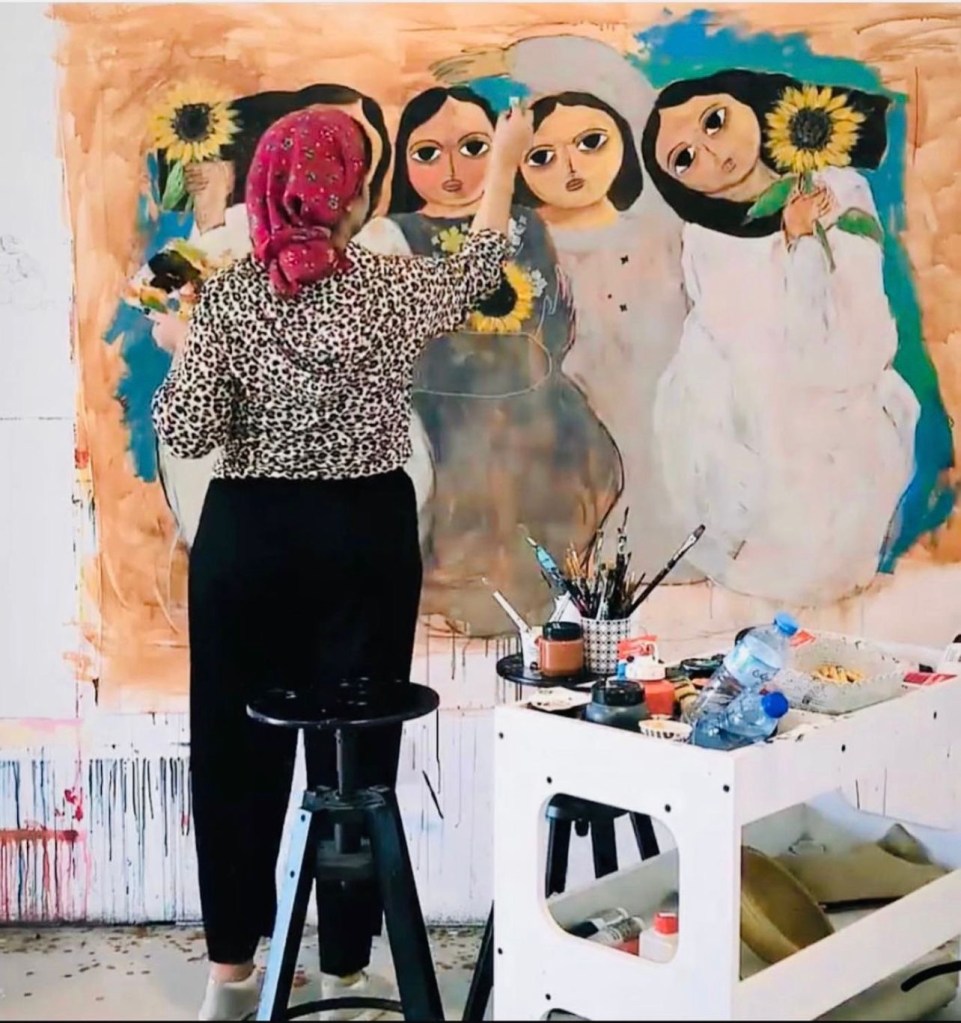
Yet rather than fragment her sense of self, this experience has deepened her Palestinian identity. “This never created a sense of contradiction for me; on the contrary, it made me feel even more Palestinian,” she reflects. “When I compare myself to Palestinians who were born abroad and denied the right to return, I realise what a real privilege it is—despite the hardships of life here.” Haya’s artistic journey began in silence. Growing up in a household of women—her mother and five sisters—she absorbed what she calls “a multiplied female experience, carrying not only my own life and journey, but also those of my sisters and my mother.” As a child, she was quiet, excelling academically but speaking only to her closest family and friends.
“From a young age, many women carry a silent fear that their voices are unimportant, destined to go unheard,” she explains. “This silence has rendered women’s pain unspoken, unrecognised—too often dismissed as mere emotion, sensitivity, or indulgence. For me, words could not contain my pain, nor could writing. So I turned to drawing.” What began as observation—sketching birds, capturing the sky—evolved into something far more significant. “I sketched everything I saw, echoing reality with my pencil,” she remembers. “It was then that I understood: this is what I am meant to do for the rest of my life—create through drawing.”
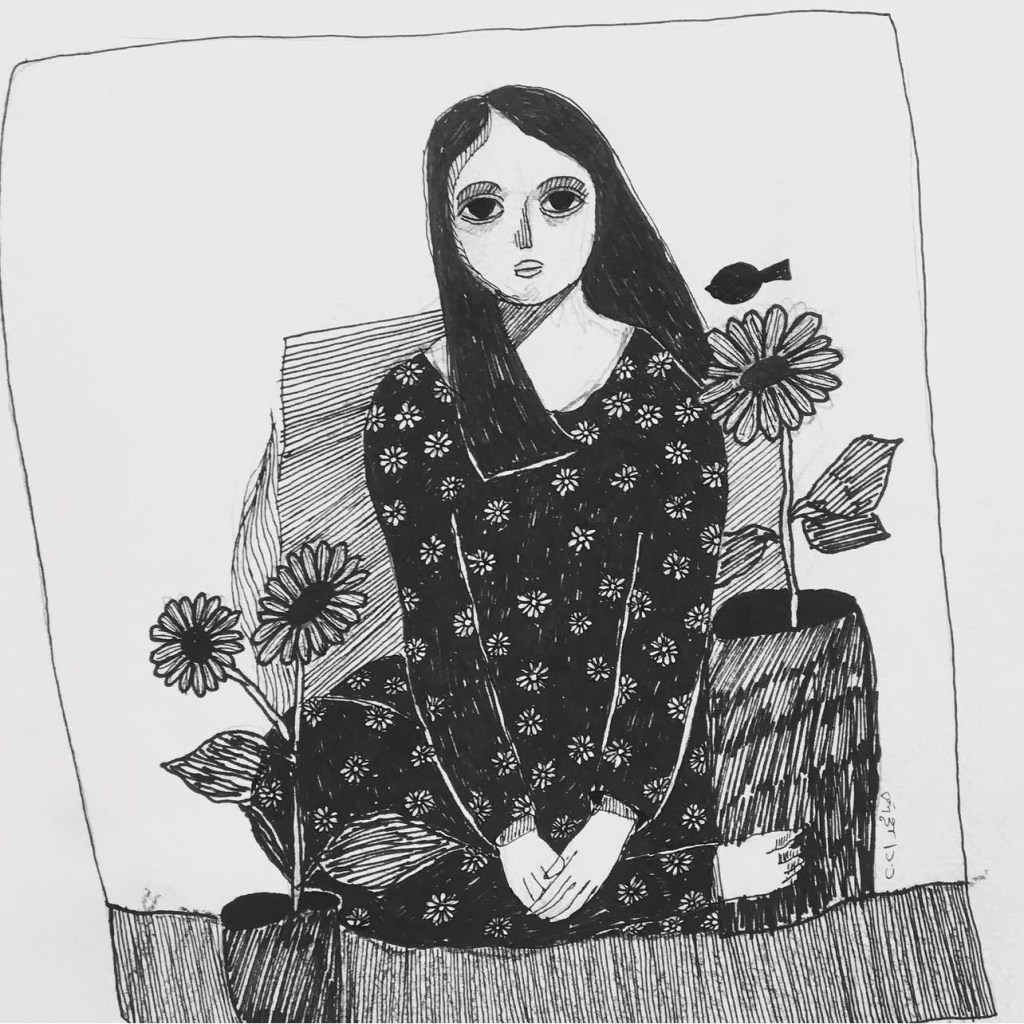
But it was her mother’s story that truly shaped Haya’s understanding of what Palestinian women endure and overcome. “My mother’s story has deeply shaped my own. She was not educated, held no degree, and possessed no formal rights. Yet, despite these obstacles, she challenged herself and society and worked tirelessly to raise an entire family. Through her, I came to understand that a woman can endure the harshest of circumstances and still become a symbol of strength and resilience.” This understanding flows directly into Haya’s My Comfortable Space series, paintings that create what she has always longed for: “a place where I feel safe and at ease.” These works portray women seated, gazing forward with eyes both sorrowful and stern, their long black hair flowing—an embodiment of their reality. They wear nightgowns adorned with bright flowers and vivid colours. Around them, walls are decorated with paintings, vases of flowers rest nearby, and books lie open in their hands.
“Each element contributes to the creation of that intimate, comforting space,” Haya explains. But these aren’t escapist fantasies. They are deliberate constructions of the spaces Palestinian women need but are often denied—spaces free from the psychological and physical violence that too many endure, spaces where choices can be made freely. The faces in these paintings share a haunting similarity. “In my paintings, you see the same eyes, the same expressions, the same states of being—yet rendered with different colours and elements,” Haya observes. “To me, it feels as though all Palestinian women are one. Their struggle is one: it is about their voice, and their right to live freely.”
When she speaks of freedom, Haya’s definition is both modest and radical: “By freedom, I mean nothing abstract or extravagant—only the simple right to live out their choices: to study, to work, to receive equal pay to that of a colleague, to raise their children with dignity, and to be protected from psychological and physical violence.” These themes have evolved through years of listening—”moving from one city to another, I began to listen more closely to women and to their voices. I carry these stories within me, and then transform them into paintings.” Her work speaks not of individual cases but of the broader question of womanhood itself, particularly the way women’s perspectives are systematically diminished.

“My work addresses the inner voice a woman gradually loses each time she is told ‘no,’ each time she is forbidden, each time she is told she cannot,” Haya explains, her words carrying the weight of countless conversations, countless stories absorbed and transformed into art. The Palestinian Artists’ Consortium has been crucial to this creative evolution. “I saw in this project a wonderful opportunity to support ourselves as independent artists, away from the mainstream art scene and galleries,” she says. “This platform has been immensely supportive, both artistically and financially.” But Haya understands the broader significance of what Ahmed has created. “Many Palestinian female artists face the usual life and artistic challenges, just as I do—or even more so. I see how these obstacles discourage many, and only a few manage to continue creating art due to numerous and significant hardships. I sincerely hope that my fellow female artists are able to persist, to keep producing art, and to continue expressing themselves and the issues that represent us.”
Financial constraints have shaped Haya’s journey profoundly. “My economic situation did not allow me to practise art daily to fully develop my craft, due to the difficulty of affording materials and tools,” she acknowledges. The consortium’s framework has provided not just visibility but actual income—the difference between creating occasionally and sustaining a practice. Yet economic challenges haven’t diminished Haya’s commitment to beauty. “By nature, I am drawn to beauty—I contemplate it, I seek it—and this is reflected in both my personal life and my artistic practice,” she says. “I have never deliberately focused on beauty; it comes naturally, even when my drawings depict characters with long, wavy black hair and large eyes. These figures resemble me in reality, yet I do not intentionally beautify them.”
This commitment to beauty isn’t naive—it’s defiant. “Life is undeniably harsh, but like flowers growing in the desert, no matter how difficult the circumstances, we must continue to flourish,” Haya reflects, her words capturing both the fragility and the fierce determination that characterise her work. The artist she has become represents more than individual achievement. The loss of a close friend and fellow artist, Heba Zagout, has deepened her understanding of art’s role in Palestinian life. The grief and the responsibility she feels to continue creating—for herself, for other women, for the voices that risk being silenced—infuses every brushstroke.
Haya’s evolution toward abstraction signals yet another shift in her artistic journey. “Lately, I have been drawn to abstract painting, and I believe that in the next phase of my practice, I will focus more on abstraction and sharper, more defined lines,” she explains. This movement toward abstraction doesn’t represent a departure from her themes but rather their distillation—the reduction of complex emotions and experiences to their essential elements. Her work can be followed on social media, where viewers can witness this evolution from representational watercolours to increasingly abstract expressions. Each piece remains rooted in her understanding of Palestinian women’s experiences, whilst pushing toward new visual languages that might capture what representation alone cannot.
“I wish the world could see us as we truly are, and as we wish to be, rather than as they want us to be,” Haya reflects. “The demands of Palestinian women are very natural and simple, yet they are also fundamental and cannot be reduced to superficial liberation issues—such as clothing or other peripheral matters—which do not reflect the real struggle.” Her vision for Palestinian women’s future is clear: “A woman becomes truly strong when she is financially independent, has access to education, and receives full healthcare—this is what I hope for all Palestinian women.” Through her watercolours, through the consortium’s platform, through her quiet determination to keep creating despite every obstacle, Haya Kaabneh builds toward this future one transparent layer at a time.
Where Haya works through emotion and lived experience, Monther Jawabreh approaches Palestinian identity through analytical deconstruction. His perspective emerges from what he calls the “sociopolitical laboratory” of refugee camp life, filtered through decades of artistic training and a mind that refuses to accept simple answers.
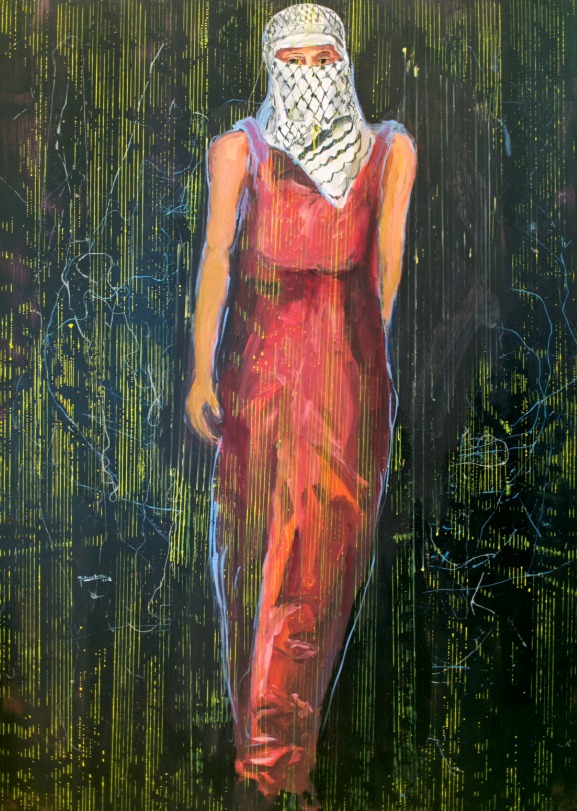
Monther stands in his studio in Al-Aroub Refugee Camp, surrounded by paintings that resist easy categorisation. His work spans video, performance, and traditional painting, but it’s his intellectual approach to Palestinian identity that sets him apart within the consortium. Where other artists in the collective emphasise optimism and beauty, Monther brings something equally valuable: critical analysis, experimental vision, and an uncompromising commitment to pushing Palestinian art beyond familiar boundaries.
“The camp was tantamount to a sociopolitical laboratory,” Monther reflects on his upbringing in Al-Aroub. “It was instrumental in my introspection amidst the intertwined human density and social interweaving of camp life. Moreover, it infused my imagination with the anecdotal imagery inspired by the realities of life and its conceivable possibilities—it all became part of my artwork lexicon and narrative.”
This laboratory metaphor isn’t accidental. Monther approaches his Palestinian identity and artistic practice with the precision of a researcher, examining assumptions, testing hypotheses, and arriving at conclusions that sometimes challenge conventional wisdom about Palestinian art and representation. His artistic evolution spans decades and mediums. “My multimedia practice aligns with geography, time, isolation, and siege, employing the most effective media to address these concepts,” he explains. “While these projects broaden my artistic reflections, painting remains central to my practice as an ongoing and open project to explore conceptual, political and place-based conflicts.”
This methodical approach extends to how he understands Palestinian experience itself. Where others might focus on documentation or emotional expression, Monther sees his role as transformation: “I approach art as an experimental process and a self-exploration of latent energies influenced by external conditions. Over the years, this contributed to the diversity of techniques and styles that I have been developing, and which define and inform my artistic and visual identity.” The significance of this approach becomes clear when considering the broader context of Palestinian art. Much international attention focuses on Palestinian suffering, creating what Monther sees as a limiting framework that reduces complex artistic expression to simple political messaging.
“My art practice balances creative exploration and contextual inquiry, deconstructing my personal as well as the Palestinian reality to position it within broader human understanding. As I do so, I remain devoted to visual originality,” he explains. This balance—between specific Palestinian experience and universal human themes—represents sophisticated artistic thinking that refuses to be confined by others’ expectations. Monther’s participation in the consortium reflects this methodical approach. Unlike artists who join collectives seeking community or support, his involvement is strategic: “When I participate in art collectives, I join my voice with other young artists, stand with them in our circumstances, and move beyond a bystander to actively contribute my ideas, experiences, and artistic journey to help free their practice from derivative orientation; my aim is to support, not to be driven by attraction.”
This statement reveals much about Monther’s understanding of Palestinian art’s current challenges. The danger he identifies—”derivative orientation”—speaks to his concern that Palestinian artists might become trapped by external expectations, creating work that fulfils others’ ideas about what Palestinian art should be rather than exploring what it could become. His vision for collective work goes beyond simple collaboration: “Art collectives embody joint resilience through creativity, collective thinking, communication, and strategic collaboration that converge to address major issues such as the Palestinian cause; it is difficult to reduce such work to a single individual or a repetitive experience.”
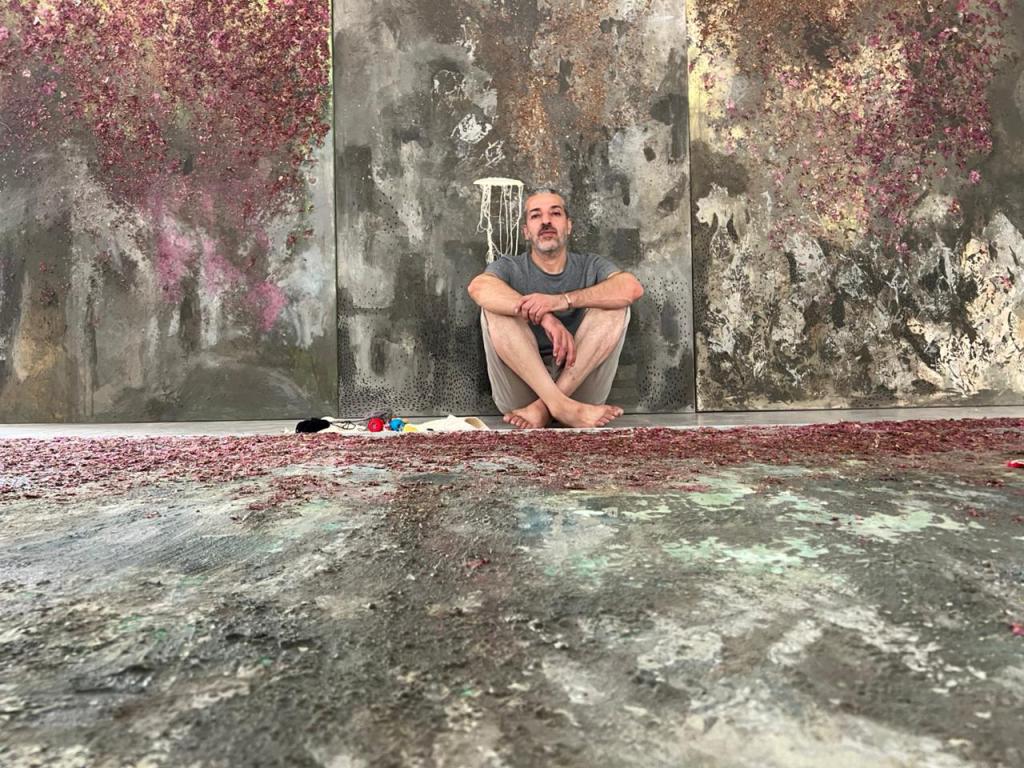

This perspective positions the consortium not just as a space for individual artists but as a laboratory for developing new approaches to Palestinian cultural expression—approaches that might transcend traditional limitations and reach new audiences in new ways. Monther’s upcoming exhibition, Strategies of Flexibility: Cement, Cloth, Bloom, at Basement23 Gallery in Amman, exemplifies his experimental approach. The title itself suggests his method: examining how Palestinians navigate constraints (cement), adapt to circumstances (cloth), and create beauty despite limitations (bloom). These aren’t just artistic themes—they’re analytical frameworks for understanding Palestinian resilience.
His work has been collected by institutions across the world: Vilaa es Art in Morocco, Institut Du Monde Arabe in France, The Palestinian Museum in Palestine, and Imago Mundi Collection in Italy. This international recognition speaks to his success in achieving what he describes as “positioning Palestinian reality within broader human understanding” without sacrificing its specificity. Yet Monther remains deeply connected to the political dimensions of Palestinian art. “Since the occupation of Palestine in 1948, significant political transformations have shaped the region. Young people grew up in constrained and confined living conditions, and at times, they were separate and disconnected from the world around them. This created an open confrontation to gain freedom. At the heart of such confrontation has been the cultural and artistic channels.”
His analysis of art’s role is both historical and strategic: “Art became the means by which we communicated our narrative and originality to the world. Hence, art became concerned with ideas, essential for reflecting the reality of life under occupation and to assert Palestinian identity.” But Monther pushes this understanding further, arguing for an evolution in how Palestinian art functions internationally: “I believe Palestinian art has evolved to embrace experimental approaches that push conceptual, visual, and technical boundaries, making an impact on sustainable solidarity-based awareness, understanding, and influence rather than mere pity.”
This distinction—between pity and solidarity—captures something essential about Monther’s vision. Pity positions Palestinians as victims requiring rescue. Solidarity positions them as equals deserving support in their own self-determined struggles. The difference shapes everything: how work is created, how it’s presented, how it’s received. “Of course, the onus is on Palestinian artists to persevere in the originality of their work, which is key to achieving that aspired for solidarity,” Monther adds, placing responsibility squarely on artists themselves to resist the easier path of creating work that confirms external expectations about Palestinian suffering.


When asked about supporting Palestinian artists and culture, Monther’s response reveals his sophisticated understanding of representation and humanity: “While political realities shape our creative process and society, we too hold hopes, ambitions, and dreams like all peoples and nations. By embracing our humanity and our just cause, readers, each in their own ability and from their own position, can play a role to impact the perpetuity of our culture and existence.” This formulation — “we too hold hopes, ambitions, and dreams like all peoples and nations” — might seem obvious, but it addresses a persistent problem in how Palestinian life is portrayed internationally. Too often, Palestinians are presented only in relation to conflict, stripped of the full range of human experience. Monther’s work insists on this fuller humanity whilst never minimising the reality of occupation and resistance.
His vision for Palestinian art’s future reflects this same balance: “I hope it continues to present new techniques and experiences, to be part of global cultural development, and to remain connected rather than isolated.” Connection without assimilation. Innovation without abandoning identity. These are the tensions Monther navigates in his work, and they reflect the broader challenges facing Palestinian artists working within international contexts. Through the consortium, Monther has found a space that allows for this kind of sophisticated engagement. Working alongside artists like Alaa, Ahmed, and Haya, he contributes to a shared perspective that resists simple categorisation. His intellectual rigour balances others’ emotional approaches; his experimental methods complement their more traditional techniques; his critical analysis strengthens their optimistic visions.
Four voices. Four approaches. Four distinct ways of being Palestinian, being an artist, and being human in 2025. From Alaa Albaba’s colourful transformation of Al-Amari’s concrete blocks into soaring dreams, to Ahmed Hmeedat’s strategic construction of platforms for collective empowerment, to Haya Kaabneh’s watercolour metaphors that capture the unchangeable beauty of Palestinian womanhood, to Monther Jawabreh’s critical deconstruction and reconstruction of Palestinian artistic identity—the Palestinian Artists’ Consortium has become proof that Palestinian art cannot be reduced to a single narrative, a single emotion, a single response to occupation and exile.
These artists have chosen creation over destruction, transformation over victimhood, collective strength over individual isolation. They have built something that transcends the immediate circumstances of their creation—a movement that demonstrates Palestinian art’s sophistication, diversity, and refusal to be contained by others’ expectations. The consortium’s greatest achievement isn’t just giving these artists a platform—it’s showing the world that Palestinian creativity speaks in countless distinct voices, each one authentic, each one necessary. Where international media too often reduces Palestinian life to headlines and statistics, these artists insist on the full range of human experience: beauty alongside struggle, innovation alongside tradition, intellectual rigour alongside emotional truth.

As we enter Palestine Month, as attention turns once again to Palestinian lives and Palestinian futures, these four artists remind us that the most powerful resistance might not be found in the streets or in the headlines, but in studios and galleries, in watercolours and canvases, in the quiet daily choice to create rather than destroy, to build rather than tear down, to imagine possibilities rather than accept limitations. Their work continues. Their artistic vision grows stronger. Through the Palestinian Artists’ Consortium, they prove that even in the hardest ground, even in the most devastating circumstances, flowers can thrive in the desert—vibrant, resilient, and so undeniably alive.
 neunmagazine.com