
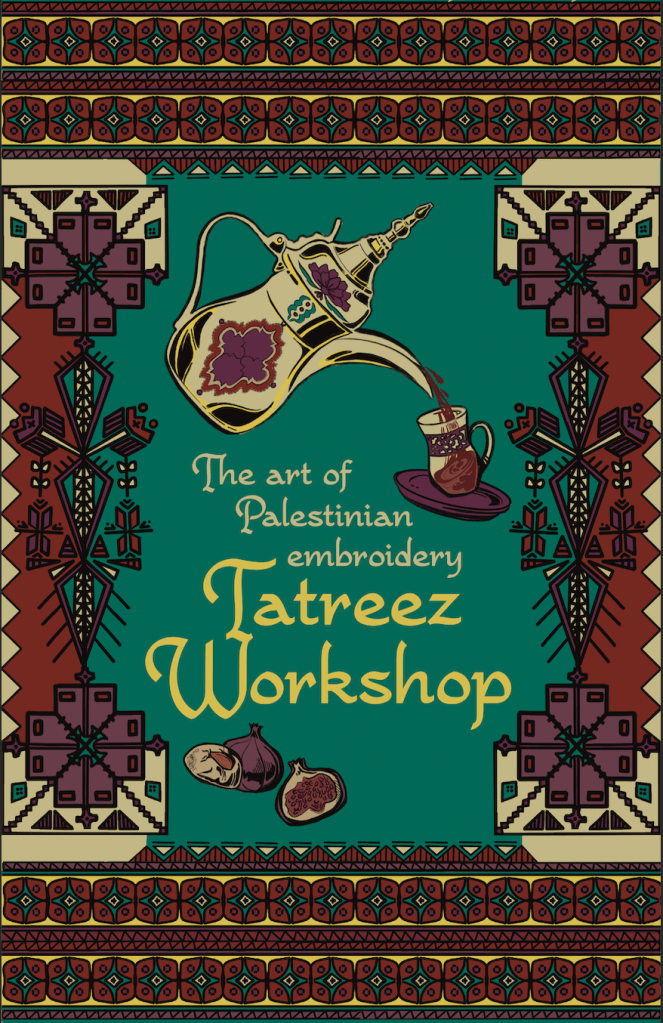
Through research-driven, cross-media works, Dina El-Nakla celebrates family, womanhood, and heritage with a bold, unmistakably personal voice.
Artist Dina El-Nakla speaks through the meticulous research that defines each of her works. Moving fluidly between different media, from painting to poster design, she weaves a consistent narrative rooted in a deep connection to her roots. Her art celebrates family values, womanhood, and cultural legacy, offering a tender yet powerful reflection on identity and belonging.
Could you walk me through your first approach to art? How did your creative journey start?
Most of my projects come from something I’ve dreamt about since childhood — something I’ve always wanted to see, do, or be part of. So in that way, I progress through my ideation phases all giddy and excited. When creating, I usually start by researching to fill in the gaps: reading essays and books, visiting museums, and looking at other artists’ work from the past and present. From there, I often already have key images or scenes that have lived in my head since the idea first sparked. I sketch those out, then build around them—filling in what’s missing and constructing a kind of quilt made of interlocking themes. Because of this centre-outward approach, I sometimes have to switch entire mediums or formats, but by the end, I usually find a way to preserve the heart of my original idea. Somewhere in that process, I pause to ask myself about the ethics of what I’m making—what good it will bring to me, my family, and my country.
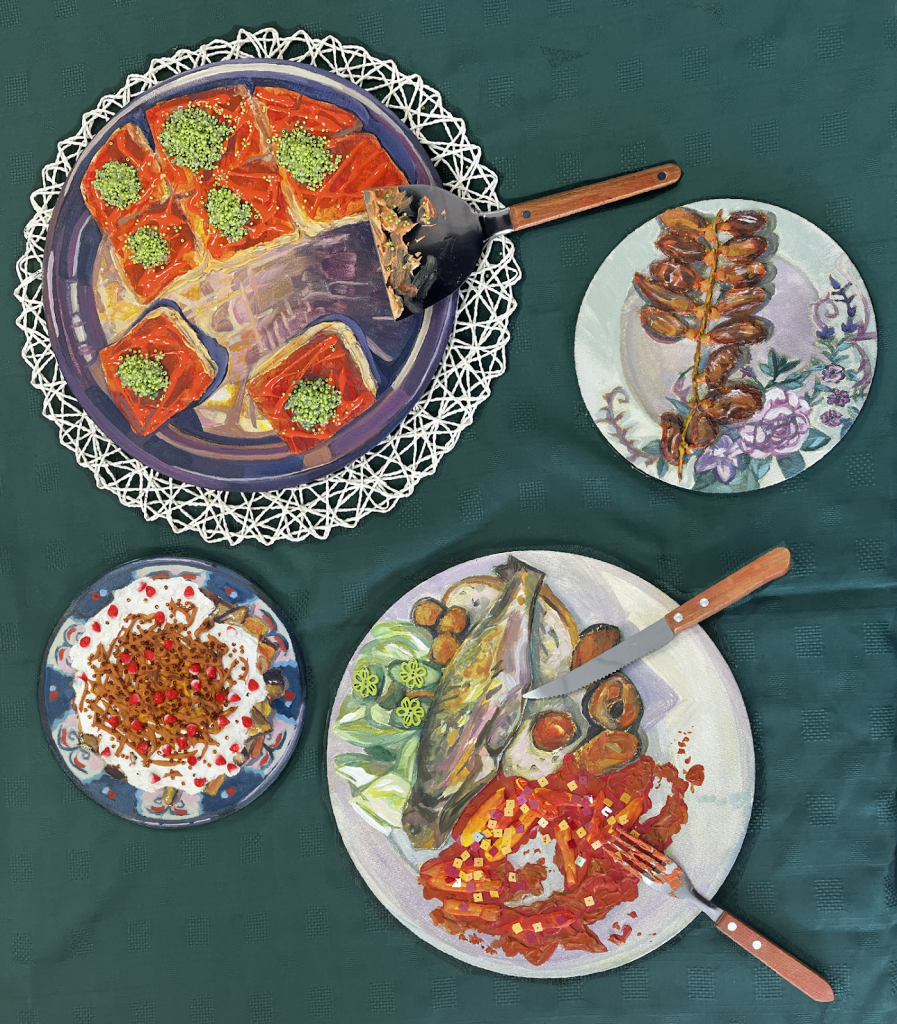
Your family’s recipes are a recurrent object in your artworks. What role do womanhood and family play in your expression?
I think my entire language of expression is inherited from my family. The way I see the world, the rhythm in which I move through it, even the people I most wish to please, all stem from them. I’m drawn to the domestic sphere — the home, the small endearments, the gestures that make up daily life. Those quiet, unspoken rituals are where I find the most beauty. I want to depict my family in a way that feels both idealistic and honest, capturing a sweet spot between how I see them and how they deserve to be seen. I also believe that my expression revolves around feelings of righteous anger, led by my love, something I find shared amongst Palestinian women.
Your work is layered and enriched with symbols recalling Palestine. What’s the message you intend to share with the world?
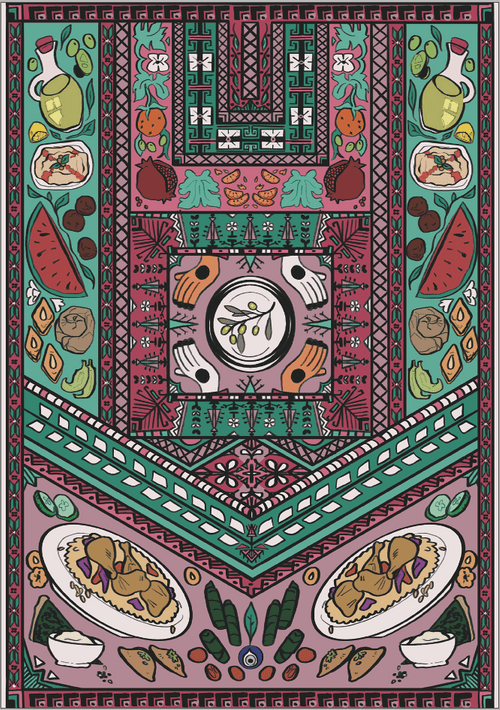
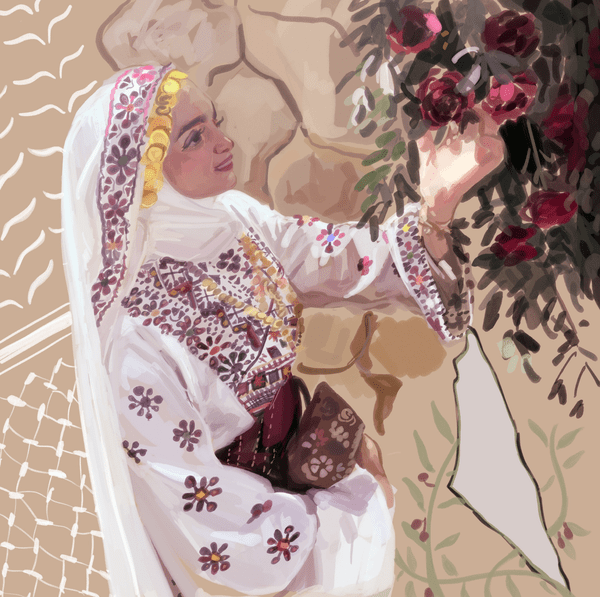
I don’t really think of my work addressing “the world.” The audience I call upon feels smaller, more intimate—those who feel pangs of familiarity and belonging within the ‘silly’, candy-coloured worlds I build. If others learn about or feel taken by Palestinian culture along the way, that’s a beautiful side effect, but honestly, never the goal. I’ve spent a lot of time studying the meanings behind different Tatreez motifs and how their patterns shift from one village to another. I love layering my visuals with dense blocks of embroidery, mimicking the rich detail of a thobe’s bodice. After 1948, women in exile began to prioritise stitching for a larger, national identity rather than for their local regions, creating “Palestinian” dresses rather than ones belonging to Yaffa or Nablus.
Through the writings of Tania Tamari Nasir and Widad Kamel Kawar, and archival sites like Tirazain, I’ve learnt how motifs go back to their villages and how women used embroidery as a language of record-keeping and semiotics. One of the most recognisable symbols is ‘the Cypress Tree’, denoting the universal Tree of Life. Stitched differently across each region of Palestine, it can vary from being large, compact, and diamond-shaped in Gaza, to long, slender, and patterned in Al Khalil. Upright, it celebrates; reversed, it mourns. I want people to feel the same ardent joy I do when I see Tatreez. I aim to be unapologetically obnoxious in my romantic, ardent love for it. Just as Palestinians in diaspora fill their homes with embroidered cushions, maps, and Palestinian handicrafts, I want to embellish everything I touch with that same pride.”
What is Palestine to you?
The only time I’ve ever set foot in Palestine was when I went to Gaza as an infant. So, for me, Palestine exists through my family. It’s my mother, my father, my grandmother. Palestine, to me, is both unattainable and all-encompassing in the life I live. My identity, however, is grounded in current political objectives and realities, so I firmly reject the cliché impulse to reduce ‘homeland’ to a hazy, sentimental abstraction. Palestine is much more alive than that. It’s the love of my life—the food I eat, the holidays I celebrate, the tenderness that underlines my every decision. My greatest romance, my eternal home, even from afar.
As a multimedia artist, how do you juggle your inspirations—do you have any preferred medium that you keep going back to?
No matter what medium I’m working with, whether it’s animation, film, code, or editorial, I always tether myself to illustration, tried and true. It’s my anchor, the thread that ties everything together. I’m insanely attached to the software Procreate; it’s where most of my visual thinking manifests. I need to sketch out storyboards or flat plans, annotate scenes, or create rough little animations to feel out timing and rhythm. Many of my projects function like collages, both conceptually and visually. I’m not sure whether I think in terms of layering and medleys because of my collaging process, or if my process emerged because that’s how my mind naturally works—but I’ve made peace with that blur.
What is next for you?
Right now, I’ve begun researching how video games reproduce imperialist rhetoric through their narratives and mechanics. It feels like a marriage of my two greatest fascinations—politics and play! Again, very self-indulgent to my child self, but I’m hoping to eventually develop it into a full game one day, but for now, I’d like to try my hand at building the 3D assets, character models, or maps myself. It’s still in its early stages, but it feels like one of those ideas that’s been quietly growing in me for years.
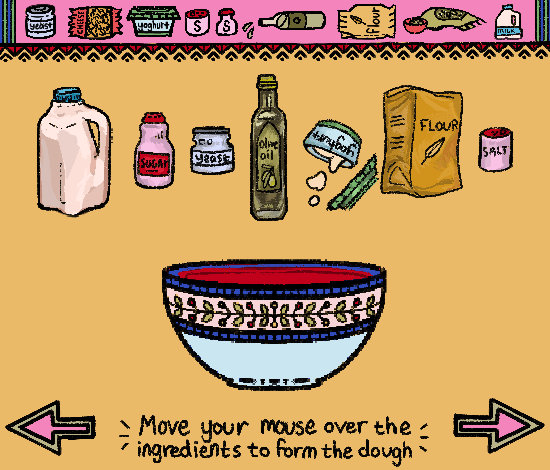
At this phase of my practice, I think I’ve become quite self-indulgent with what I make. No matter how hard I try to intellectualise or complicate a concept, I always end up returning to its most comforting, instinctual form.
From childhood dreams to video game mechanics, from Gaza as an infant to London as an artist, Dina El-Nakla’s work proves that identity isn’t geography: it’s inheritance. Through every stitch, every pixel, every carefully chosen symbol, she embroiders Palestinian stories into contemporary frames, ensuring that “righteous anger led by love” finds its visual voice in a world that needs to listen.
Dina is a second-year Graphic Design student and Illustrator based in London.
Among her most recent works:
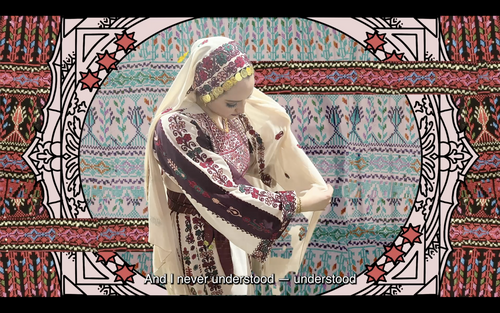
Threads of Witness (2025): A short film stitching together interviews, animations, and illustrations that invoke the importance of the Palestinian art of cross-stitch, “Tatreez”, in the lives of her female family members across the diaspora.
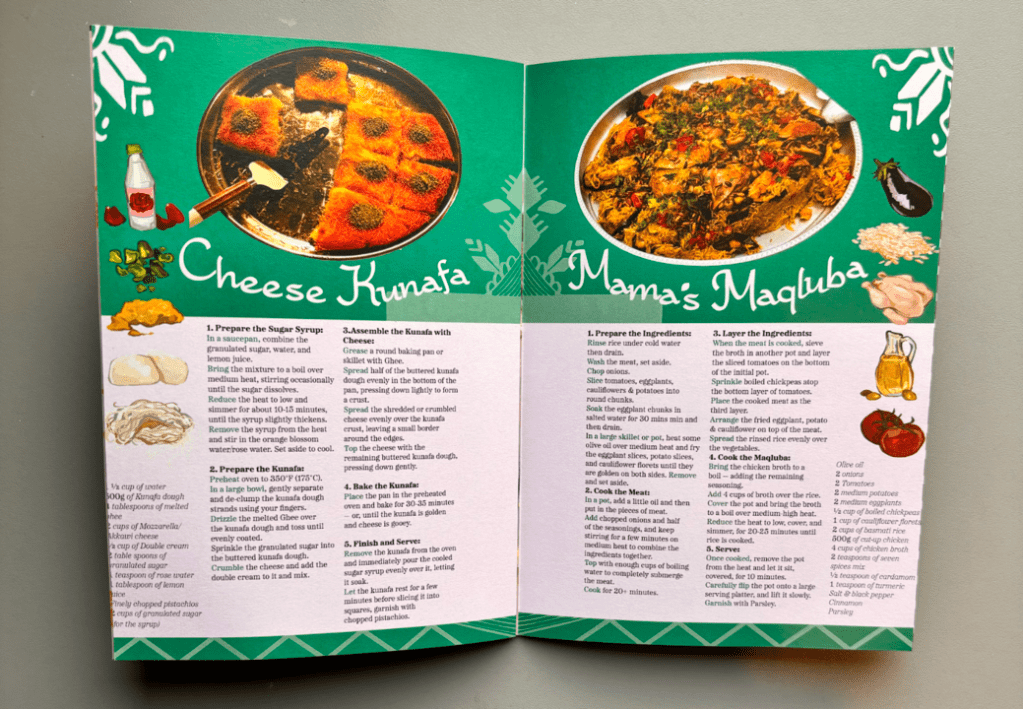
Eating in Exodus (2024): A romantic display of her devotion to Palestinian food, this zine centres around cultural conservation, food sovereignty, and indigenous cuisine in Palestine.
 neunmagazine.com