

Amid trauma and uncertainty, bead work becomes a lifeline, grounding an artist as she honours Palestinian women and the stories that breathe through the Tatreez patterns shaping her work.
Rooted in a rich heritage, Zeina found an unexpected path from corporate life to craft. Her journey into bead weaving became not just a creative calling but a way to reconnect with history, identity, and the stories carried through generations of Palestinian women. Here she shares her story and the impact her jewellery has had on her – and those who wear it.
“I’m a two-time immigrant. I was born and raised in Jordan to a Palestinian mother and an Iraqi father who moved there in 1974. My parents met and studied in Lebanon, and I also studied there. So I’d like to think my heritage is deeply rooted in what’s known as Bilad al-Sham (the left-hand region, encompassing modern-day Syria, Lebanon, Jordan, Palestine, and parts of southern Turkey and Iraq). I’ve been living in London for the past eight years now, so that adds another layer to my story.
Becoming a jewellery maker was never on my career bingo card. I graduated with a degree in Business, then went on to do two postgraduate degrees: one in Human Resources and another in Behavioural Science. I imagined I’d just climb the corporate ladder until I reached a C-level (senior leadership) role someday.
I have London and my experiences there to thank for changing that. Facing racism, nearing burnout, and becoming disenchanted with corporate life (I mean, being treated as a “human resource” says it all) really pushed me to question what I was doing.
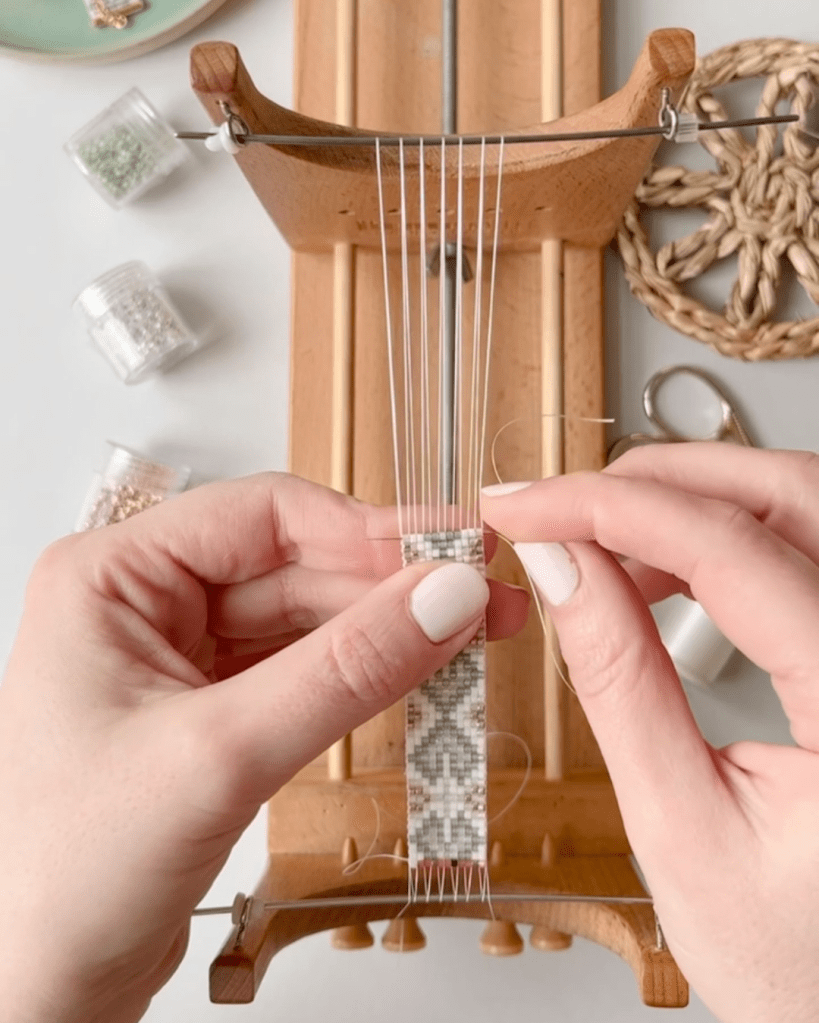
About three years ago, during a difficult and traumatic time, I turned to craft, as I always have done, to cope. I taught myself how to weave, and that’s when things began to shift. As I got deeper into bead weaving, I started noticing these quiet similarities between its structure and Tatreez, the traditional Palestinian embroidery I grew up around. That’s when it clicked. I realised this could be something bigger than me, so I gave myself a year to see if I could turn it into something real. And I haven’t looked back since.”

“I usually introduce two collections a year — Spring/Summer and Autumn/Winter. For each one, I try to spotlight a specific city or village. It often starts very simply: I open a Tatreez book, flip through the pages, look at the patterns, and try to imagine how they might translate into jewellery.
Sometimes I come across a pattern from a village I’m not familiar with, and that’s when the research begins. I learn about the village, its Tatreez, its demographics, and what it was known for. Once I’ve decided on a particular place, I move on to the colour scheme. The Spring/Summer collections usually feature brighter colours, while the Autumn/Winter ones lean toward more muted or earthy tones.
In my Ramleh Collection for Spring/Summer, I used magenta and green. They are colours my grandmother, who is from Ramleh, often used in her cross-stitching. For the Al Naqab Collection in Autumn/Winter, I drew from the tones of the desert.
After that, the real experimentation begins. The colours I imagine don’t always work together the way I think they will, so there’s a lot of weaving and unweaving, swapping one shade for another, tweaking a pattern here and there — until it finally feels right.
I take the role of presenting Palestinian folk art very seriously. These patterns carry so much history and identity, so I want to make sure I’m honouring them in the best way I can.”

“My grandmother and mother are the ones who taught me Tatreez. And with that came lessons about colour: How to combine them, which ones belong together, and which ones don’t. I owe so much of what I do today to them.
When I think about the emotions behind my work, two always come up: curiosity and love. Curiosity, because I’m constantly exploring these ancient patterns; experimenting with them, reimagining them through colour, and sometimes tweaking them so they fit within my pieces. It’s a lot of trial and error; I’ll undo hours of work if something doesn’t sit right and start again. It’s all part of seeing if I can present a familiar pattern in a new, unexpected way.
And love, for the women who created Tatreez in the first place. It was the Fallahi women — the rural women — who tended the land, raised the children, and still found the time and creativity to turn thread into folk art. Their hands and their stories are stitched into every pattern, and I like to think a little bit of that spirit is woven into my work too.”
“I started this jewellery business partly as a way to educate people about Tatreez, but what I didn’t realise at the time was that it would also become an education for me.
At first, I didn’t know that Tatreez wasn’t practised across all of historic Palestine, or that specific patterns were connected to certain cities and villages. Some of these places were ones I’d never even heard of before. So whenever I wanted to introduce a new collection, I’d find myself researching not just the embroidery, but also the history of each village — what life was like there before and after the Nakba.
It’s been a beautiful process in that sense. I’ve learned so much about the smaller villages, the people, and their way of life. But there’s also a kind of sadness that comes with that — knowing that, for now, I can’t go there and see it all for myself.
At the same time, this journey has prepared me. Through my work, I’ve built a kind of knowledge base – one that helps me connect the patterns I work with to the places and people they come from. So when I do eventually visit Palestine, I think I’ll arrive with a sense of familiarity, like I already know parts of it through the stories, designs, and histories I’ve come to learn about.”
“I didn’t anticipate [the impact my jewellery would have] at all. I started this business about six months before October 7th [2023], and at the time, awareness around the Palestinian cause, or even around Tatreez, wasn’t what it is today. I thought my work would mainly resonate with some Palestinians in the diaspora or with people who already had a close connection to the culture.
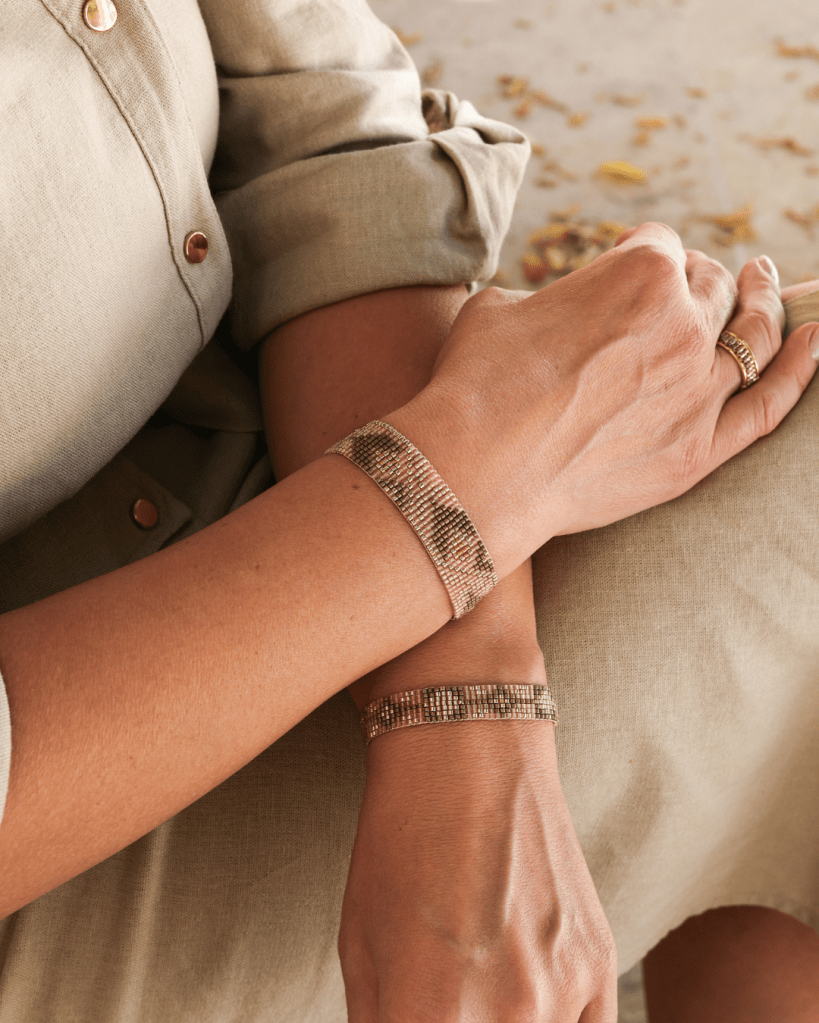
What I didn’t expect was how deeply people would connect to it, that it would give them strength or a sense of pride during such painful times. Hearing people say that my pieces make them feel seen or connected to their roots has been incredibly grounding.
As a small business – a little fish in a huge ocean – it’s easy to get discouraged. There’s so much work that goes into what I do, and sometimes the results don’t show right away. So, when I hear from customers, when they share what a piece means to them, that’s what keeps me going. I’m not trying to sound sappy or anything, but I genuinely mean that. Those messages and moments are what drive me forward.
It’s also made me more intentional about how I approach each collection. I think more now about the stories and symbols I’m preserving, and how they might speak to someone far from home.
And to be completely honest, I didn’t expect it to have such an impact on me either. Doing beadwork and spending hours on the loom genuinely saved me from myself. Watching the genocide and ethnic cleansing unfold – as a Palestinian in the diaspora, and as someone who lives with anxiety – it was so easy to spiral, to fixate on the news. Beadwork became this meditative process that kept me grounded. It gave me something to hold onto when everything else felt unbearable.”
“I’m always thinking about how to expand what I do – maybe explore other traditional crafts or collaborate with other Palestinian artists and makers. But at the heart of it, I just want to keep creating pieces that connect people: to their culture, to their stories, or even just to something beautiful they can carry with them.
I’d also like to urge people to continue supporting the people in Gaza. Since the so-called ceasefire came into effect, donations have dropped significantly. If anyone is looking for local grassroots organisations to donate to, the Sameer Project [a mutual aid organization led by three Palestinians in the diaspora, working on the ground to supply aid and clearing rubble and debris from destroyed neighbourhoods] has been doing incredible work on the ground and making a real difference.”

Zeina’s jewellery doesn’t just echo ancestral patterns; it keeps them alive, carrying forward one bead, one story, one wearer at a time. In her hands, craft becomes a way of remembering – and of refusing to forget.

 neunmagazine.com