

The London-based artist explains how Palestinian creators are seizing control of their stories through unexpected genres—from sci-fi to Western comedy—refusing the limited forms they’re “allowed” to use.
Larissa Sansour occupies that rare space where artistic excellence converges with fearless vision. The London-based Palestinian artist has spent two decades dismantling expectations about what Palestinian art can be, earning her place at Venice Biennale—one of the art world’s most prestigious international exhibitions—and in leading galleries globally, not through adherence to prescribed forms, but through bold rebellion. Her lens captures not just images, but possibilities—transforming every frame into a meditation on artistic freedom and the power of narrative control. Rather than simply documenting reality, Sansour reimagines it entirely, creating new worlds that challenge conventional boundaries.
Her work pulses with purpose: to expand the very definition of Palestinian artistic expression, proving that identity need not be a cage. Through science fiction epics and comedic parodies, dystopian futures and absurdist encounters, she demonstrates that Palestinian stories belong in every genre, every medium, every territory previously deemed off-limits. When she dons that red sombrero in her birthplace of Bethlehem, facing down the segregation wall with the swagger of a Western gunslinger, she’s not just making art—she’s claiming sovereignty. This is what artistic courage looks like: the determination not to be repressed by others’ limitations.

In conversation, Sansour reveals the deliberate philosophy driving these bold choices. For her, adopting science fiction and other genres often dismissed as escapist becomes “a way of asserting voice rather than being defined by victimhood.” By placing Palestinian narratives in speculative universes, she challenges the assumption that Palestinian stories can only ever be documentary or testimonial. Yet this freedom comes with responsibility. “That doesn’t mean I abandon political content,” she explains. “On the contrary, science fiction as a genre and elaborating on poetic narratives give me distance to frame absence, memory, and erasure.”
This philosophy is most powerfully revealed in Nation Estate (2012), where she envisions a skyscraper housing all of Palestine: a vision that exposes “the absurdity and spectacle of how our statehood is reduced to extractive models of display.” The key, she emphasises, lies in maintaining “critical rigour, to let cinematic genres operate as metaphors rather than diversion, and to invite the viewer into a place of reflection rather than mere spectacle.” For her, “a new space is needed to address trauma that cannot be set up just with straightforward realism.”

This conversation about creative territories unfolds into something deeper—an exploration of how Palestinian voices have navigated the complex landscape of cultural discourse. Sansour recalls Edward Said’s argument that Palestinians have had to wait for external validation of their story, describing her deliberate reversal of this dynamic. “In my work, I try to reverse that calculus: I don’t ask for permission—I assume agency. The aim is for the Palestinian voice to be as equipped as any other voice.”
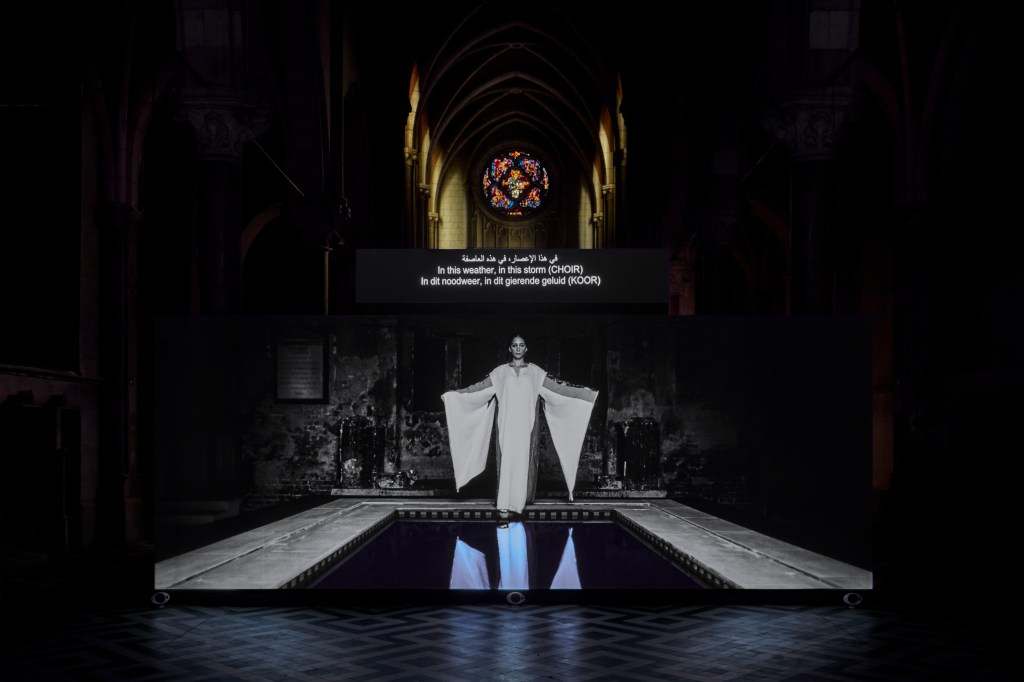
Genre subversion becomes her act of narrative self-determination. “By using science fiction, satire, and other narrative modes, I claim those genres for Palestinian stories, indicating that our experience is not outside culture but is culture.” In In Vitro (2019), she situates a conversation between two women—one born before an eco-disaster and one after—into “universal terms of inherited trauma and survival.” Through these forms, she explains, “we reclaim how we are seen—and potentially how we see ourselves.”
For Sansour, these questions of artistic sovereignty become intensely personal when she turns her lens toward Bethlehem, the city that shaped her vision. “Bethlehem is not just the place where I was born—it is a point of departure for stories of loss, transition and speculative geography, both in my work and in history.”
Her relationship with representing her birthplace has evolved dramatically over the past two decades. Early on, in Bethlehem Bandolero (2005), “the humour and Western tropes let me wrestle with identity and tragedy in a playful way, countering expectations of solemnity.” Over time, her vision has evolved into a dystopian landscape. In In Vitro, she begins with familiar symbols, such as the Church of the Nativity, and dismantles them as part of a wider climate-apocalypse logic. “So the work shifts from playful critique to immersed speculation,” she reflects. “Both approaches are about transformation—Bethlehem becomes a site of metaphor, memory and futurity.”
This evolution reflects not only her maturing artistic practice—moving from experimental short films to large-scale, multiple-screen installations with feature film duration—but also her deepening engagement with “questions of inheritance, legacy, and rethinking the place I grew up in.”

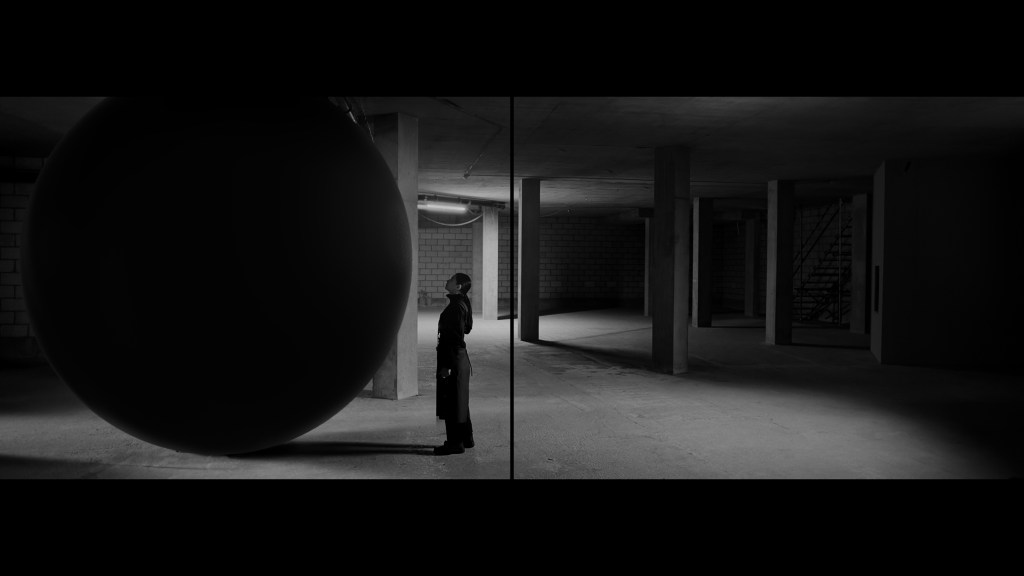
This evolution in representing place reveals her broader artistic philosophy—one that recognises the profound power of mythology to reshape contemporary understanding. “The tension between myth and history is central to what I do,” Sansour explains. “I engage myth not to escape reality, but to find ways to make it visible.” Her method involves “an attempt to de-victimise the Palestinian by giving them full agency in a world where notions of reality and truth become more and more blurred.”
Yet she continually anchors her work in political urgency—occupation, dispossession, and memory gaps. Her film In the Future They Ate from the Finest Porcelain directly confronts how “archaeology is used as a significant political tool by Israel, to advance the country’s colonial aspiration for expansion and domination.” The protagonist, who calls herself a narrative terrorist, aims to subvert historical narrative by planting porcelain plates for future archaeologists to discover. “By planting artefacts for future archaeologists to excavate, she hopes to confirm a politically advantageous narrative and alter the foundations for future political dialogue.” The work poses fundamental questions: “How long do these artefacts need to remain in the ground before they become real and who gets to tell their story?”
Yet these questions of artistic identity become even more complex when viewed through the lens of international recognition, where institutional frameworks can both elevate and constrain. Sansour’s navigation between cultural contexts—Palestinian by birth, London-based by choice, and selected to represent Denmark through institutional appointment—creates what she calls a “two-fold audience, and from a two-fold perspective. “Living and working between places revealed to her “how far Palestinian reality is from most people’s imaginaries.”
Representing Denmark at the Venice Biennale exemplifies this complexity. “It allowed me a platform that would otherwise be closed, but it also meant negotiating institutional languages and expectations.” Rather than seeing this as a limitation, she transforms it into an opportunity. Her multiple cultural positions enable her to “map the narrative across vantage points—Palestinian, British, Danish—and challenge the framings each presents.”
“It is precisely this mobility that enables me to be the narrator rather than the narrated,” she reflects. “Institutional access becomes part of the reclamation process: I use those contexts to redirect gaze and agency back to the Palestinian subject.”
The artistry reveals a profound truth: that authentic expression emerges not from conforming to expected narratives, but from the courage to forge entirely new ones. In transcending boundaries others would impose on Palestinian creativity, she opens vast territories for future artists to explore. Her work stands as a testament to the transformative power of artistic sovereignty—proof that when creators claim their right to tell stories in whatever forms they choose, they don’t just change art; they change what’s possible. Through satire and speculation, through the absurd and the profound, Larissa Sansour reveals what lies beyond our current prejudices and constraints: a world where imagination itself becomes the path to liberation.

 neunmagazine.com