
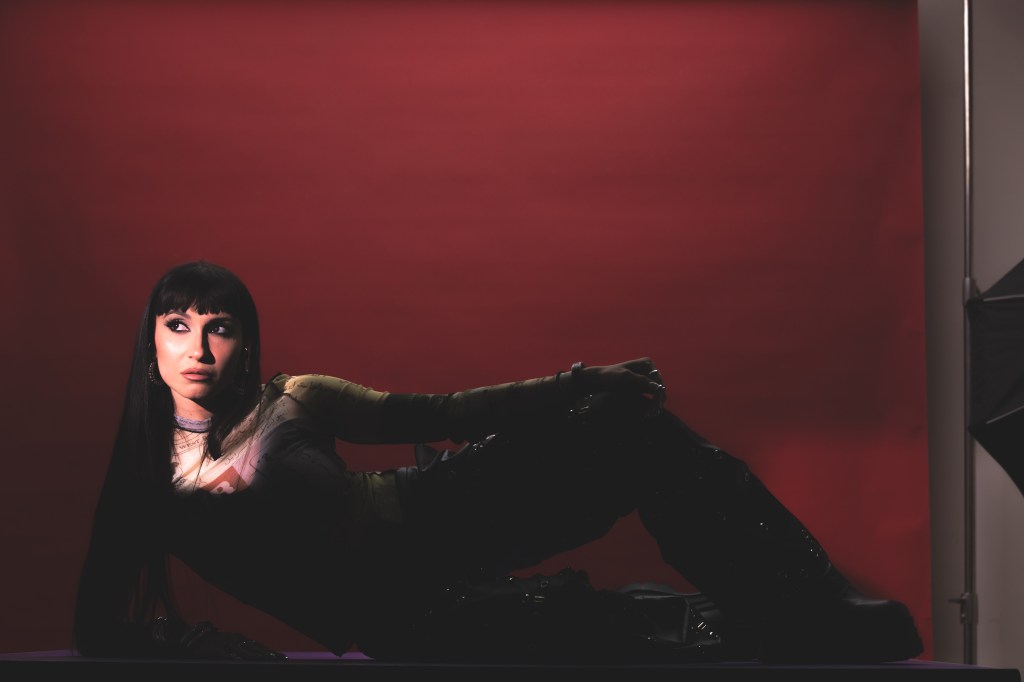
Lina Makoul reflects on industry pressures, political realities, the freedom to create on her own terms, and the pull of a place that shapes every song.
Lina Makoul has never been an artist who shies away from truth. The independent Palestinian singer expresses her sound on honesty, weaving personal stories with the realities she refuses to ignore. Earlier this year, she released “Radiya,” meaning “being content,” a track that embodies both calmness and defiance. This Friday, December 5, her new single, “Akka,” arrives on all major streaming platforms.
Speaking with Lina, it’s clear that her voice offstage is just as direct as the one in her music. When asked how she balances the personal and the political, she pushes back on the idea altogether: “I don’t see my work as political; I just don’t avoid my reality,” she says. “People call it political — I call them privileged.”
It’s this mix of clarity, conviction, and creative independence that defines our conversation.
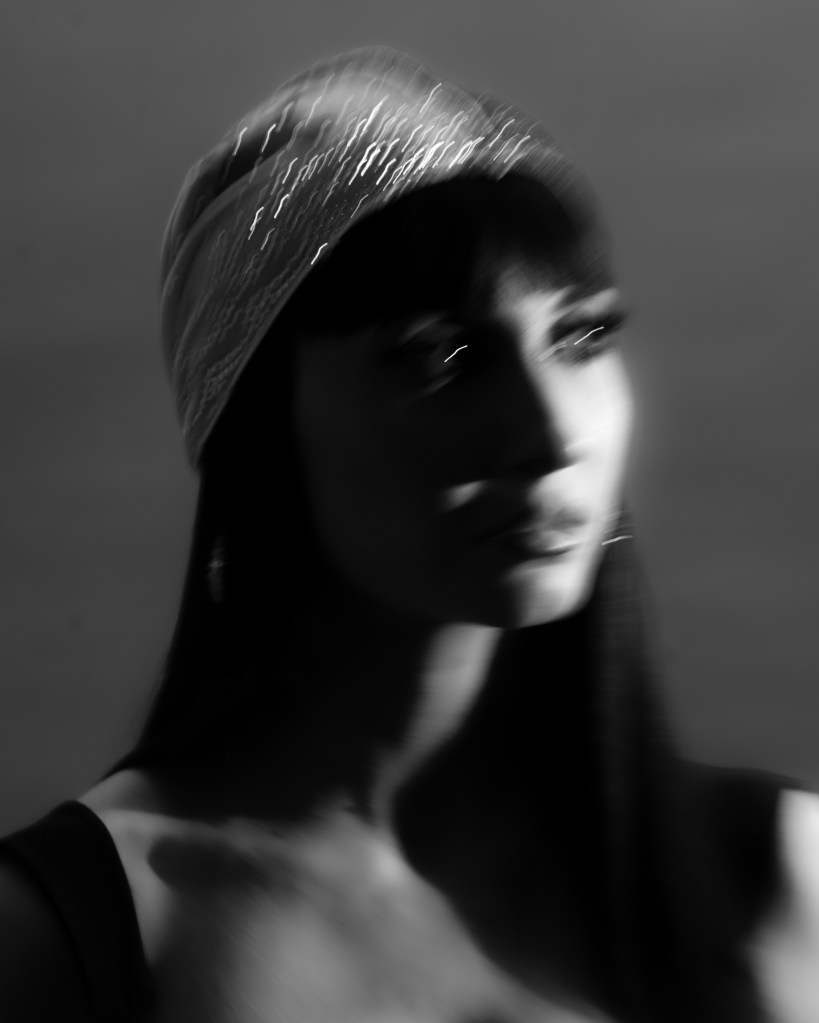
You’ve been performing since you were young, and many people first discovered you through The Voice. How do you look back on that moment today — how do you feel it shaped your path, both as an artist and as a Palestinian woman entering the music world?
Honestly, I used to be very pissed about interviewers mentioning me winning The Voice for a very long period, and I feel like this is the first time I actually don’t mind it. I guess I’m at a point in my career and political being where I have finally made peace with my decision to participate in 2012, grateful for the crazy, risky, unusual journey I took, because it’s been mirroring our lives as Palestinians in 48’ under not only physical occupation but rather a psychological, mental, and cultural occupation and designed brainwashing.
That moment also forced me to confront what it means to be visible as a 19-year-old woman on such a massive stage, carrying identity, power, expectation, and stereotype all at once. It pushed me to understand very early that my presence alone was political, even when I didn’t intend it to be.
My father told me in the middle of an argument we had when I was 18 and refusing to go to university as I was expected to, that if I wanted to become a music artist, I should aim to be the biggest in the world. My mother raised me and my siblings to always be honest not only with others, but with ourselves, and the combination of the two made me the artist I am today, refusing the capitalistic control over art, owning all my music and creative freedom, and dedicating my time, energy, and being to understanding myself aspart of a people rather than through the eyes of an individual.
And honestly, that whole experience pushed me towards the political clarity and independence I have today. It made me realise that my route will never be separate from my people and the place I come from.
I do question the route I’m on occasionally, I’m not going to lie. I constantly wonder if I’m making my life harder when I can probably achieve wider recognition, but it just doesn’t sit right.
In the years since, you’ve built something entirely your own — a sound, a message, a way of working that reflects your own rhythm and convictions. What has that evolution been like for you, moving from early recognition to creating completely on your own terms?
Starting off from a place where you’re entirely controlled, from the nail polish you choose to put on your nails to whether you’re allowed to speak in your mother tongue (Arabic) on socials when you know absolutely nothing about how the entertainment industry works, was such a big motivation towards a road of complete freedom. Discovering all the loopholes, getting out of label contracts, discovering how many limits you put on yourself just from the idea of thinking you’re not free is just mad.
That shift from early recognition to building something entirely my own made me confront how much of my identity and expression were being shaped by other people’s fears and expectations. It also made me very aware of how much power I was giving away without realising it.
It was actually a great parallel to living in a place where your future is always controlled by an entity that absolutely DOESN’T want the best for you. You can’t plan anything because there’s always a higher force—other than God— that controls you. You’re controlled by fear because somebody is controlling all your creations. You know what I mean?
I’m not sure, but the moment I started seeing parallels between occupation and the music industry, I couldn’t stay on the same route. And honestly, that’s what pushed me to create on my own terms, with my own rhythm, because depending on those systems felt like repeating the same psychological pattern.
I decided to do whatever felt right to me in every given moment, even if that meant changing my mind before a release or altering a whole concept a day before a shoot. I recognised that freedom is definitely not about breaking the rules, but rather having the privilege to break your own.
Your music often touches on belonging and distance. How has living between places — between Palestine and everywhere else — influenced how you write and create?
Such a good question. I’m grateful that my job takes me to many places in the world, and I’m able to meet and discuss ideas, philosophy, spirituality, ideology, and art with many special people. I thrive through genuine connections, that’s how I charge, and that’s how I evolve personally and artistically.
Living between places- between Palestine and everywhere else- constantly shifts my perspective, and that movement really affects how I write. I usually write what I need to let out of my system so I can literally observe as a third person and completely detach and move on.
Performing is meditative to me. I give my all, and I receive all the energy that the audience is sending my way. I invest in reading the room, and I’m not scared to stop the show to say something I feel like saying. I tell my life story through my songs, in a specific order, making sure a genuine human connection is being formed with the viewer.
Touring keeps tuning the type of music I want to perform more of on stage. Last year, I toured for three months with Saint Levant, and I became aware of how much I missed using my whole register on stage, getting out of breath as if I had just run a marathon. I miss singing with live instruments. I understood that I miss being a sensitive person on stage, too, that I’ve been standing strong for too long.
And honestly, living between worlds makes those realisations sharper, because every place brings out a different layer of me.
Usually, flights are my favourite place for writing. Most of my songs have parts that were written on planes. I’m usually sleeping, and I wake up all of a sudden and reach for my notebook that I take with me on every flight and start recording on my phone while whispering. These are my most treasured writing moments.
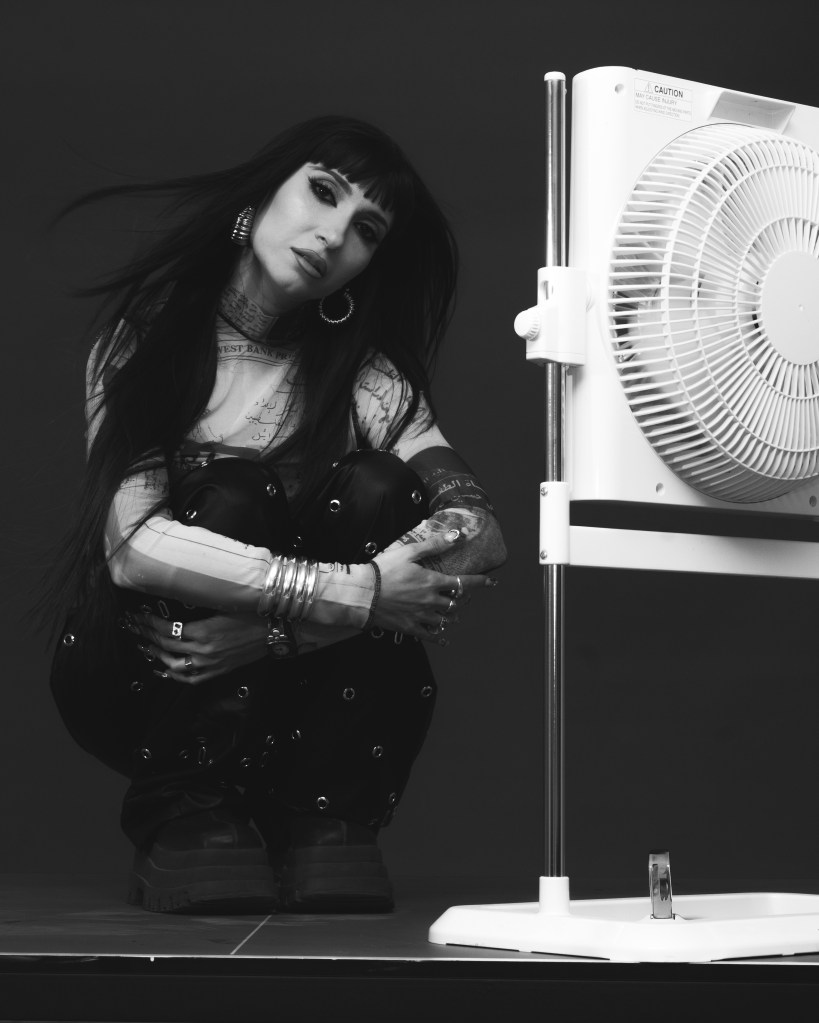
When was the last time you found light in an unexpected place?
For the past two years. I’ve realised that if I keep normalising Western privilege, I’ll miss out on Mediterranean privilege. Because who said the real meaning of being privileged is having money, the ability to consume anything we desire, to travel, wear luxury, or fine dining? Who said privilege isn’t belonging to a land? Being made from the soil your ancestors are buried in? Knowing the indigenous plants of your land? Last week I was wandering in my city, Akka, which is within 48 borders (Israel). My city is an ancient shore city, mostly known for her ancient walls that stopped Napoleon Bonaparte from invading it, making it the only city in the world he couldn’t conquer. As a tradition, our boys gather on these walls every weekend and jump into the sea. Some of them are four years old. It’s a beautiful spectacle to watch and witness.
So I was there with my partner, taking some videos for my new release “Akka,” and all of a sudden, he stopped filming. I look behind me, and it’s a group of 50 teenage settlers, all wearing white, guarded by two of their apparent tutors with M16S (machine guns), blocking the top of the walls and spitting on the boys while jumping.
Do you know how much light it brought to my heart when me and the boys just smiled at each other and acted as if there was nobody there, understanding exactly we’re not falling for the provocation? I don’t think any normal person would have held themselves back and smiled.
What is a favourite line you’ve written? And is there a Palestinian artist or song that has had a big impact on you?
I’ve recently quoted the most Palestinian song to ever shape me and my identity. It’s titled “Law Sherbo El Bahar”, which translates to “Even if They Drank the Sea” by the Akkawi band Walla’at, in my latest release “Akka.” I start the song by quoting them, as a reminder. This song shaped us as a generation and taught us that we shouldn’t sell our houses in our city. That we don’t need that money because our city is its people rather than the buildings.
The line that resonates with me the most is actually from the parts I wrote on the same song: I wrote, “Even if I wander, wander, wander, to her I always return.” This line gave me peace, while the only peace I was feeling was when I was touring abroad.
I have another line I love from “Radiya”, which translates to: “I own what money can’t buy, I know beyond knowledge, I send out what doesn’t align, and to me, that’s enough.”

In the end, Lina’s hopes stretch far beyond her own music. She imagines an artistic landscape rooted in its people rather than Western models — one that grows its own industry, honours every generation, and treats art as a record of how life is truly lived.
Art, she reminds us, is how we document reality — and sometimes, it speaks louder than history ever will.
 neunmagazine.com