
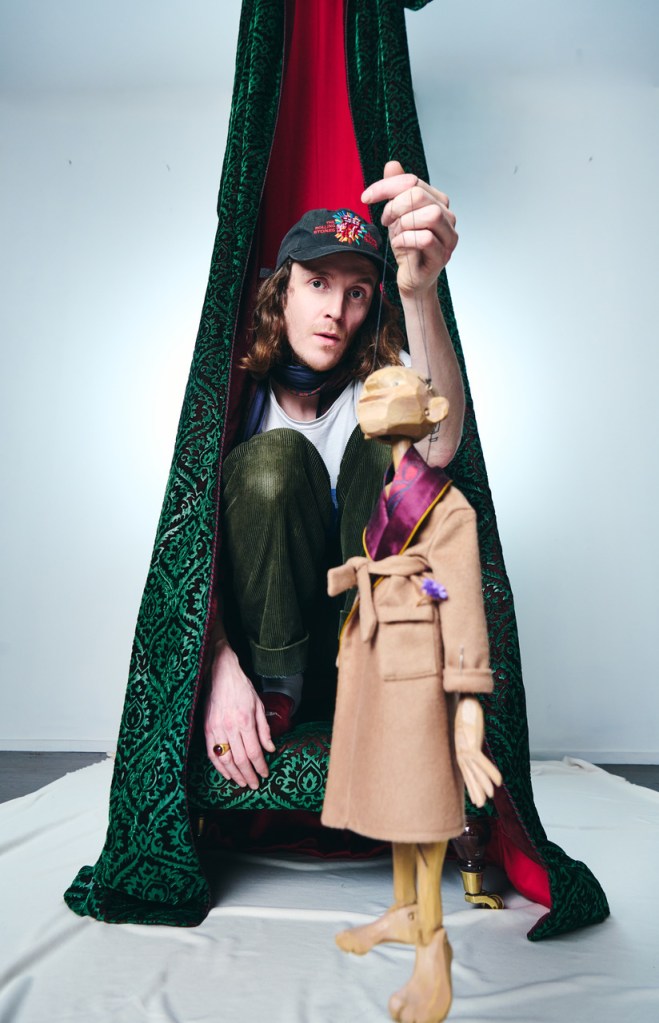
The master tailor and artist extraordinaire presents his sophomore exhibition In the Garden of the Happy Dead at Savile Row and talks about his love for his parents, collecting weird and wonderful things and always doing the right thing.
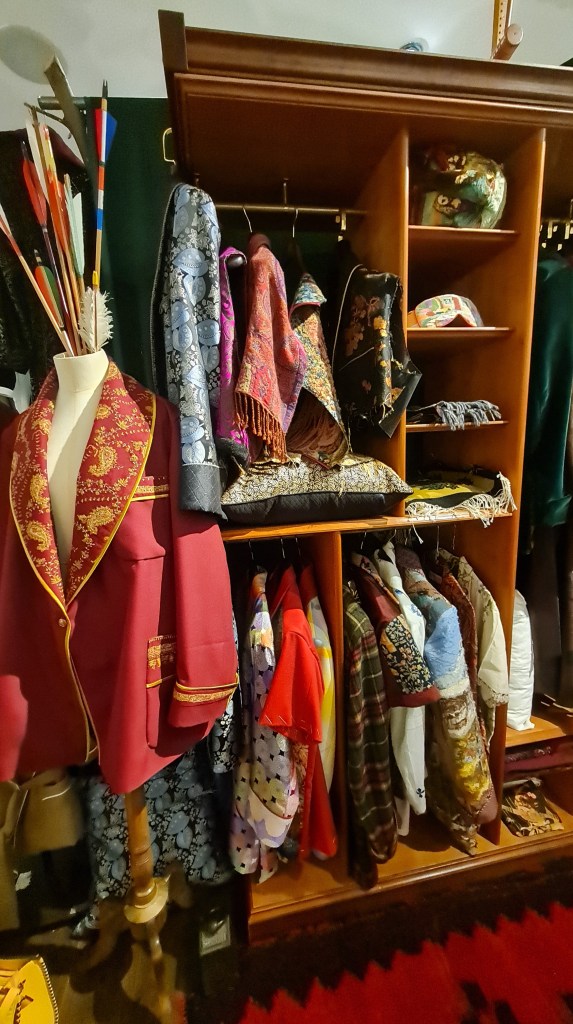
On a bright evening at the beginning of March I’m walking on Savile Row, just a few minutes from Piccadilly Circus. It’s my first time here, in what feels like an exclusive part of designer London, and I try not to gawk. This street has been synonymous with traditional bespoke tailoring and housed the country’s finest craftspeople since the 18th century. As I hurry past a blacked-out SUV that costs twice the price of the house I live in, I spot the address I’m looking for: Daniel Hanson, 36 Savile Row. My nerves dissipate immediately. There is a small group of people mingling outside the front, drinks in hand, chatting and laughing. A young boy is playing in the shop window in front of a rail of gowns (Hanson calls it ‘The Den’, with a secret door for children only). A white dog curiously flits between visitors, enjoying a quick flash of attention. Friendly faces greet me, I’m offered a drink and invited into the building.
My invitation to attend the press viewing of the sophomore exhibition of Nicholas Hanson, Daniel Hanson’s younger son, came from a serendipitous meeting two weeks earlier on a late night train from London to Nottingham, his home. Passing through the carriage, he stopped, drawn, it seemed, to the fact that my children were busy reading and writing rather than staring at screens. Having recently become a parent himself, Nicholas told us his worries about the impact digital devices have on children. To my children’s mild bewilderment, he told them they were lucky to have parents like us, and to look after us. A few moments later, he handed my husband his business card and a leaflet about his upcoming exhibition at Savile Row.
Later, in our interview, as we laugh about the happy coincidence of that moment, Nicholas says: “There’s so many situations in life where you have to look after your parents – it’s just nice to be reminded of that sometimes.” His words may seem random, but when you understand the story of not just Nicholas but also his father, Daniel Hanson, their meaning becomes clear.
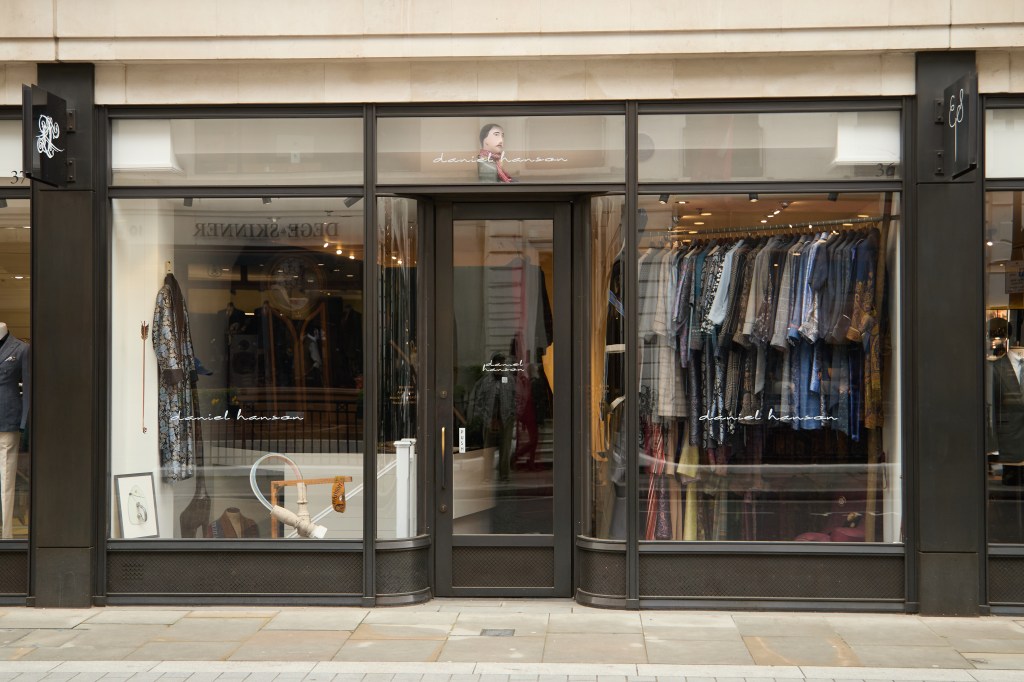
Inspired by second-hand dressing gowns, Daniel Hanson, one of the world’s finest dressing robe tailors, launched his first collection in 1987. His sole investor was his wife Julie, who deeply believed in her husband’s dreams and vision. The money she invested was from her job as a carer. “Our business is founded on care money”, Nicholas laughs, “not blood money, not drug money, not diamonds, not oil. Care money.”
A chance meeting with the Harrods buyer on a train the same year led to the first order of Men’s Nightwear in 1988. It was the beginning of something extraordinary, during which Daniel Hanson made robes for the likes of Michael Jackson, Ozzy Osbourne and was commissioned to make dressing gowns for Prince William and Princess Catherine for their wedding in 2011. Sir Elton John has been a fan for decades, buying his first robe in 1997, and famously wore a Hanson gown in the 2018 John Lewis Christmas advert.
Sadly, in 2019, Nicholas’ father died of cancer, leaving Nicholas and the Hanson family bereft though the legacy prevailed. Four years later, Savile Row extended an invitation to the family business to have a three month pop-up — so successful that they have been there ever since.
Nicholas’ multi-media art installations exhibited at the shop from 5th to 21st March 2026 pay tribute to those who shaped his life and artistry most: his late father, whom he calls his creative guidance, his mother, whom he praises as his moral compass, and his experiences from childhood through to adulthood. Named In the Garden of the Happy Dead, Nicholas lays bare the love for his family and his qualms with the social and political world beyond it.
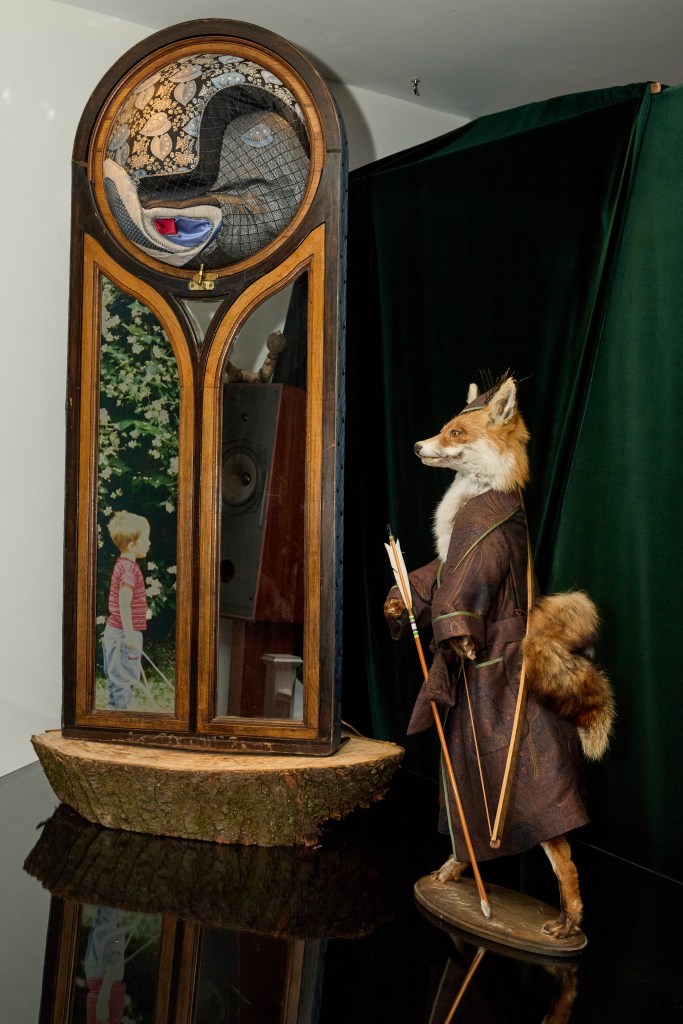
The first thing I see when I walk through the door is Foxhood (2023), an antique taxidermy fox dressed in a miniature Hanson gown and Robin Hood hat— a self-portrait of the artist and nod to his late father. On its significance as an act of rebellion of the current status quo of politics and society, Nicholas simply says: “You know, I don’t run down the street telling everyone I’m going to save the world. I just make a sculpture of Robin Hood wearing a dressing gown that hopefully will make people think about saving the world.”
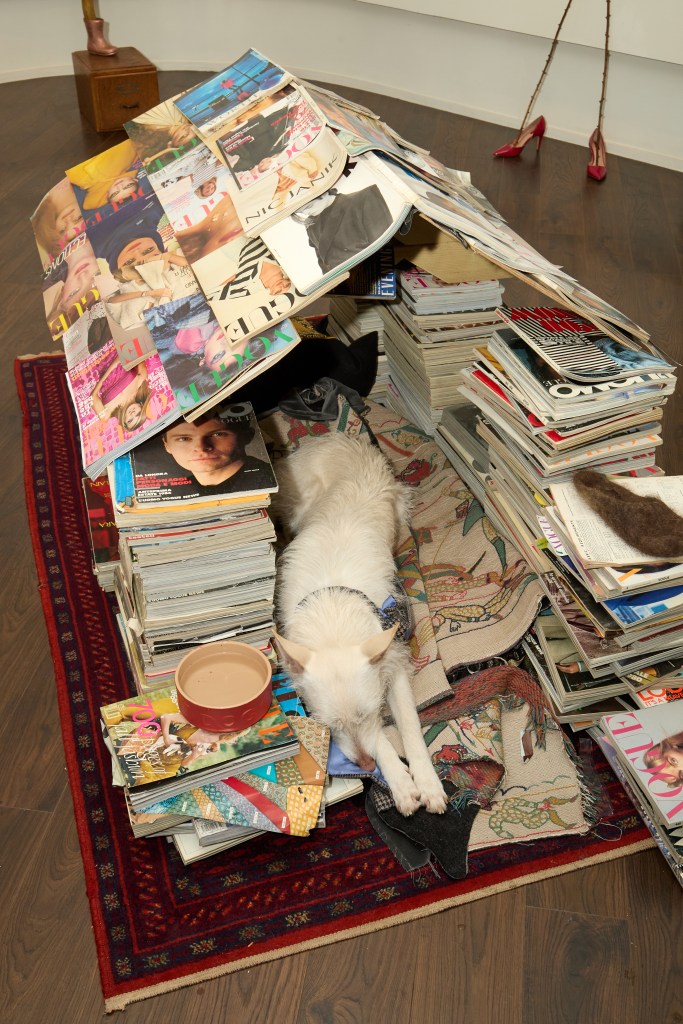
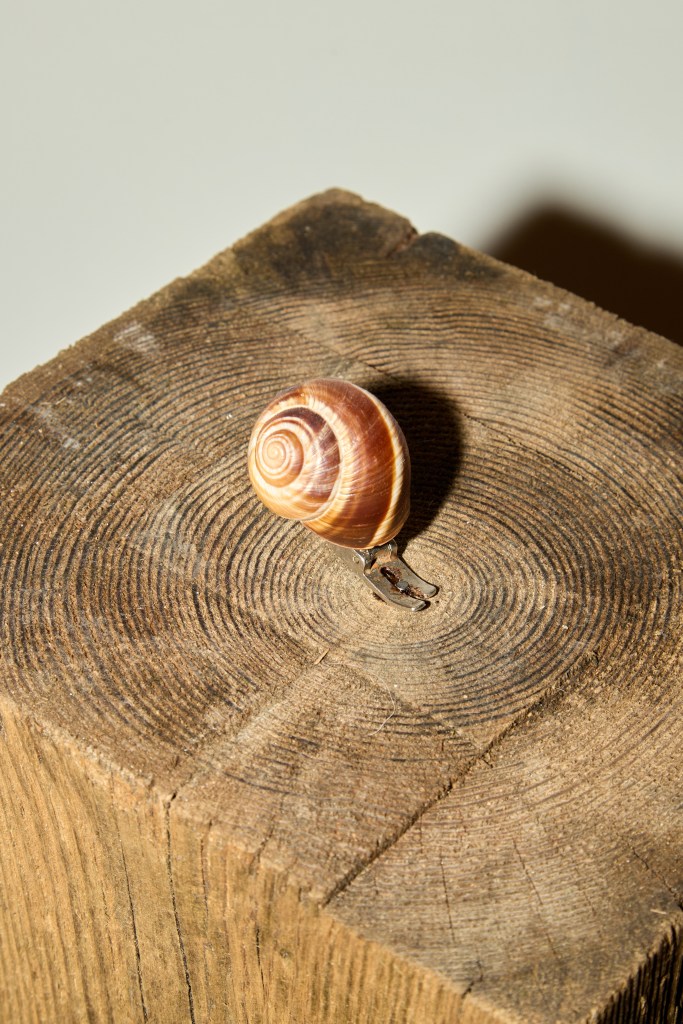
What strikes me most as I take in the exhibition is the relaxed and familial atmosphere as we move from sculpture to sculpture, dinner jacket to evening robe, whilst Wilfrid Wright, curator and friend of Nicholas, tells us the story behind every item. To my delight, I’m allowed to touch the extraordinary jackets, robes and gowns, each handcrafted and finished to perfection. I marvel over a piece called Slow and Steady (2025), a French snail shell perched on a sewing machine foot he once found close to his father’s old workstation, and take pictures of a dog house built from old Vogue magazines. Nicholas’ lurcher Lottie now snoozes soundly on a dog bed made from black and silver offcuts of cloth, having tired from roaming the groups of visitors. Nicholas tells me that he used to build a den for himself as a child out of those same magazines whilst his father was working in his atelier.
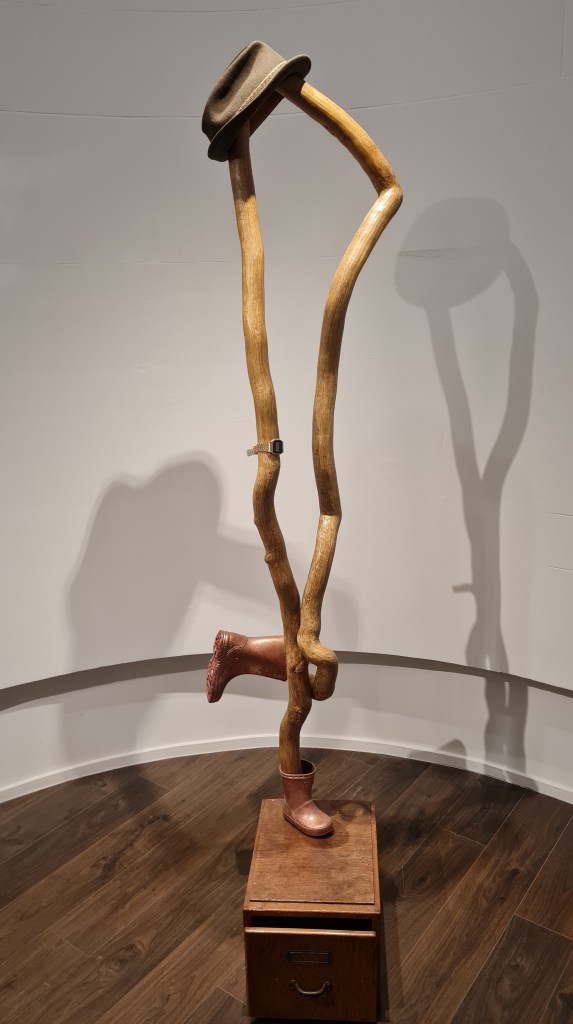
His childhood and adoration of his parents run through everything. Mum (2025) is an installation featuring an intertwined piece of ivy standing in golden infant wellington boots and topped with “Pete Doherty’s hat, which he lost [in his heydays] after the infamous Baby Shambles Riot in 2004”. Here, Nicholas has captured his mother’s carefree and hedonistic life before she had children. As a proud father to his six-month-old son, he honours this transition from youthful freedom to parental responsibility.
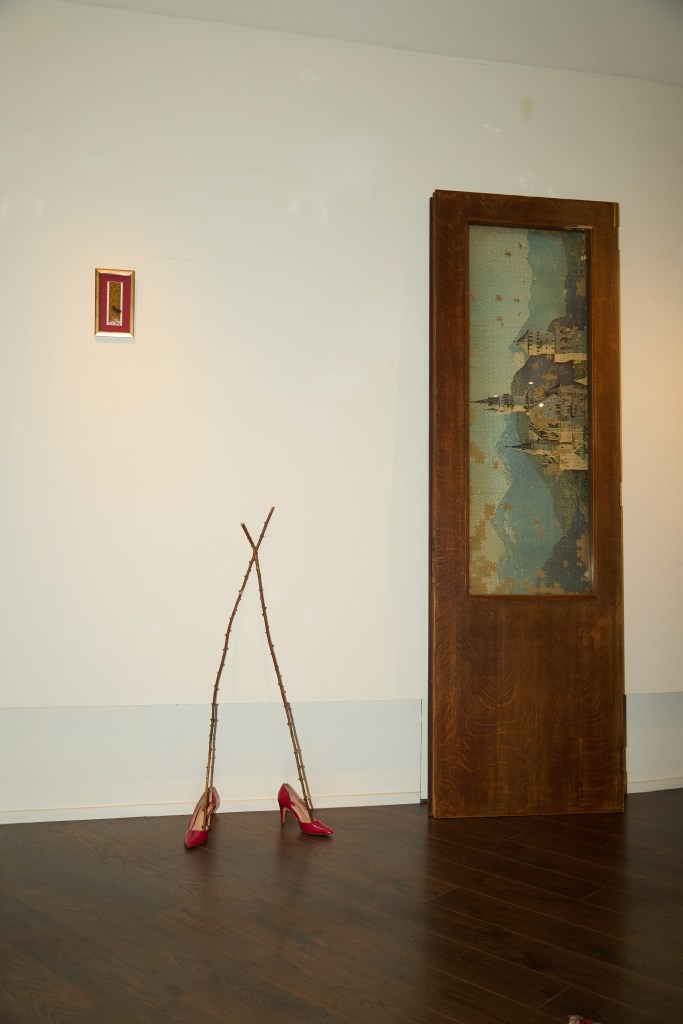
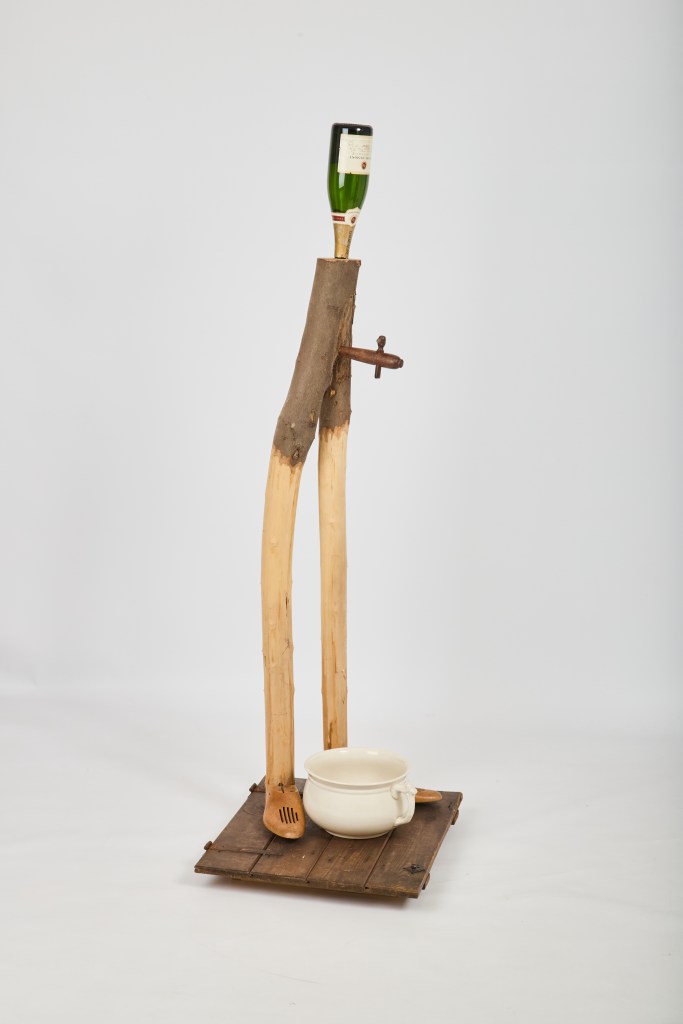
A few metres along the wall, I spot two thorny sticks propped up in red high-heeled shoes, called Fashion Legs (2025). Nearby the prickly statue is a tall door that Nicholas has taken from the apartment building of his student flat in Antwerp, Belgium, where he studied fashion, design and art at the Royal Academy of Fine Arts while his father was already ill. “Every time I went home, my dad was skinnier, frailer, less able to do gardening, less able to do the things he loved. And it really messed me up. I was really unwell.” He made the piece in 2018, incorporating a giant puzzle of the iconic German castle Neuschwanstein where a wooden panel or glass may have been beforehand. In a characteristic twist, the artwork combines two things Nicholas is not particularly fond of: Puzzles and the “tyranny of a predetermined outcome”, eliminating the process of creative play.
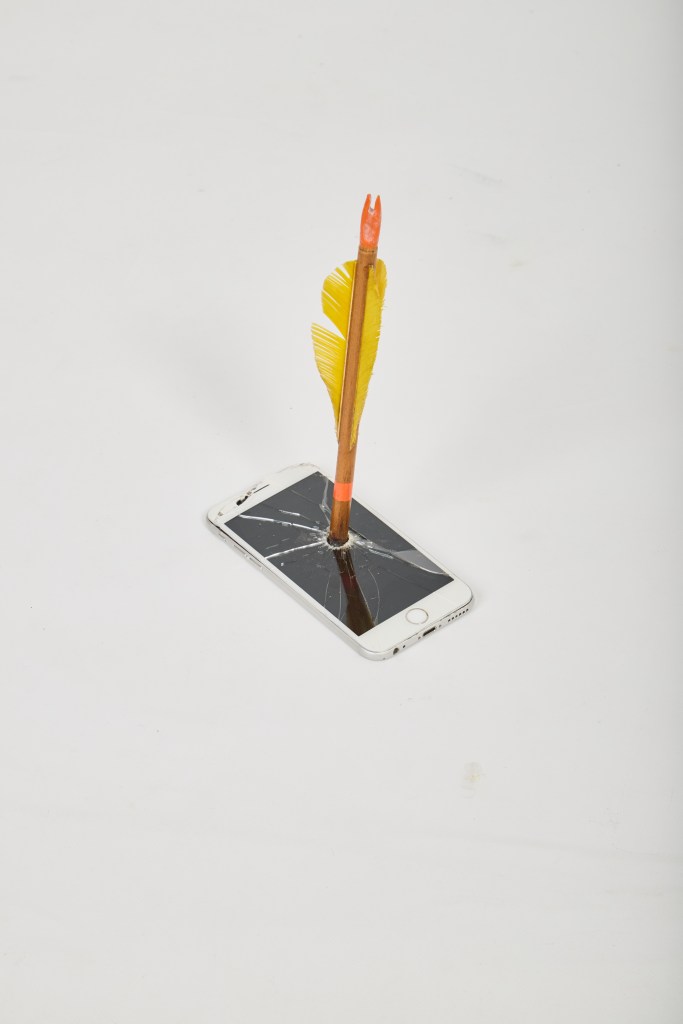
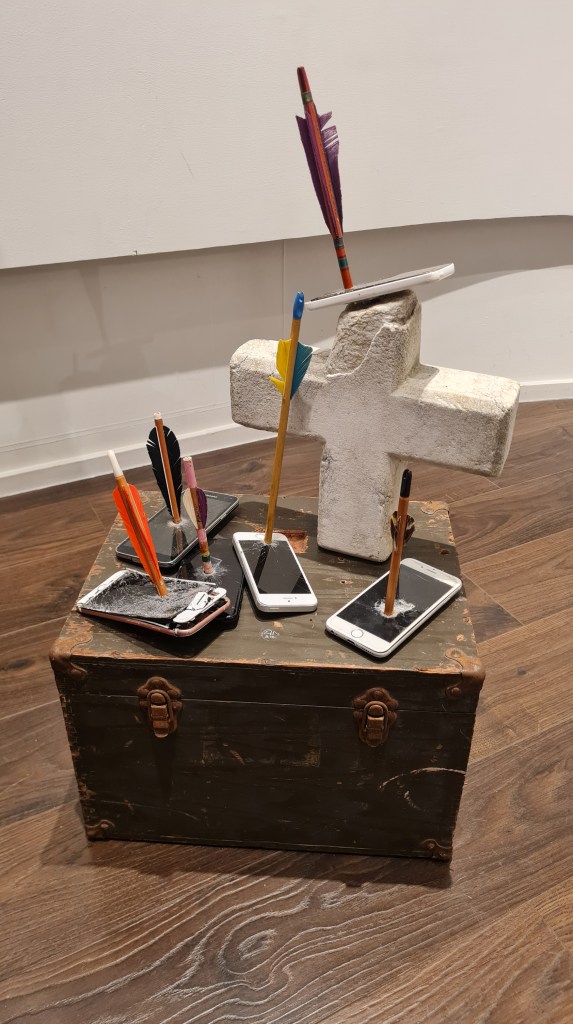
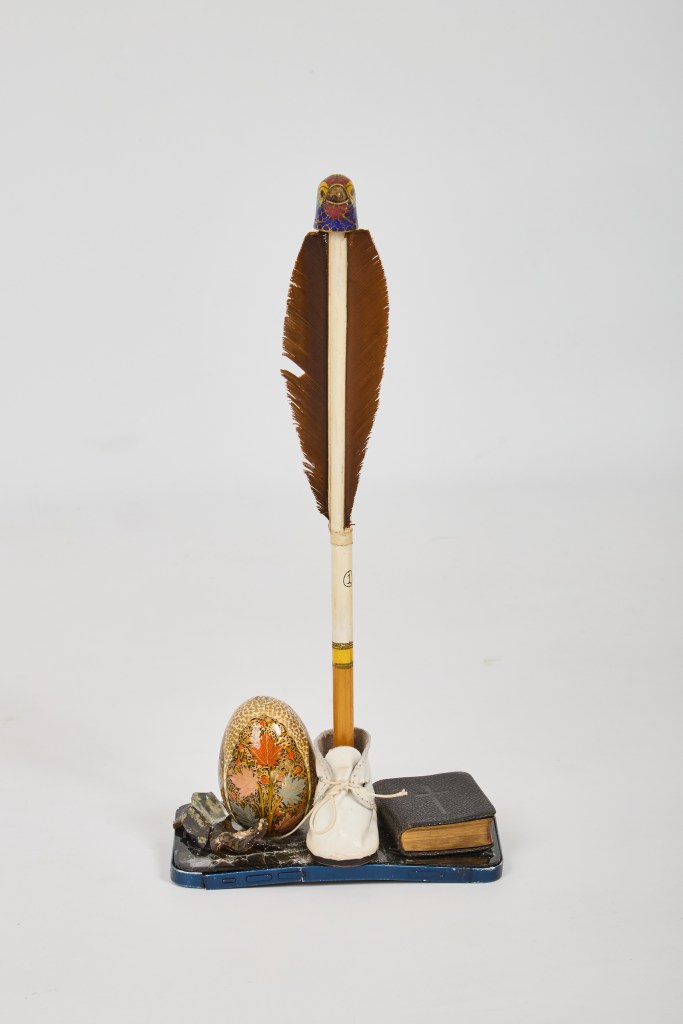
Dotted throughout the exhibition are some of the 42 sculptures named Phone Down (2025/2026). They are shattered smart phones, their destruction a process Nicholas enjoyed immensely. His disdain for our dependency on digital technologies, especially smart phones and tablets is unmistakable. “I hate it when people say that curiosity killed the cat. No, curiosity didn’t turn us into fascists! What actually kills us is convenience. Convenience made the cat fat, lazy and have a heart attack. And smart phones are just that: Convenience.”
I ask Nicholas about materials and processes. “In the Garden of the Happy Dead includes many objects that died a long time ago and they’ve always been in my life”, Nicholas explains. He tells me that the first stick he ever fell in love with was a silver birch which he found while chopping firewood with his father. He refused to hand it over for the fire : “And that stick has lived on my shelf ever since, because sticks are cooler than any toy. They’re not defined as a thing. It’s a gift that nature’s giving you. And a stick is whatever you want it to be.”
His affinity for collected items connects directly to his practice of working with his hands. “I take great satisfaction in connecting things” —Nicholas continues — “which is no different to making a garment, than making a skate ramp. The processes are very similar. You have your sideboards, you have your beams, you have your interlinings. It’s all the same, just different material. And I think Wilfrid [Wright] puts it really nicely: ‘Nicholas takes great pride in working with old and often strange materials.’”
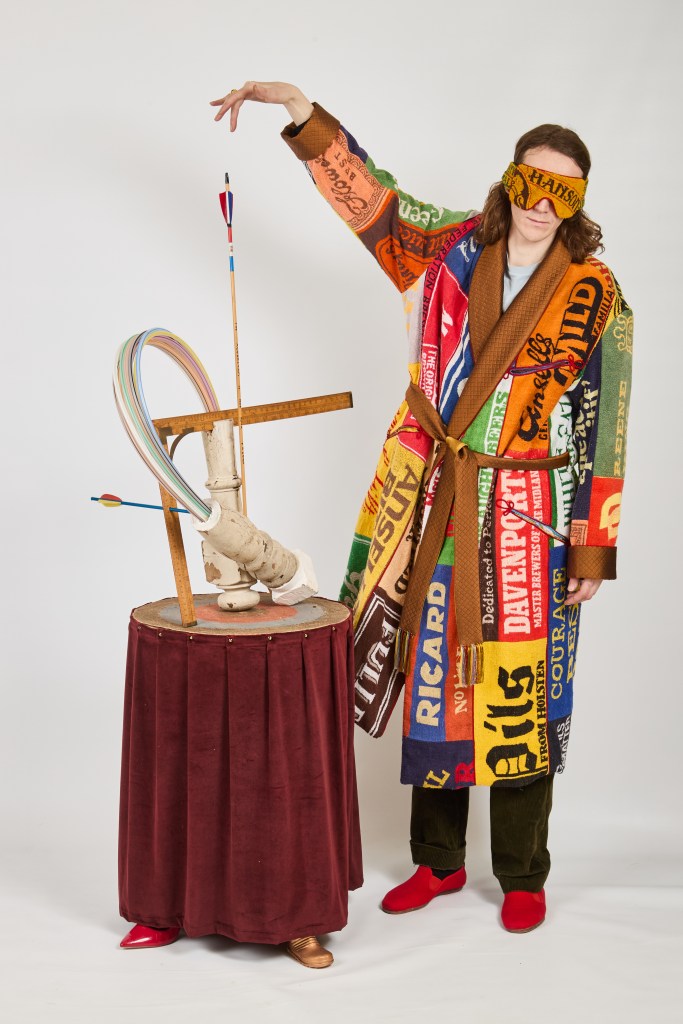
Nicholas’ journey as a tailor and artist has been equally shaped by his parents and his own love of the arts. A talented skateboarder during his childhood and teenage years, he chose against becoming a professional, and turned to creating things. On his father’s advice he went straight from college to a fabric mill.
“I went to Abraham Moon & Sons; that’s the only vertical mill in England. They work with the shepherds, they get the raw wool, they wash it, they dye it, they spin it to yarn. And I worked on the factory floor, just lugging things around, cutting the cloth to order.” He also began collecting scrap cloth from the mill, something he does to this day. “Martin Aveyard, their old creative director, hooked me up with a lot of scrap cloth that was unviable for production, such as strike-offs and samples. From there he went to Newham for a bespoke tailoring apprenticeship, before heading to the Royal Academy of Fine Arts in Antwerp (2017-2019). “You have a two-day interview where you do painting, drawing, sketching and answer random questions. I got the highest mark out of 500 applicants. And they put everyone’s marks publicly on the wall! It’s like Harry Potter for fascists, it’s horrible.” He returned to the UK in 2018 to spend his father’s final months with him.
Back in the family business, his commitment to sustainability runs through everything he makes. He tells me about a soft launch in April for Young Hanson with Lighthouse in Soho: “I’m not even going to weave any labels. Every garment is going to be hand signed. And I’ll just use an acid pen on cotton. I’ve got such an existential feeling of making new things in a world that we’ve so obviously drowned with crap. So if you’re going to make something, use the surplus materials that are already there, like your grandma’s embroidered tablecloths or something from a charity shop.”
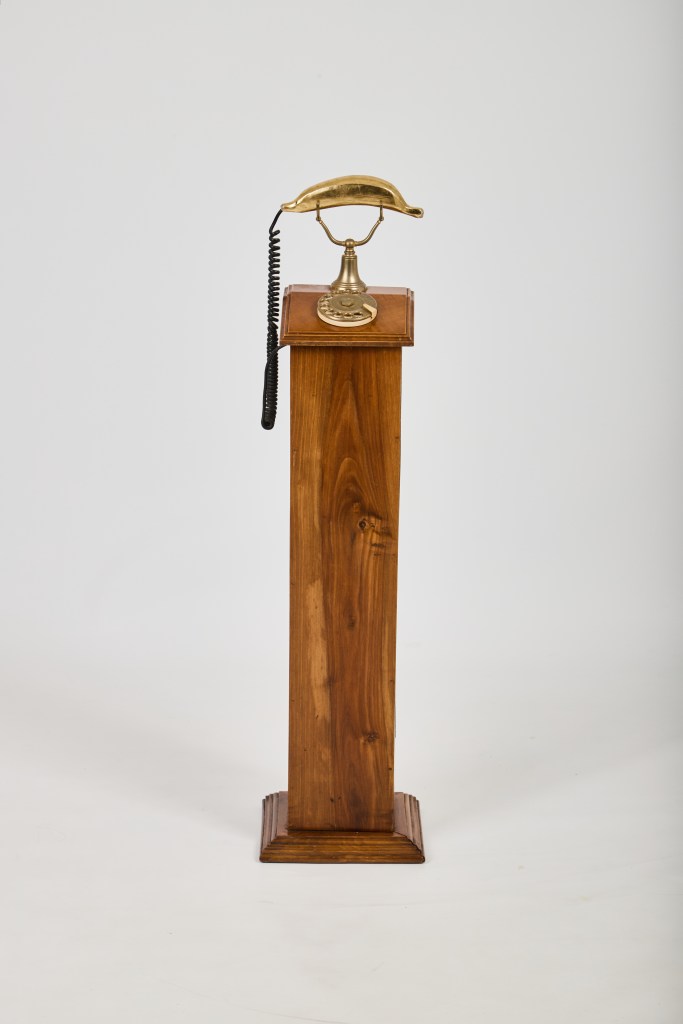
When I ask him about future projects, he speaks about a collaborative show with his friend Maximiliaan Verswijvelt-Boudens at the Antwerp Fashion Festival in June this year. “I’m Robin Hood and Maximiliaan is the Sheriff. The show discusses what would happen if, instead of looking after the king’s wealth, the Sheriff worked together with Robin Hood to disperse the bananas. And when I talk about bananas, I don’t just mean the fruit, I also mean the smuggled cocaine, the diamonds, the money, and all the seedy shit.” He chuckles and adds: “I love bananas. ‘Nana’ was my first word. And it’s the first thing I eat every day.”
As I step out of 36 Savile Row and head into the city’s bustling dusk, I feel joyful and enriched by the art, the stories and the genuine kindness I just experienced. Nicholas Hanson is an incredible amalgamation of artistry and conviction to do the morally right thing. His child-like gusto for life, his wonder and respect for our planet and his mission to live his life in harmony with his values isn’t just admirable but also infectious. The collector of weird and wonderful things carries his heart on his sleeve which is one of his greatest strengths. The ongoing success of the family business and high-profile clientele makes him grateful, fully aware of opportunities it has given him and continues to give him. He’s equally unfazed by it all – not in an uncaring way but in a way that shows you that his love for the arts, his craft and the people he holds dear always comes first.
 neunmagazine.com