
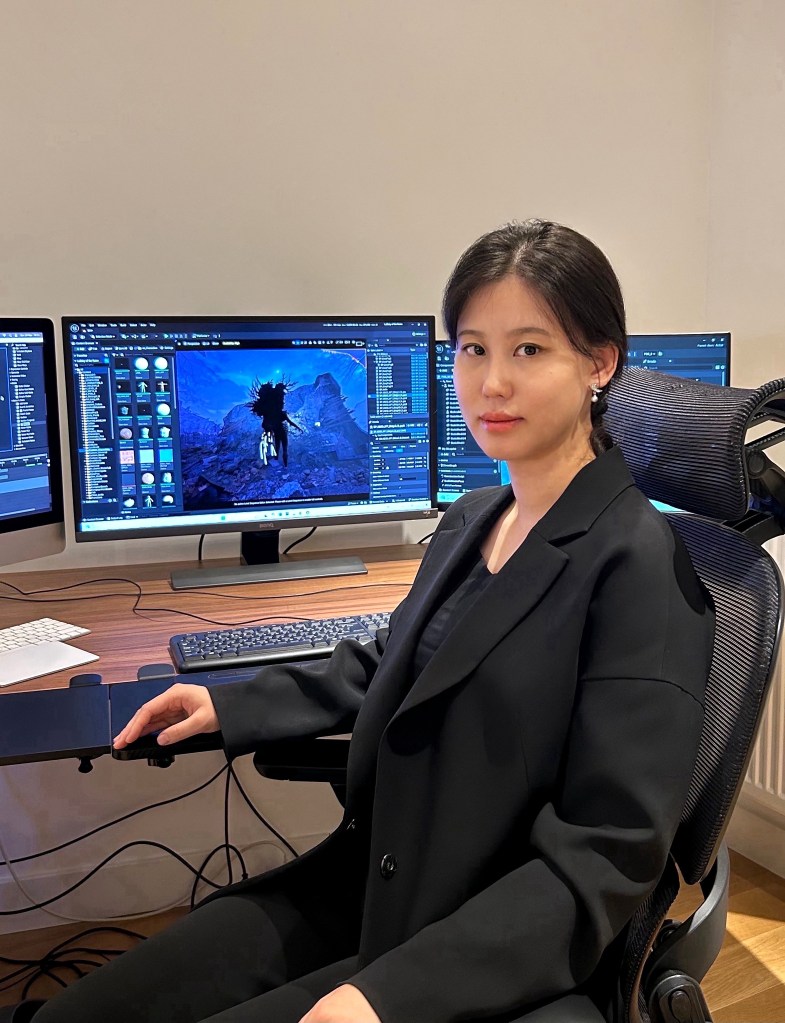
In London’s digital underground, a new mythology is being coded. It’s a world where stones are sung to sleep, where data cables erupt like mineral veins through synthetic skin, and where the act of mourning is not a terminus, but a permanent, vital state of being.
Driving this new creative vision is Eunjo Lee, a South Korean artist and filmmaker whose work sits at the centre of the “bio-digital entanglement” of our contemporary era.
Born in 1996 and now operating between Seoul and London, Lee’s trajectory has been one of professional and academic success, yet her creative genesis lies far from the polished screens of Unreal Engine or the “white cubes” of London galleries. It begins, instead, with the small burial mounds of her childhood.
“My creative genesis is rooted in mourning and death – the most profound emotions and concepts that have captivated me since my childhood,” Lee recalls . She traces her practice back to a childhood habit of wandering her neighbourhood to find dead insects or cats, moving them to build small burial mounds and returning to those sites to “converse with the departed.” These early rituals established a lifelong preoccupation with “the persistent act of staying by the side of absence.”
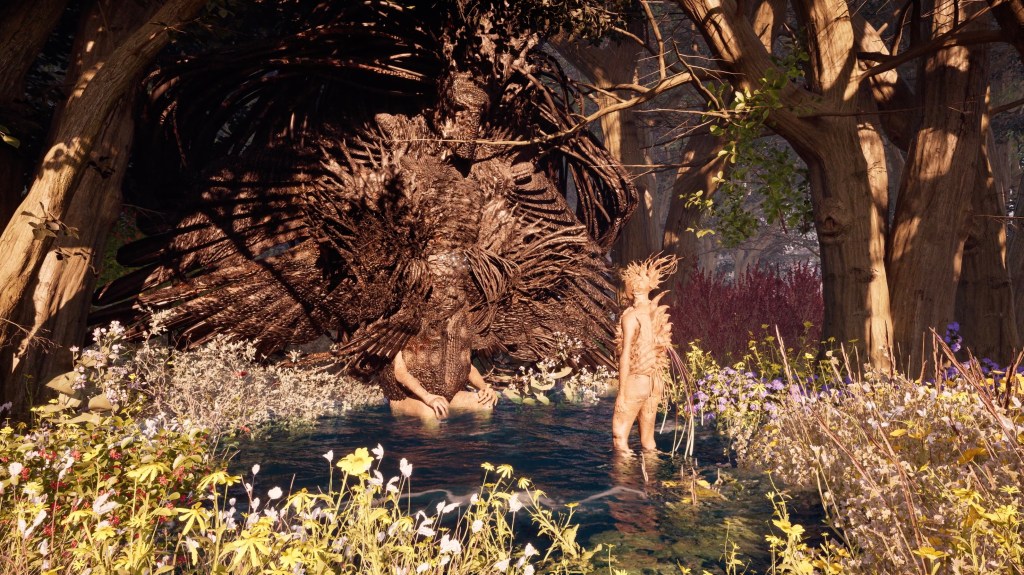
For Lee, the traditional social mandate to “let go” or “move on” after a loss is fundamentally unfamiliar. Influenced by French philosopher Jacques Derrida’s notion that “failed mourning is the only successful mourning,” she views the persistent act of staring at the unreachable as a “necessary devotion.” This philosophy was deepened during her twenties in South Korea, where she witnessed social tragedies, like the personal loss of beloved friends who chose to leave this world early, being “erased with unsettling speed” as society rushed back to a state of normality, “acting as if nothing had happened.”
To remain among the living while holding onto the aching gap where a loved one once stood is, in Lee’s view, akin to tending a garden. In response to both social and personal loss, Lee chose to let the departed live within her “inner garden” as her primary form of mourning.
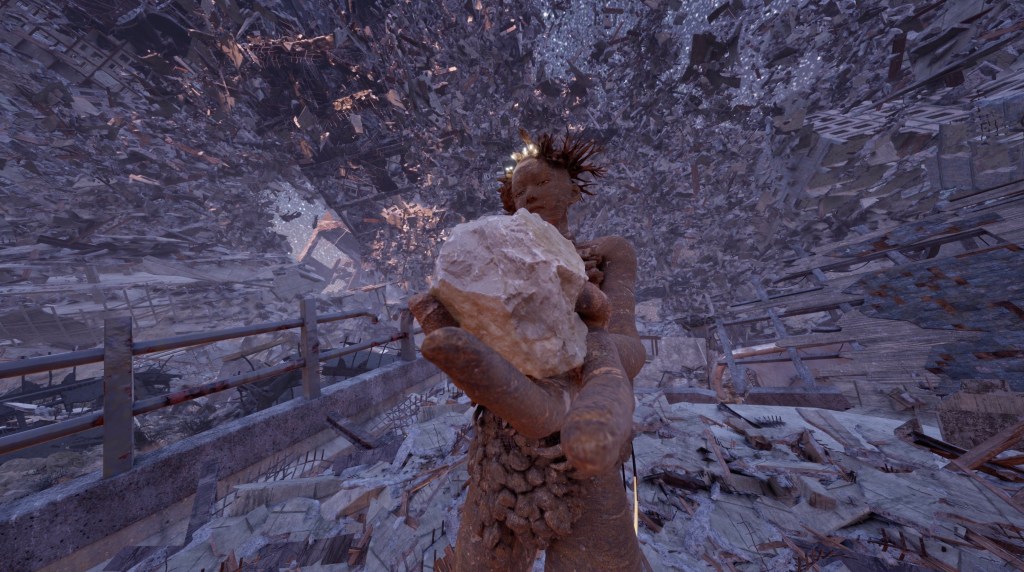
Instead of trying to ‘fix’ grief, she treats it as a place to explore, seeing it as the key to deeper human connection. This deeply personal landscape of loss has expanded into a vast digital world-building practice. Using tools like Blender and Unreal Engine, Lee constructs immersive environments that she describes as “contemporary mythology.” Her digital worlds are more than just art; they are sacred spaces built to hold our collective sadness, showing that all living and digital things are part of the same great mystery.
A key idea in Lee’s work is “digital animism” — the belief that the line between living things and objects dissolves entirely. She is inspired by the idea that everything, from the electricity in a wire to the rocks in the ground, pulses with its own agency. For Lee, software is not an instrument to be wielded but a living collaborator — something closer to kin than tool.
In her film The Lullaby of the Ruins, a child mourns the death of a stone, a gesture Lee describes as “a primordial impulse to make the impossible possible: the desire to bring life back to what is dead”. This challenges the assumption that feeling is exclusive territory for the living, as Lee asserts that “empathy and ethical consideration should not be restricted by biological boundaries or the presence of a pulse”. For Lee, seeing life in a stone or a ruin is a way to protest against an extractive worldview that reduces the non-human to raw material. She believes that “if we can find the soul in a cold, inert stone, we can foster a deeper sense of responsibility and humility toward the vast, unseen networks of being that sustain us”.
Lee’s work is famously shaped by the tension between Seoul and London. She describes Seoul as her “emotional bedrock,” the site of the social calamities and personal tragedies that form the psychological foundation of her practice. London, conversely, provides the “intellectual openness” and the navigational tools to explore these emotions through global discourses like Posthumanism and New Materialism. The tension between these two cities is generative; while Seoul provides the “engine” of primary emotional motive, London offers the framework to translate personal grief into a universal narrative.
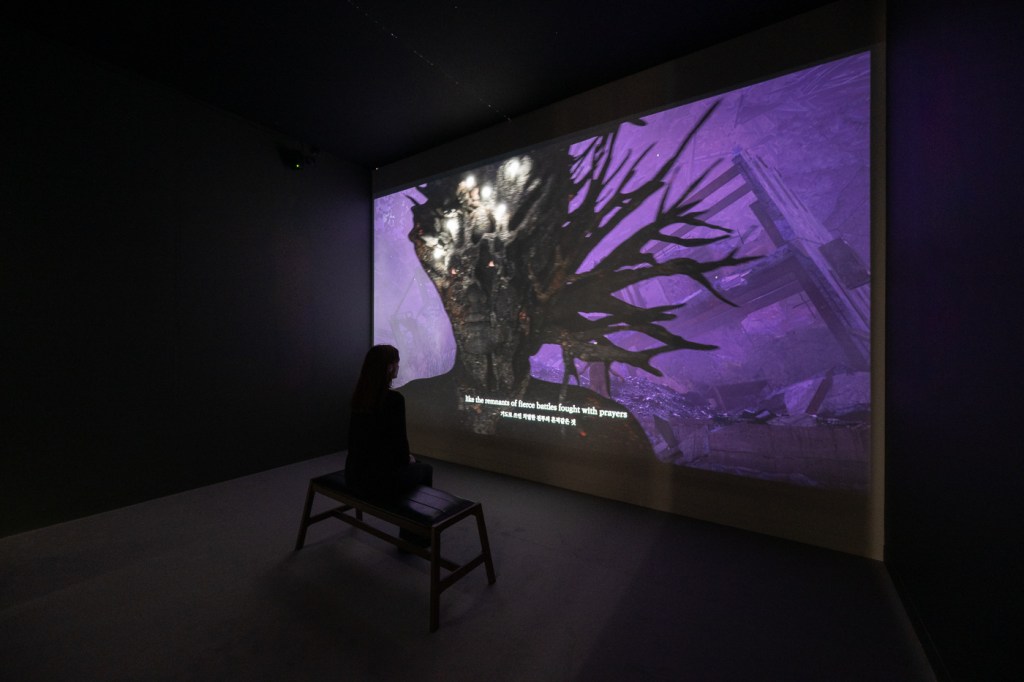
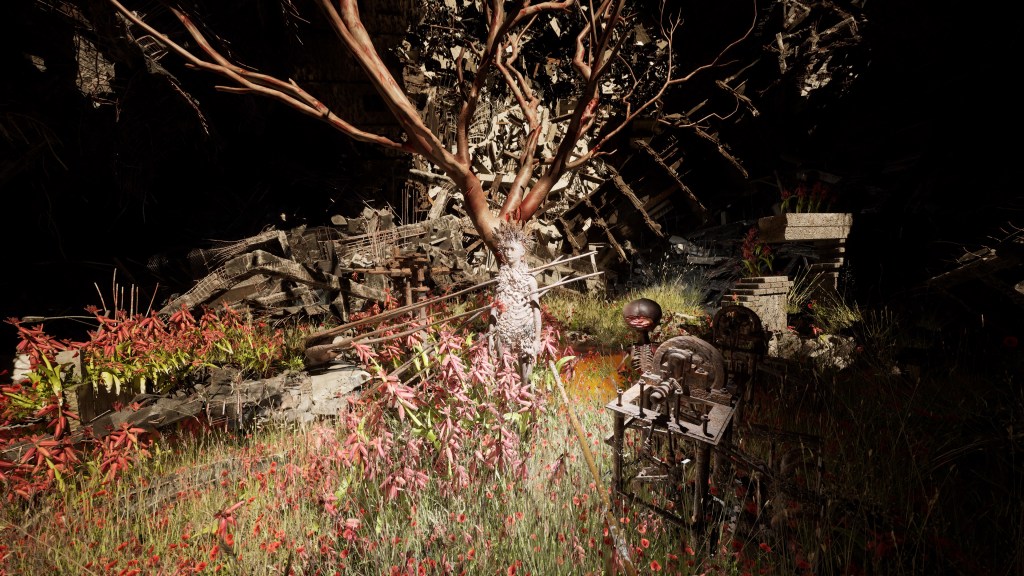
This is visible in her commission with HERVISIONS – a London-based curatorial agency focused on the intersection of art and digital technology – where she created a “garden of bones” around a central pole that connects the earth and sky. At its centre sits ‘The Keeper,’ assuming the posture of the Buddha at the moment before enlightenment — not fleeing death, but remaining present within it.
In a digital landscape often obsessed with sterile, polished perfection, Lee intentionally embraces the glitch. She views these technical ruptures not as failures, but as “digital ruins” that reject the deceptive surfaces of high-tech capitalism. “As a woman, a solo creator, and an ethnic minority navigating the landscape of London, I perceive these digital ruptures as a profound ecofeminist statement,” she explains. These imperfections function as “visceral traces” of her labour and existence, carving out a “sacred space” for her marginalised identity.
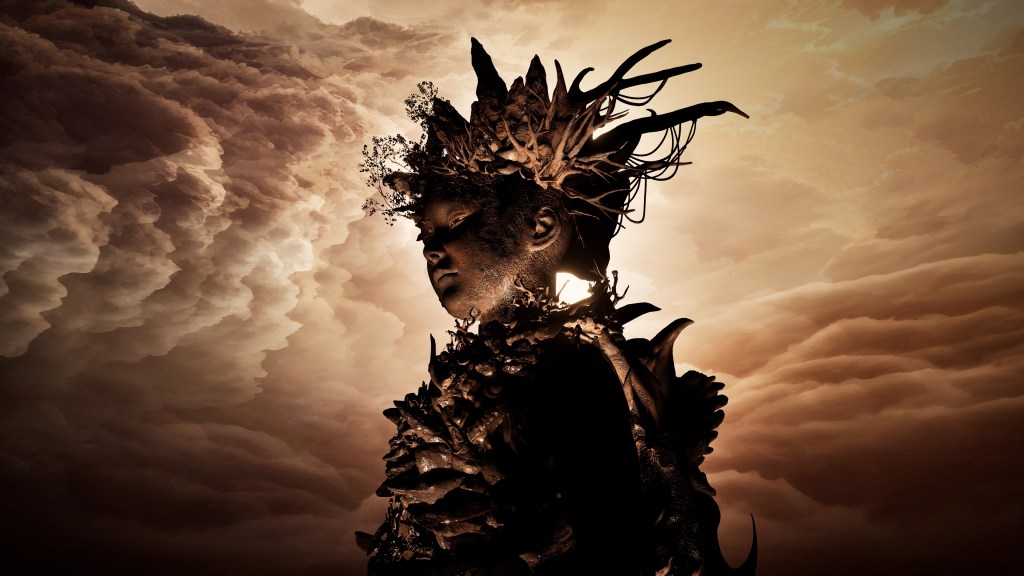
In the context of her work on mourning, the glitch serves as a powerful visual metaphor for trauma — a “non-linear break that ruptures the continuity of memory.” This extends to the “corecore” aesthetic, a TikTok-native genre of rapid, emotional montages. While corecore often leans into nihilistic fragmentation — capturing the overwhelming and often hopeless feeling of living in a hyper-saturated digital world — Lee sees it as a way to reach the “core of an emotion directly.” She experiments with these fast-paced, fragmented pulses to create “generative rituals,” asking whether the “poor image” — low-resolution and highly shared — can gain a shamanic power through its very circulation.
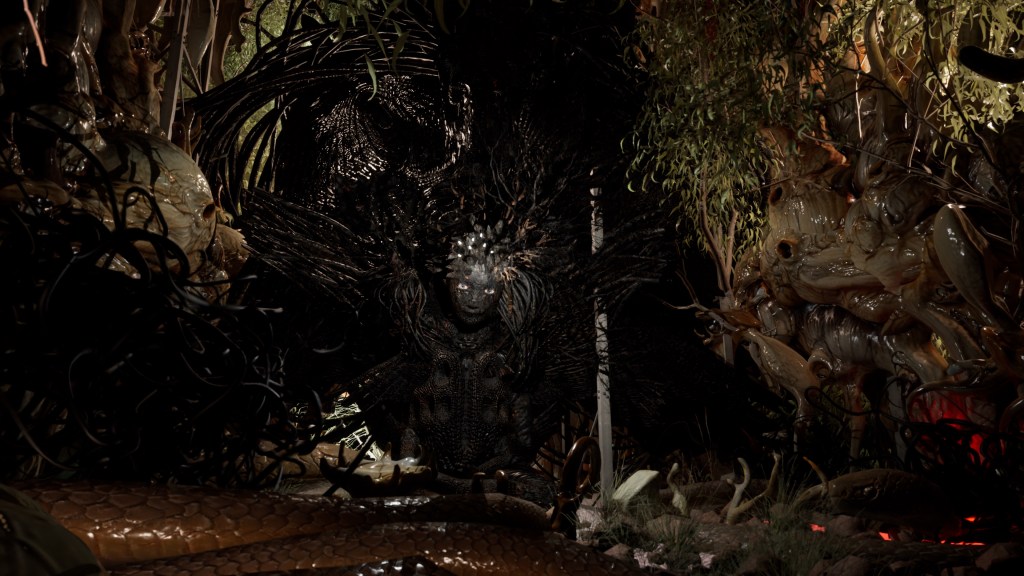
Lee’s relationship with artificial intelligence is similarly inflected by this devotion to connection. She does not see AI as a threat to her authorship, but as a “profound bridge” between her individual intent and the “vast, collective unconscious of humanity” archived in digital data. “The arrival of AI did not feel like an alien force falling from the sky; it felt like a mirror held up to our shared subconscious,” she notes. While she maintains meticulous control over her worlds — often using AI primarily for the pragmatic task of converting 2D sketches into 3D assets — she welcomes the “third presence” it brings into the studio. This algorithmic entity translates her internal symbols in unexpected ways, acting as a “psychic medium where ancient archetypes and digital aesthetics cross-pollinate.”
As Eunjo Lee prepares for significant presentations in 2026 — including a commissioned online residency with Google Arts and Culture and a residency with the LAS Art Foundation – her work remains anchored in the questions of her childhood . If machines and non-human entities were to possess consciousness, what language would they speak? What would a world look like if it casually accepted the “abject” — the disturbing boundary-crosser, as a vibrant part of a new ecology?
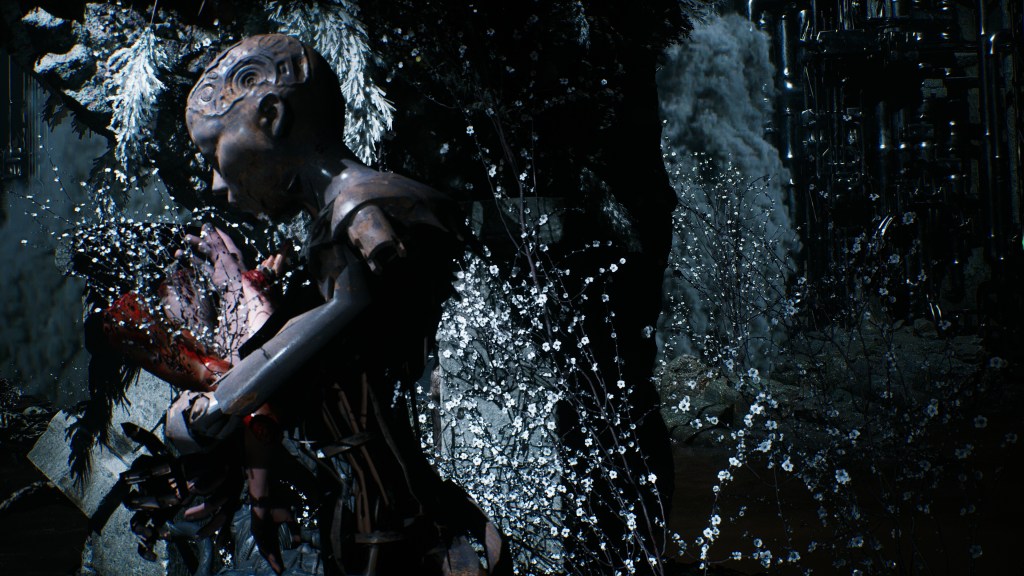
For Eunjo Lee, the digital realm is not a departure from the Earth, but a way to foster a ‘more profound and integrated connection’ with it. By tending to the ruins of our digital and physical pasts, she reminds us that mourning is the root of how we understand one another. In her digital forest, monstrosity is not an anomaly to be feared, but a sanctuary — a place where the living and the absent are not separated at all — where staying, refusing to let go, is not failure but the most human act of all.
 neunmagazine.com