Art as resistance, memory as rebellion
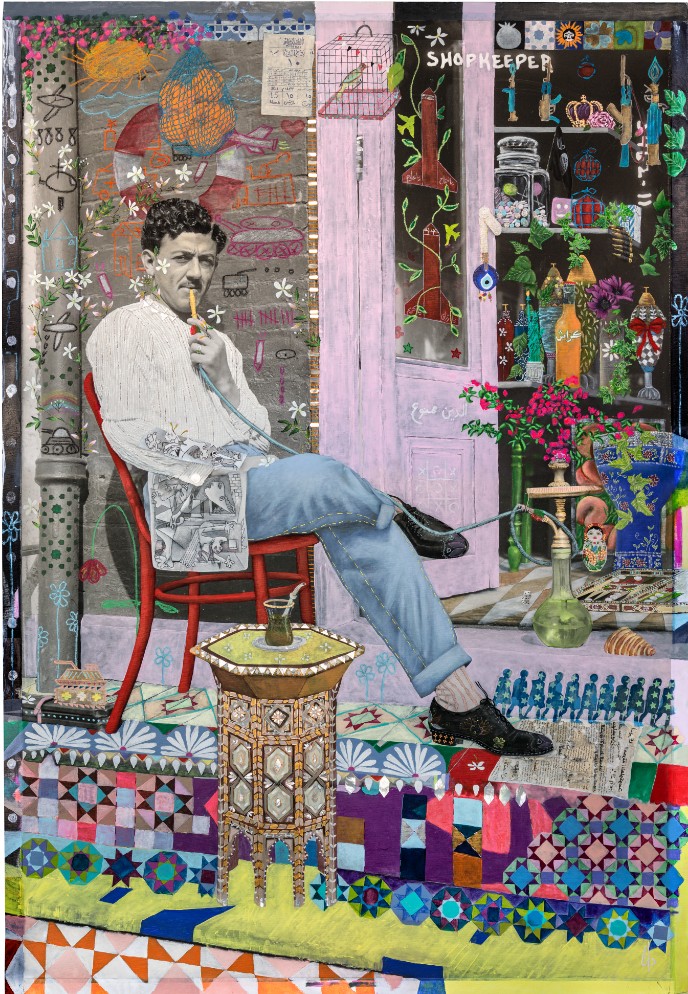
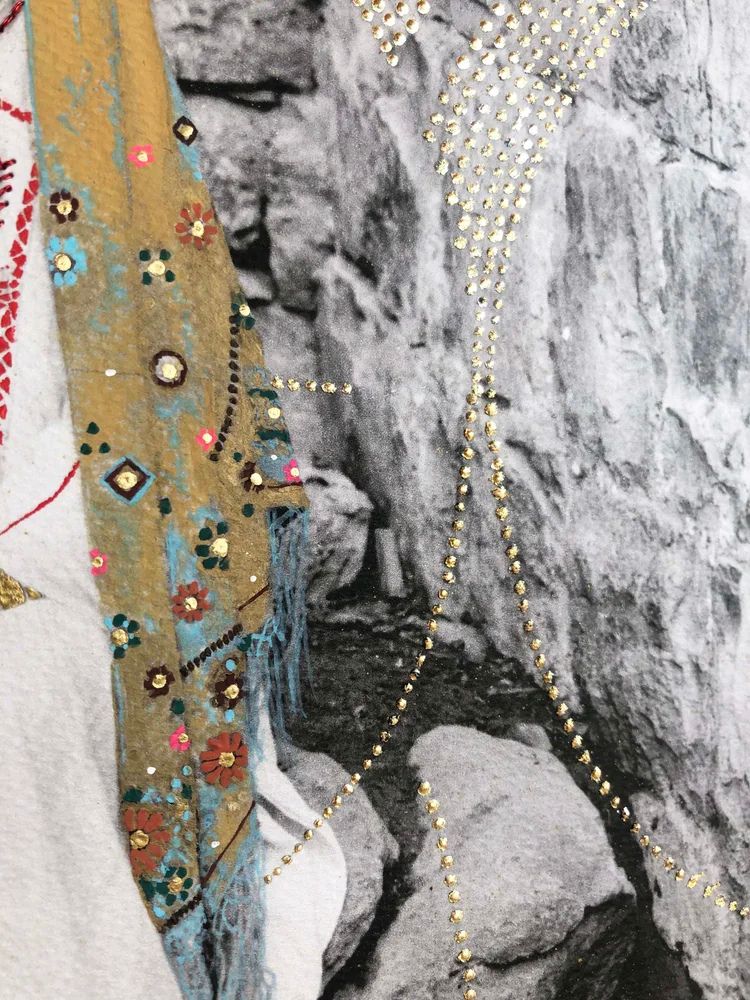
For Dana Barqawi, creativity begins with archaeology. Each piece starts with an archival photograph – someone from the Levant, a face that lived between the 1890s and 1940s, a stranger whose narrative she will excavate through investigation and paint. “I always choose subjects that look straight at the camera,” she explains. “My pieces are large in size, so they bring closeness despite being a hundred years apart.”
This process is inheritance made manifest. Dana grew up surrounded by women who painted, sewed, designed, and made art – her grandmother and aunts were painters and embroiderers who immersed her world in mixed media. “Creativity has always been a part of my life as a child; I used to paint and draw,” she recalls. What began as a childhood expression has evolved into something more urgent: visual defiance against colonial erasure.
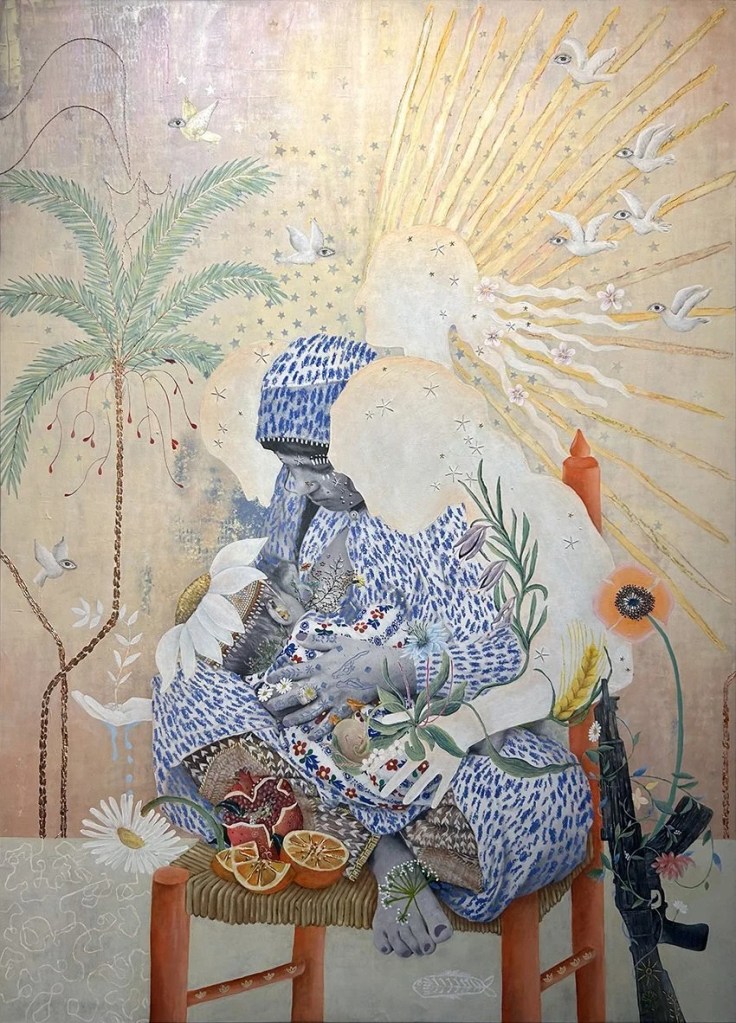
Her canvases stratify history like geological formations. Beneath her beautiful, colourful surfaces – fresh and happy at first glance – lies deeper excavation. “When you look at the depths, there’s a past deep down,” she says. Native plants and flowers populate her landscapes: pomegranate, olive trees, and the flora of home. Yet these symbols carry dual meaning. “The symbolism is that they are beautiful and they represent how we humans try to cover the mistakes we make with pretty things.”
For Dana, Palestine was never an abstract concept but a daily reminder shaped by absence. “Palestine was always in the news; you see the aggression of the Israeli army from a very young age. The political situation was always a topic of discussion, so you grew up with the idea that you come from a country that you cannot go to, that you have a house somewhere that has been stolen, and you develop a connection to a land you have never been to.”
Dana’s methodology proves both meticulous and intuitive. “The base of my pieces is archival photographs of a person from the region or country I want to focus on, mostly countries of the Levant. I select photos of people living in these areas, I design the concept, and paint it.” But this apparent simplicity masks rigorous preparation. “There’s extensive investigation and reading on the region and the concept I want to explore. For example, if I’m covering the Syrian war, there is substantial research behind it, and I want to be as accurate and as close to the truth as possible.”
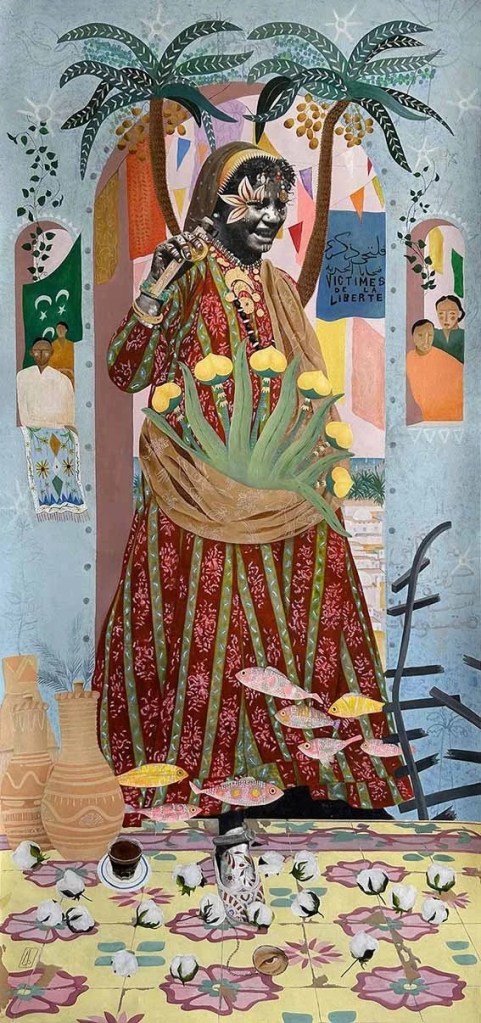
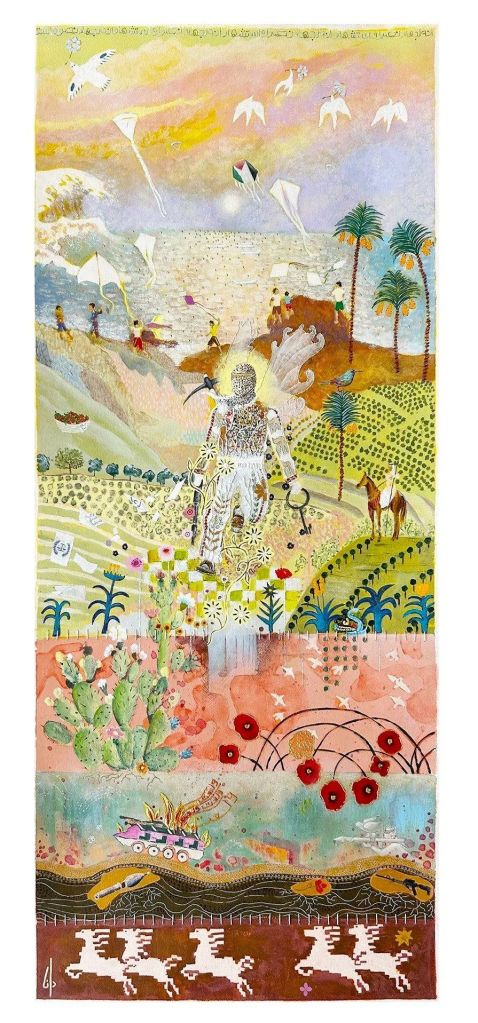
This commitment to truth-telling extends beyond historical accuracy into personal authenticity. “I don’t think about how my pieces will be perceived because I don’t want to be censored,” she says. “I think about how truthful and authentic it is. I align my creativity with truth as much as I can. I put my pieces out there, and people perceive it differently.” The stratification in her pieces mirrors the complexity of the narratives she tells. Gold leaf, embroidery, native flora – each element carries symbolic weight. Her hues are vibrant, almost joyous, yet deliberately deceptive. “My colours are beautiful and colourful, and they look fresh and happy. When you look at the depths, there’s a past deep down.”
Dana’s architectural background informs her understanding of how narratives build upon each other. “Studying architecture, I found it interesting to focus on socio-political issues. I realised everything is interconnected. I used storytelling to try to connect history to modern-day events. I see the world as stratified, and all the strata are interacting all the time; it’s important to understand them to understand how the world functions.” This interconnectedness shapes her creative philosophy. “When it comes to storytelling, it’s important to tell our own narratives and not have them imposed on us. There is never one way of telling a narrative. I do it through painting because it’s the best for me, it can be through music, poetry…it’s important to have as many perspectives.”
Her inspiration reaches beyond Palestine to other movements of defiance. “I am inspired by people all over the world – Mexican and Egyptian creativity. During the industrial revolution, Mexican expression came from the people, the working class, and it spoke to people. Beautiful pieces and murals that were understood by everyone, not by a particular group of people. It was really accessible and understood, and relatable; it moved people.”
This universal language of resistance returns Dana to her central focus. For her, Palestine exists simultaneously as an ancestral home and moral framework. “Palestine to me is home, it’s where my ancestors come from, but politically it represents the freedom of the world. It is the moral compass of the world. If Palestine is free, it means the system we live in is affected; we live in a capitalist imperial system, as I see it, Palestine and Gaza specifically are the last man standing against this monster.”
Through her investigation, she discovered that Palestinian liberation connects to broader patterns of oppression. “At the beginning, it was focused on Palestine and wanted to narrate the Palestinian narrative and challenge colonialism. Through investigation, I see that Palestine is not happening in isolation and things that are happening in the world are affecting Palestine and vice versa. I focus on the Levant, but I also feature black Americans in the West. The struggle is one, all oppression is one; it might look different, but it’s really one man using the same tactics and strategy, that’s why it was important to connect.”
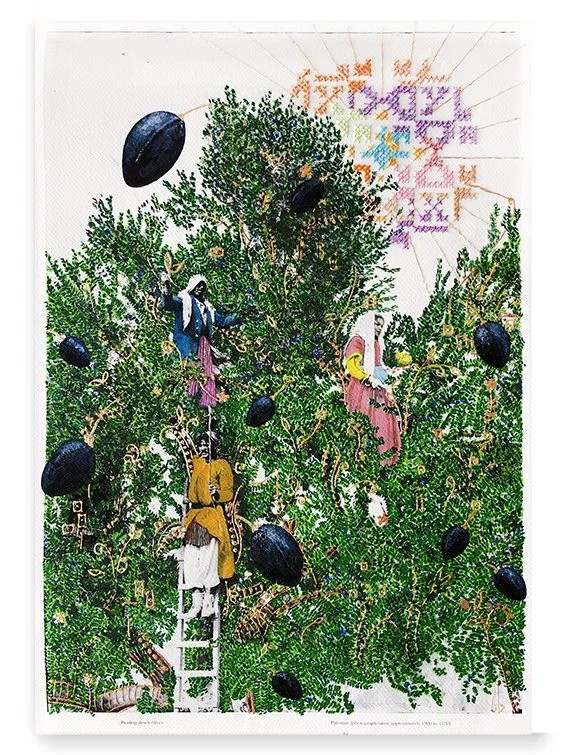
Dana’s creative process requires both physical and emotional grounding. “The outdoors are important for me. An early run sets the mood for the whole day. A million things run through my mind at the same time, so I feel that helps. I feel frustrated because of injustice and oppression. I have gotten angry during the last two years. It’s been emotional for me, and being outdoors helps settle my nerves. I ride horses and draw strength from their friendliness, which is both energetic and grounding.” Her evolution as a creator has demanded increasing boldness. “On a personal level, initially, my pieces were more on the conservative side; I was limiting myself until I understood our ancestors’ defiance; they told it without fear. I want to be as loud as possible with my narrative.”
Dana Barqawi’s canvases do more than restore forgotten faces – they excavate suppressed histories and challenge the colonial impulse to erase. Through her meticulous stratification of gold leaf and embroidery over archival photographs, she creates what she calls “closeness despite the hundred years apart.” Her pieces prove that creativity can serve as both a memorial and a manifesto, preserving Palestinian identity whilst connecting it to universal struggles against oppression.
In Dana’s studio in Amman, the personal and political converge through every brushstroke. Her vibrant surfaces may appear celebratory, but they conceal deeper archaeological truths about displacement, defiance, and the power of collective memory. When she says, “I want to be as loud as possible with my narrative,” she speaks not just for herself but for all those whose narratives have been systematically silenced. In a world that would prefer Palestinian stories remain invisible, Dana’s creativity insists on being seen.