
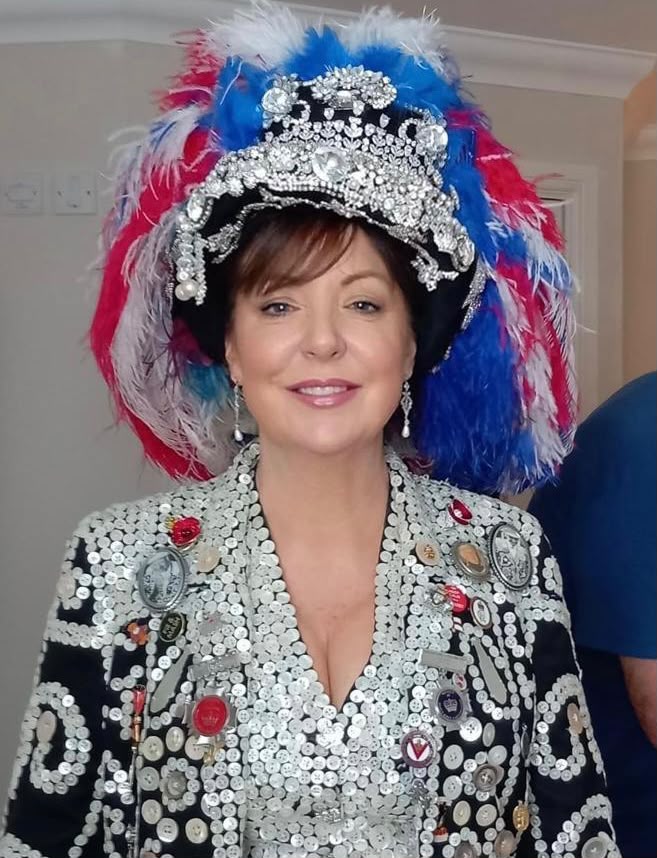
Written by Gleb Korolev
When people think about London traditions, their minds usually jump to the monarchy, red telephone boxes or black cabs. Far fewer know about the Pearly Kings and Queens, although they have been part of London’s cultural landscape for more than 150 years.
Perhaps that is because the Pearlies have never been interested in fame. For Teresa Watts, Pearly Queen of Clapton, the tradition has always been about something much simpler: helping out people – cheering them up. “It’s a vocation,” she tells me. “We don’t get paid. Every penny we collect goes to charity. We take nothing from it.”
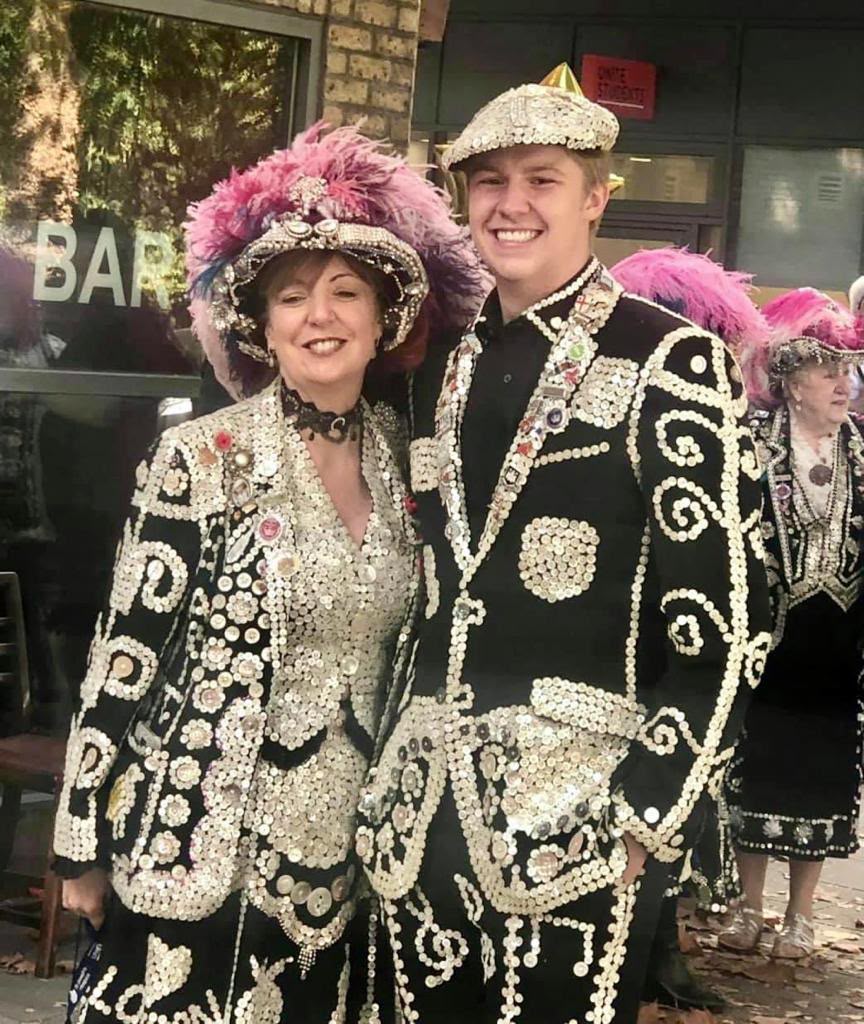
Dressed in a distinctive suit covered in thousands of mother-of-pearl buttons, Watts is part of one of London’s most unique working-class institutions. Yet the famous suits, remarkable as they are, tell only a small part of the story. Behind every button lies a tradition built on charity, community and an unwavering commitment to helping those in need. And in many ways, that story begins with family. As in real monarchy, Watts was born into the Pearly movement. Her great-great-uncle George served as the Pearly King of London, while another relative, Fred, was the Pearly King of Westminster. At the age of eighteen, she was crowned Pearly Queen of Clapton, continuing a legacy that stretches back generations. “My mum is the Pearly Queen of Hackney,” she says proudly. “She’s got a British Empire Medal for over sixty years of charity work.”
Growing up surrounded by Pearlies had a lasting impact on her childhood. “I genuinely thought everybody was a pearly until I was about fourteen,” she laughs. Like most teenagers, she went through a phase of feeling self-conscious about standing out. Walking around in clothes covered with thousands of buttons is not exactly the easiest way to blend in. But those feelings eventually disappeared as she came to appreciate the deeper purpose behind the tradition. “It means everything,” she says. “I grew up around it.”
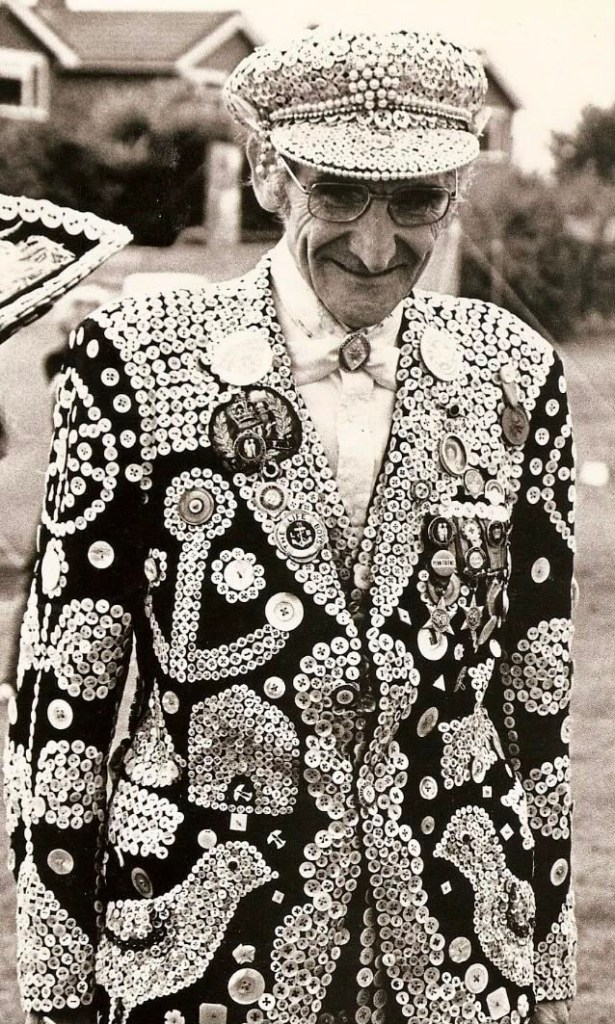
To understand why the movement means so much to its members, it is necessary to travel back to Victorian London. The Pearly Kings and Queens tradition was founded by Henry Croft in 1875. Croft was only thirteen years old, living in an orphanage and working as a road sweeper and rat catcher. Inspired by costermongers, the working-class street traders who sold fruit and vegetables across London, he began decorating his clothes with mother-of-pearl buttons and collecting donations for charitable causes. The idea was surprisingly simple. The unusual clothing attracted attention, attention attracted donations, and donations helped people who needed support.
One hundred and fifty years later, the formula remains remarkably unchanged. “The ethos is still exactly the same,” Teresa says. That continuity is one of the reasons the tradition has survived while many others have faded. The Pearlies have never attempted to reinvent themselves. Their mission remains rooted in the same values that inspired Croft in Victorian London: generosity, service and solidarity. Those values are unmistakably working-class. Historically, the movement emerged from communities that understood hardship firsthand. Costermongers were not wealthy. They survived through hard work, mutual support and a strong sense of community responsibility. Those same principles continue to define the Pearlies today. In an era where traditions are often repackaged and commercialised, there is something refreshing about a movement that remains stubbornly focused on helping others.
Watts’ own charitable work demonstrates that commitment. Alongside her Pearly duties, she works in social care, where she regularly encounters people facing serious hardship. Rather than seeing charity as something separate from her everyday life, the two have become deeply connected. “Time is the greatest commodity,” she says. “More than money. More than resources.” It is perhaps the most powerful statement she makes during our conversation. Money matters, of course. Donations allow the Pearlies to fund projects and support vulnerable people. Yet Watts argues that giving somebody your attention, your presence and your effort can often be even more valuable. “Giving somebody time can change their life.” This philosophy shapes everything she does.
For the past six years, Watts has organised an annual Christmas toy appeal. Last year alone, the initiative supported nine domestic violence units and four special educational needs schools. Around 4,000 children received four presents each. That figure is impressive on paper, but it only scratches the surface of the work taking place throughout the year. Watts regularly helps stock baby banks with essential supplies, from clothing and toiletries to everyday items many people take for granted. Working closely with vulnerable families has made her highly resourceful. If somebody has something useful they no longer need, she usually knows someone who can benefit from it. “I find a place for everything,” she says. What might be forgotten or discarded by one person can become invaluable to another. That practical approach to charity reflects another working-class characteristic: making the most of what is available. There is little glamour involved. It is simply about helping where help is needed.
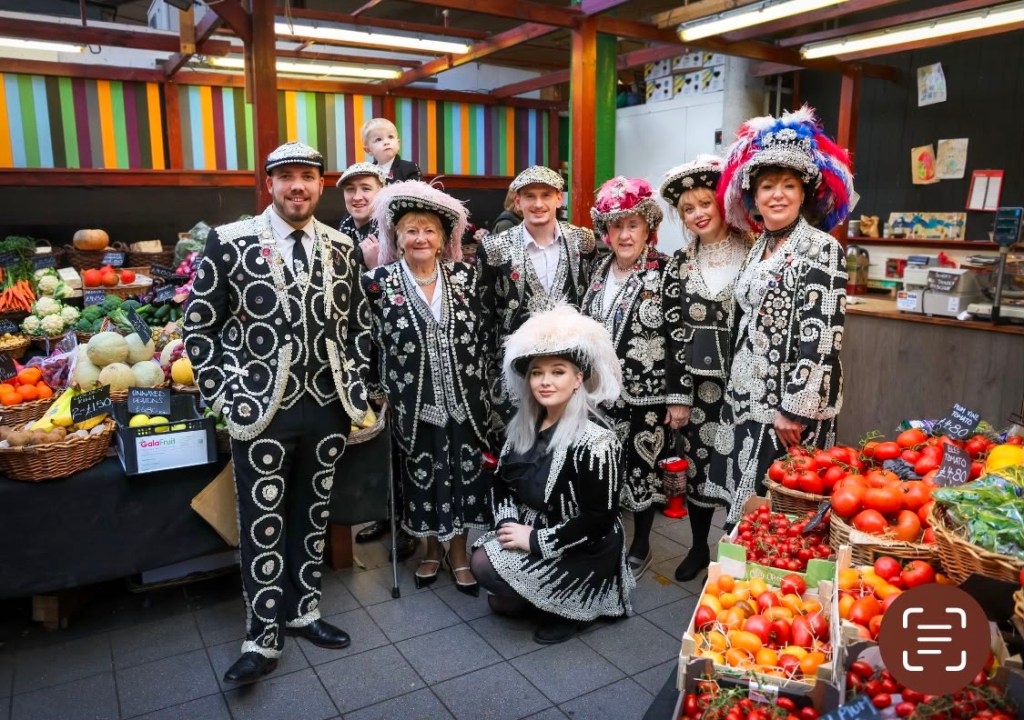
Perhaps this explains why the Pearlies continue to enjoy such affection across London. Watts describes them as “the other royal family”, a nickname that sounds amusing until you realise how widely recognised they actually are. The Pearlies attend events at the Tower of London, ceremonies at the Royal Chelsea Hospital and numerous civic functions throughout the year. They have met members of the Royal Family and regularly participate in prestigious public events. Yet there is no sense of distance or exclusivity. One day they may be attending a formal ceremony. The next day they could be collecting donations on a street corner or supporting a local community project. “It’s all about getting donations and helping people,” Watts says. That attitude may be one reason the tradition has endured for so long. The Pearlies understand that public recognition is not the goal – it is merely a tool that helps them continue their charitable work.
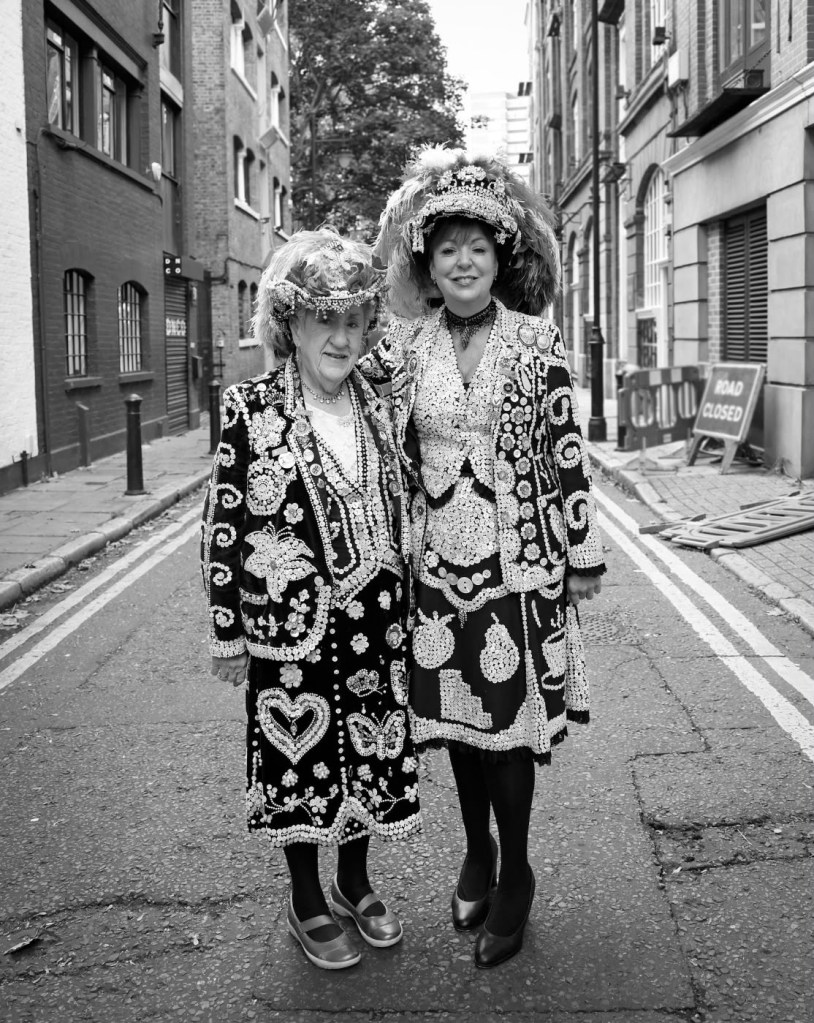
Of course, no discussion of the Pearly Kings and Queens would be complete without mentioning the suits. They are extraordinary. Each suit is handmade and covered with thousands upon thousands of mother-of-pearl buttons. Far from being decorative novelties, they are deeply personal creations that tell individual stories. Members are encouraged to design their own suits, incorporating symbols that reflect their interests, family history and local communities. Watts’ own suit celebrates both the costermonger heritage and Cockney culture. One design references “apples and pears”, the famous Cockney rhyming slang for stairs. Other details pay tribute to London’s working-class history. “It’s your story,” she says. Creating a suit is neither cheap nor easy. Mother-of-pearl buttons are becoming increasingly difficult to find, and purchasing them is expensive. Watts estimates that 144 buttons cost around twenty pounds, yet cover only a small section of fabric. Then comes the sewing. Every button must be attached individually, using strong thread. The process takes countless hours and demands remarkable patience. Some families pass down patterns through generations, creating visual links between past and present.
The results can be breathtaking. Watts’ suit contains approximately 36,000 buttons and weighs two-and-a-half stone. Remarkably, she has completed two half-marathons while wearing it. That fact alone deserves recognition. “I don’t know how I did it,” she jokes. The suits create plenty of practical challenges, too. Mother-of-pearl reacts dramatically to weather conditions. In winter, the buttons become freezing cold. During summer, they trap heat. Then there is maintenance. Buttons fall off constantly. Cleaning requires a careful balance between preserving the garment and actually removing dirt. Watts often washes her suit on a gentle cycle before spending hours repairing the inevitable damage afterwards. Yet despite the effort involved, there is no suggestion that the work is a burden. The suits are more than clothing. They are living pieces of family history.
That sense of continuity became particularly clear when Watts spoke about the future. Unlike many traditional communities, she is surprisingly optimistic. During school visits, she regularly encounters children who already know something about the Pearlies. Others become fascinated after hearing their story for the first time. “If one child learns about us and tells their parents, that’s preserving the tradition.” Education has become one of the movement’s most important tools for survival. Watts understands that traditions cannot simply be inherited, they must also be discovered. Interestingly, she points out that Henry Croft himself was only thirteen years old when he started the movement. The founder was not an elder statesman protecting tradition. He was a young person creating something new. That perspective changes how we think about heritage. “We’re always looking back,” Watts says. “But somebody could start something today and in 150 years people could still be celebrating it.” It is a hopeful idea, particularly at a time when younger generations are often criticised for lacking interest in history or community life. Watts sees things differently. She believes creativity, curiosity and a desire to make a difference still exist. They simply need opportunities to flourish.
By the end of our conversation, one thing becomes clear: the Pearly Kings and Queens are not just about buttons. The buttons catch your eye. The charity keeps your attention. For 150 years, the movement has remained faithful to the simple principle that inspired Henry Croft in Victorian London: helping others whenever possible. In an age obsessed with visibility, the Pearlies offer something refreshingly different. They use visibility not for personal gain, but for public good. Their suits sparkle, certainly. But what truly shines is the commitment behind them. And as long as people like Teresa Watts continue to dedicate their time, energy and hearts to the cause, London’s working-class legacy will remain stitched together, one pearly button at a time.

 neunmagazine.com