
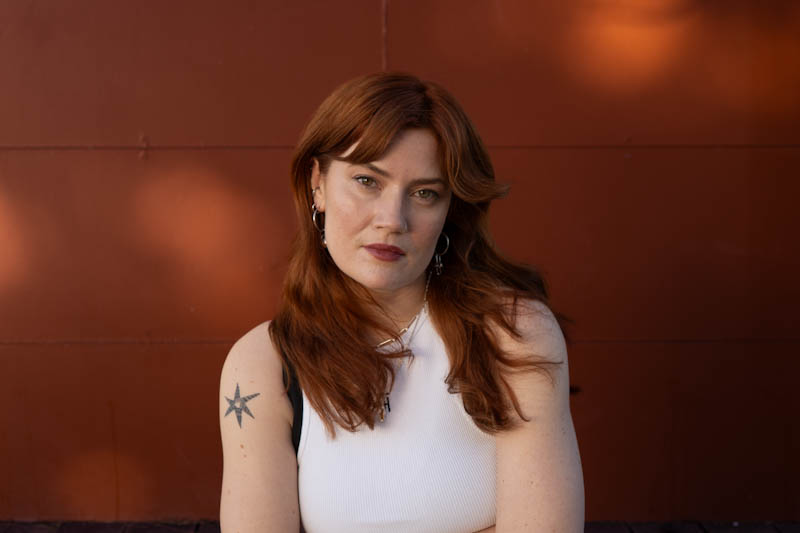
Kate Pasola curated and edited Bread Alone, a collection of 33 essays from working-class writers. The book has found wide-spread acclaim for its candid writing, not only amplifying working-class voices, but also the incredible talent and skill that so often get lost in an industry that favours words by the elite.
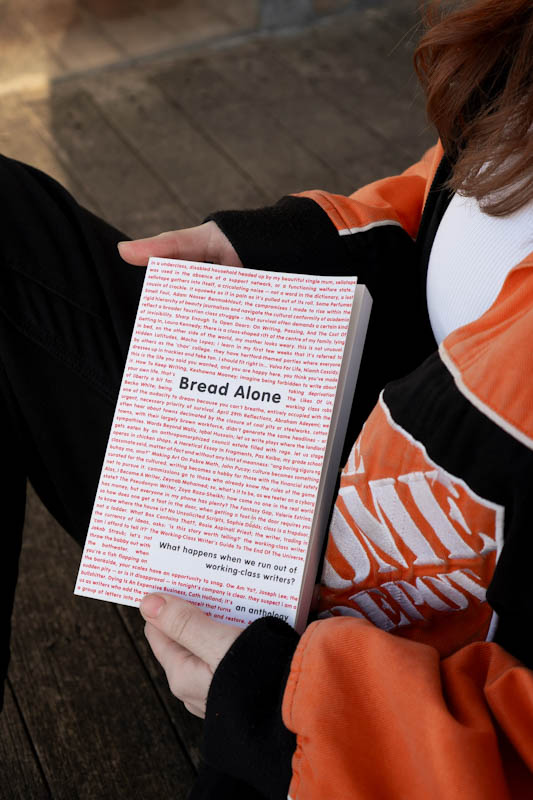
When I virtually sit opposite Kate Pasola, I feel giddy with excitement and joy. I hold Bread Alone – What happens when we run out of working class writers? to my chest, open it and read a passage from the introductory chapter she wrote for the anthology. Her words spoke to me so deeply that it felt like having an outer body experience.
‘“Read, read, read – as much as you can!” the experts preach, without a thought for the writer who has one hour a week ringfenced for their practice, and is sometimes too painfully envious to read another word written by someone else who ‘made it’. One well-meaning creative recovery book suggests the opposite: taking an entire week off writing and reading altogether, claiming you’ll get a creative ‘reset’ with benefits untold.’” Pasola (2026, p.12)
Kate put on paper what I’d been feeling and thinking for over a decade, but was too ashamed to say out loud or write on paper. Kate did it for me. She admits she initially had crossed it from the essay, but added it back again later.
“I remember thinking, I can’t say that”, she admits. “That’s not very sportsmanlike of me and not very supportive of my peers. But then I remembered that the whole point of Bread Alone was the fact that I was feeling lonely. I was aware that we’re beating around the bush and not having a fully satisfactory conversation to get into the weeds of it. Author Lucy Rose once said that we should be vulnerable and write about the things that scare us. So, saying the deepest, darkest things that you wouldn’t really want people to repeat is sometimes the most generous thing you can do. The more we talk about it, the more we’re able to release the shame of it and start working on why we are envious, why we’ve not had the chance to do our own projects. And address the fact that, systemically, there’s exclusion and only a few people do get to make it.”
Re-shaping the conversation around jealousy and envy that working-class writers may feel towards successful middle- and upper-class writers is just one point Kate hopes to make with the book. She also wanted to explore the intersectionality of additional blockers working-class writers face. “If you’re from a working-class background, that’s one hurdle. If you’re queer and from a working-class background, that’s two hurdles. And the way those interact with each other creates a whole new way of how your life may go. If you’ve grown up with a single parent or a parent with a disability, if you were incarcerated, suffered from substance abuse – all of these different things complicate your life further and your pursuit of being able to be a writer. [With the book] I wanted to show that we should be thinking of ways that it could be better for everybody. And usually when you make the world more of an accommodating and safe place for one group of people, it usually has the knock-on effect of helping another group of people, too.”
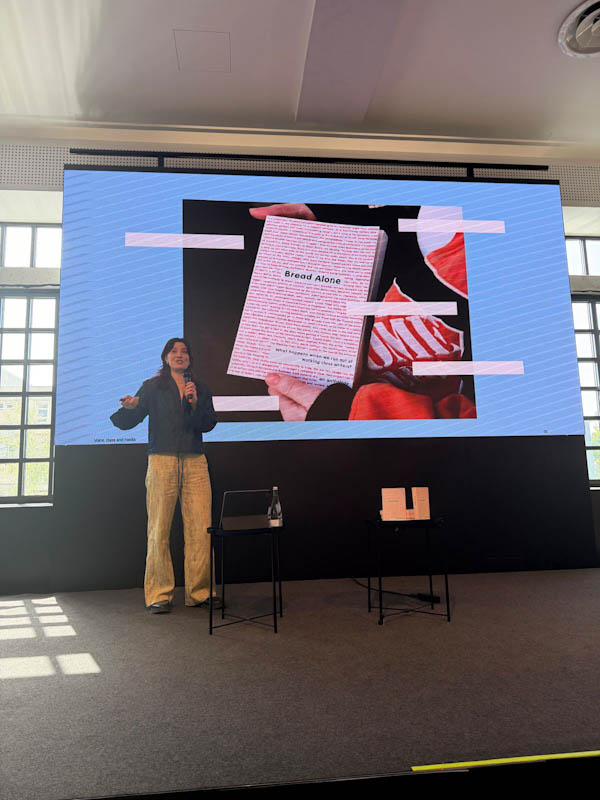
Kate’s own story, of course, is key to how and why Bread Alone exists. She grew up in the Northeast, near Newcastle. Back then, class didn’t really cross her mind. “I didn’t understand class as a topic and where I fit within any of that. It only started to emerge when I was thinking about university. I was lucky that the English department pushed me as a writer. But I wrote myself off from certain universities. I didn’t even apply to Oxbridge. I don’t know if I would have liked it anyway. Not many people from my school went to Oxbridge.”
Kate got a contextual offer from Edinburgh which boosted her confidence. But when she got there, she quickly became aware of some differences. “Some people don’t believe [class] exists, but if you’re navigating it, you very much know it does. Because of a mix up with accommodation, they put me in a shared room in the most expensive halls in Edinburgh University with all of the people who’d gone to the top-rated private schools in the country. And they were my neighbours for my first year of university. It was at that point that I thought that there’s a lot to talk about here. I noticed interesting interactions I was having. For example, once some people knew that I hadn’t gone to a school they’d heard of, they didn’t want anything else to do with me.”
It took her a while to realise that for some, a common interest was not enough to be friends. “I realised that some people are here for a very different reason. They’ve been networking from the age of 18. I don’t have anything to offer them.”
During her final year at university and while writing her dissertation, Kate worked at an arts and culture magazine to prepare for life as a journalist, very much aware that once her student loan finished, she was, financially, on her own. Her work at an arts magazine eventually led to her moving to London for a job at Cosmopolitan. “I went from a wonderful job reviewing indie punk bands to living and working in London and hanging out with all these glamorous journalists, which was an incredibly big change. And obviously I learned a lot. It’s a very different experience writing for a mainstream national or international magazine, but I did get to do some cool investigations.”
The 2020 Lockdown changed everything. Talent, brilliance and hard work alone don’t guarantee your dream job if your background isn’t steeped in connections and financial security. “Before long, I wasn’t able to afford London anymore. My landlord put up my rent by hundreds of pounds, just like that. And it started to occur to me that I also couldn’t afford to be a journalist anymore. I was going to have to leave this job that I’d wanted since I was 11. I ended up moving into marketing and working in tech for a while. It wasn’t just the only way to survive financially. If I want a future for myself, if I want to have a decent pension, if I don’t want to be in poverty when I’m an elderly person, I need to start thinking about that now. And unfortunately, that means I can’t be a journalist anymore. And I was just furious about that sacrifice that I’d had to make.”
At that time, the first thoughts about Bread Alone started to surface during conversations with an independent publisher, Indie Novella. Their callout for contributors to the anthology went beyond their expectations. Kate then knew that the book would resonate once it existed.
I ask Kate what stood out most to her when she read and edited the stories of the 32 writers who contributed to the collection. Without a second thought she tells me about the sheer talent and readiness to take on work, projects and commissions. “I’m also aware of their huge potential. And in some cases, it’s not being realised to the fullest that it could be, just simply because of exclusion. That’s the main thing that stands out.”
While editing, Kate found that most writers had meditated on a particular object from their life. Readers can expect an essay about a Volvo or a broken lamp that got sello-taped back up. In her own essay, Kate focussed on religious artefacts from the church she used to go to as a child, and how that was her access to luxury: Looking at the paintings on the wall and golden ornaments around the church.
“I haven’t quite articulated to myself yet what that means. But I would love there to be some kind of exhibition of all the objects that people meditate on in the book. I guess it’s this idea that we don’t really see our [working-class] lives reflected in objects in museums, in anthologies very much. And it’s been quite emotional to realise that we deserve to take up physical space. And we deserve to tell you about the objects that mean something to us. Because we spend a lot of time talking about objects that mean something to the elites.”
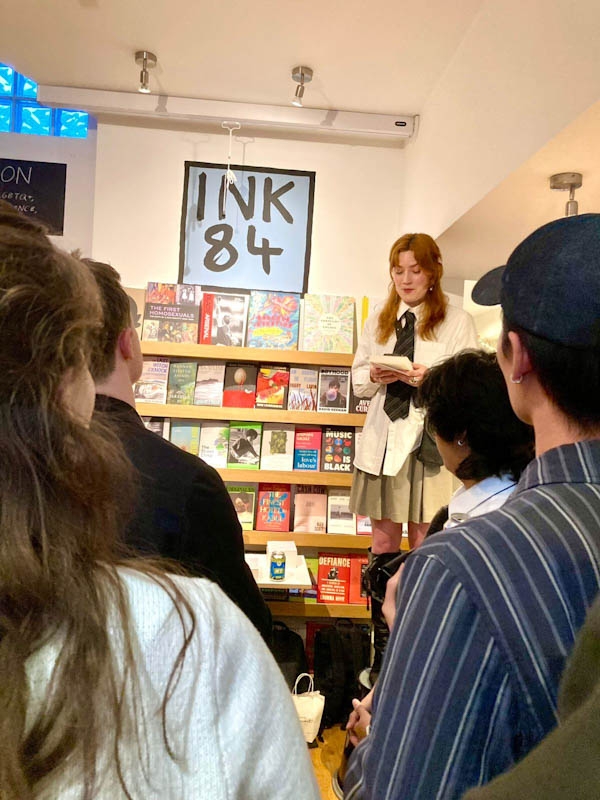
During the launch party of Bread Alone, she also noticed that many of the writers had a lot in common with each other, despite being from different and disparate backgrounds. “They were just grinning and signing each other’s books, and swapping details, taking that connection forward into future collaborations, probably. That was really exciting to see, too. And there’s a lot of talk about an anthology also being a congregation, or a gathering space that we are entitled to as writers from working-class backgrounds. We need these spaces to be able to just exist without a middle-class gaze, without an elite gaze. It’s written by people from working-class backgrounds, edited by someone from that background, and for those people.”
Amongst the most concerning facts of working-class creatives in the UK is the lack of representation. The statistics are particularly worrying when it comes to writers, authors and journalists. Even worse – the numbers are not getting better. “One of the latest figures from the report Elitist Britain 2025 from the Sutton Trust is that while only 7% of people attend private schools nationwide, the report found that half of newspaper columnists are privately educated, along with 47% of political commentators, 45% of leading podcasters and 38% of BBC executives. I’m glad to see that there’s research happening and being reported on. I think that’s definitely better than it was a couple of years ago when I started this project. But the fact that we’re still just reckoning with the extent of it is infuriating because people from working-class backgrounds know that it’s the case: Everyone’s being excluded and having to leave the industry. What we really need is a response to it. We need funding. We need more inclusion.”
Kate also points out that new forms of media, initially accessible for working-class artists, are being cannibalized immediately and turned into a product. “Profitability becomes the main consideration and therefore risk is something that you don’t want to take. And the fact that people from working-class backgrounds are seen as a risk to commission or to work with for literally no reason is quite upsetting to see.”
Most of all, she is concerned about excruciating lethargy. “We know this is a problem now. So it’s time to take action. Otherwise it’s going to be detrimental to literature, to the arts, to the media, because it’s going to become very much a monolith of everybody having the same opinion and the same story. There’s also a lot of fictional division and it’s so clear that it’s billionaires and political elites that are benefiting from these divisions that don’t really exist. And that’s why something like Bread Alone is dangerous for those elites, because they don’t want us to talk to each other. They don’t want to realise how much we have in common. I think that’s why we’re not given the opportunity to do it too often, because we’ll realise how powerful we are when we speak as one rather than as divided people.”
I ask Kate if she has a message to fellow working-class writers who have been feeling the bite of injustice because of class division. “To paraphrase Ashley Hickson-Lovence from one of his Instagram Stories: ’Every single person has a story inside of them that’s worth telling.’ – And I think there are a lot of people who need to hear that and who need to be reminded that their story is a positive contribution to the world. And that it’s not their fault if they’re not being heard.”
Changing how we talk to ourselves and the generations after us also plays a huge role: “A lot of people from a young age need to internalise the idea that their story is important and the way they choose to tell it is important, too. They don’t need to assimilate to an elite gaze. Because we’d get so much cooler writing if that happened. They don’t have to fit a particular genre or a particular type of book that’s hot right now. They can tell their own story.”
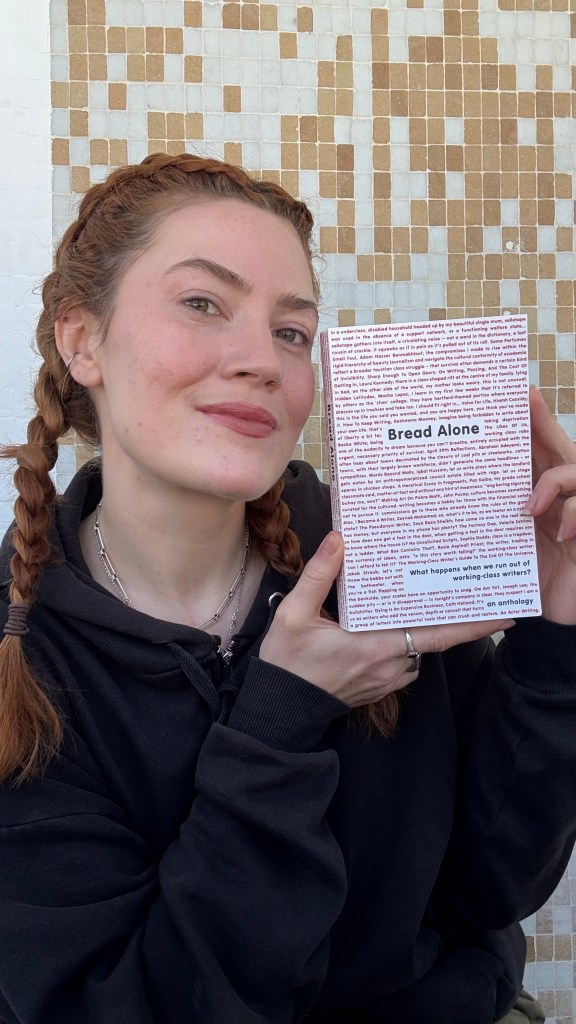
With Bread Alone, Kate didn’t just give multiple working-class writers a voice, platform and community to be heard. She also continues to light a fire in every working-class writer who picks up her book and recognises themselves, just like I did. That day, I felt seen, I felt understood, I felt less alone.
I tell her she gave me the courage to continue working on my novel, the one I started over a decade ago. She answers in solidarity: “I’ve got projects that I am about ten years behind in writing myself that I want to make happen. But, you know, we’ve got to spin lots of plates to keep things afloat. And we’re doing our best and we can’t be ashamed of the fact that we aren’t being bankrolled to write novels year after year. It’s not our fault. It’s just that the current system is unfortunately against us.”
 neunmagazine.com