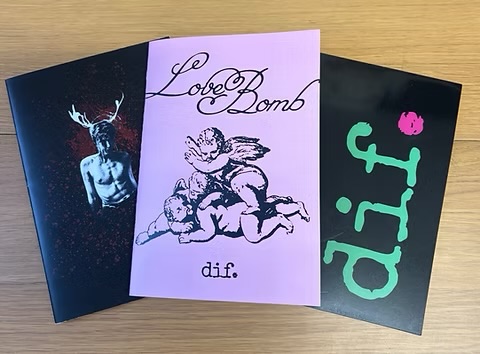
DIF, their boundary-breaking writing project, exists for one reason: to give overlooked writers and artists the space, the page, and the voice they were always owed.
Sam developed dif, a zine, following a research residency in Manchester. He linked up with his collaborator John from other projects, later joined by writer Bea Ralston and graphic designer Louis Bullen. Their mission was simple and quietly radical: to give a voice to the overlooked, and to create a space where first-time artists could be present in the field, regardless of where they were starting from.
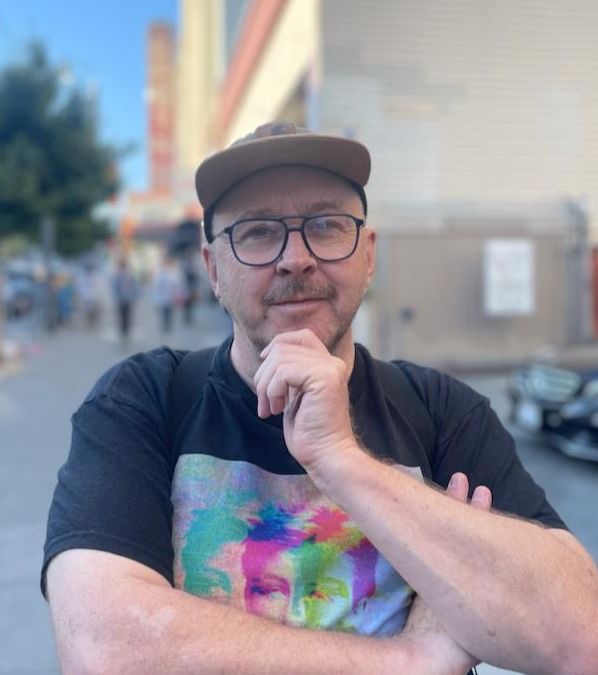
As a native New Yorker, John Lugo-Trebble’s life as a writer and storyteller is rooted in preserving queer life across generations through the stories he tells. Sam Jenks, a British writer and advocate of the arts, continues to be involved in every project where creativity resides. As a proud gay man, Sam continues to advocate for representation for the queer community. Together, their shared ideas and love for creating and producing brought dif, a zine from the queer community for the queer community, to life.
“dif does different things”, Sam explains. He used to run an LGBTQ+ writing project which included workshops, writing consultations on submissions to publishers and agents. And there was a lot of networking. But what he really wanted was to create an environment that produced creativity and allowed artists to grow and freely express themselves, especially for first-time artists whose work would be overlooked. The previous project offered advice and support, but it stopped short of actually producing work or making silent voices heard. For Sam, that had to change.
dif works through a system of flexibility where there are no rules. Submissions could be short stories, a 4-5 page play, and even music. According to Sam, the contributors themselves shape what dif becomes. “We asked them: Can you help us define what dif is?” That openness has produced three zines to date, each featuring between 20 and 25 artists, spanning fiction, non-fiction, plays and sketches.
dif is not about being a publisher, it’s more of putting the writing out in the space and letting the work liberate itself. For John, receiving submissions is an act of liberation. “I feel liberated when I read what [the writers] send in, it makes me think, I can burst those boundaries as well – they inspire me to do that.”
Their first open call received over 100 submissions, and what struck John was not any single piece but a running theme: the laying bare of emotions, vulnerability and highly personal writing that made him sit up and listen. “These writers and artists trusted us with their sacred pieces. They didn’t hold back and it got me thinking about the times my own submissions did hold back. It made me realise that in those cases, my own censorship and lack of confidence was a hindrance to getting my work out there.”
For John, the written word “binds humanity”: “Stories connect humanity across borders and generations when they touch on core emotions that humans can relate to such as love, loss, and acceptance.”
Coming out stories hold a particular power for him: “They are personal journeys of liberation and the desire to find one’s place in this world.” His first two published books, Lu’s Outing and The Deadbeat Club, centre on a character who is not just coming out but ultimately wants to make his mark after hiding in the shadows for so long. Books he returns to for that same quality include Reflections of a Rock Lobster by Aaron Frick and The Milkman is on his Way by David Rees; two books set in different countries and different times, but carrying the same message of finding happiness as a gay man.
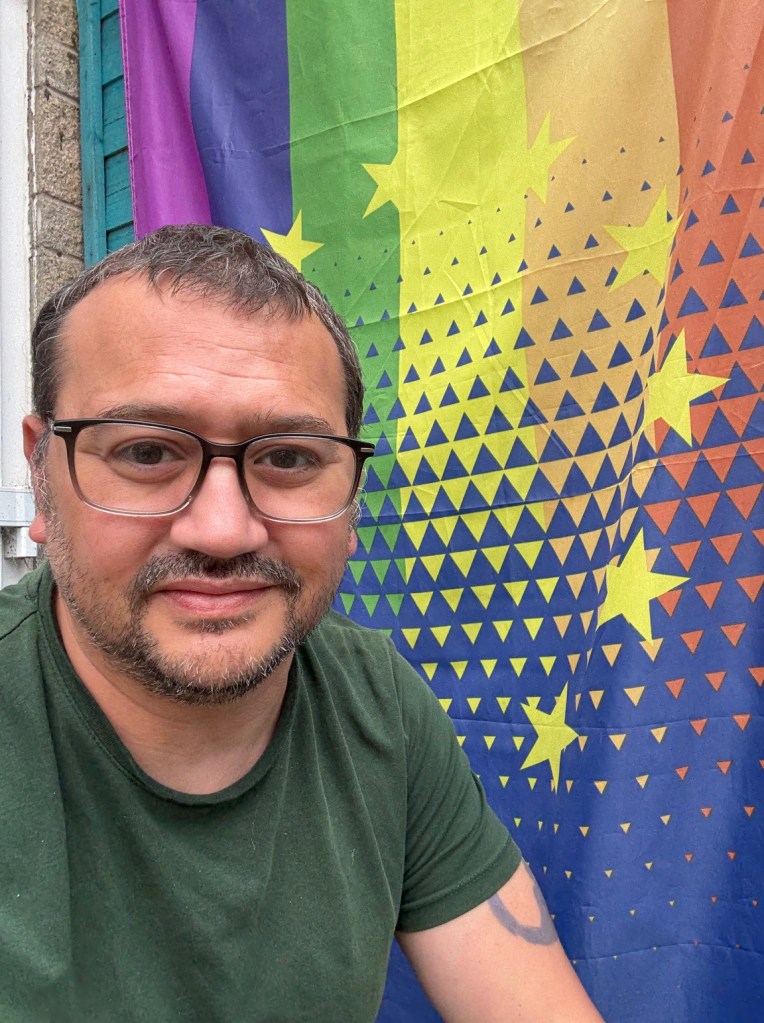
For John, reading and writing have always been acts of emotional recognition. “I approach each piece of writing with the same audience in mind but that audience may not exactly look the same each time. I always remember what I felt like as a kid to read stories that spoke to me and made me feel seen. When I start a story, I imagine that out there, there is someone who may read this story and on that day, they need that connection.” As he has grown as a writer, that sense of connection has deepened into something larger; a feeling of belonging to a tradition. “As a writer, my identity as I have gotten older has been feeling more at home in the role of storyteller and part of a long tradition of queer storytellers who help preserve and pass on our experiences and history forward, being part of a timeline that is international and infinite.”
Sam Jenks has always seen himself as a reader despite his passion for writing, which started with appointment diaries and evolved into journals, deepening over time into an intimate archive of lived experiences. For Sam, there is a deeper thread running through all of it; an interest in how queer people respond to, negotiate and move through space. He explains that space is “by and large assumed to be designed by and for the prevailing version of straight/family/hegemony of culture. Being queer is just that, at odds with it, and therefore queer spaces are often hidden, coded. If you know, you know.”
A local supermarket near him has been known as the ‘gay Sainsbury’s’ for over twenty years, invisible as such to the outside world, but a known gathering space for those in the community. Hiding in plain sight. The counterpoint, he notes, is how some spaces become openly iconic; the statue of Alan Turing in Sackville Gardens, Manchester, a place to gather, to visit, to be visible. It is an interest he explores directly in his latest novella, Homoland, examining “how urban and rural landscapes predominantly reflect straight values and ways of living.”
Both Sam and John agree that the LGBTQ+ community is progressing; artists and writers are evolving and finding their audiences. But there is still a distance to travel. The obstacle, both agree, is audience openness. Readers who stay within familiar genres risk a narrow view of what queer life and queer writing can offer. “If you just read the LGBTQ+ stuff that comes out from the mainstream publishers then you will only have a particular view of LGBTQ+ existence and experience.”
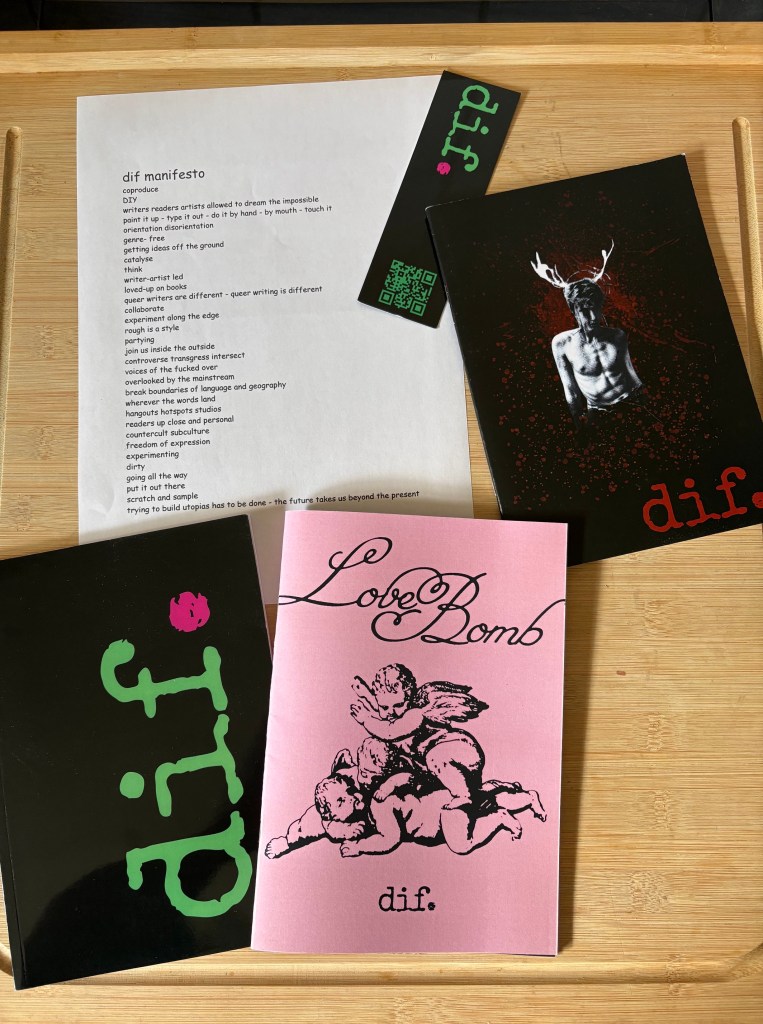
What motivates Sam and John, above everything, is the written word itself. “The written word for me is proof of life,” John says. “It marks our space on this planet and freezes it in time. This is why books are powerful in the right hands, dangerous in the wrong hands. It’s why there is this push to vilify and regulate them.” In dif, every submission is received with that same conviction; each piece read with an open heart, each voice given the space it deserves. For Sam, the selection process for each zine is about fit rather than merit. “We’re aiming for it to be as good, readable and of high artistic quality.’’